Department of Structure of Macromolecules, Centro Nacional de Biotecnología, Consejo Superior de Investigaciones Científicas (CNB-CSIC), Madrid, Spain.
Mistral Beamline, Experiment Division, ALBA Synchrotron (ALBA-CELLS), Barcelona, Spain.
mSphere. 2020 Oct 14;5(5):e00928-20. doi: 10.1128/mSphere.00928-20.
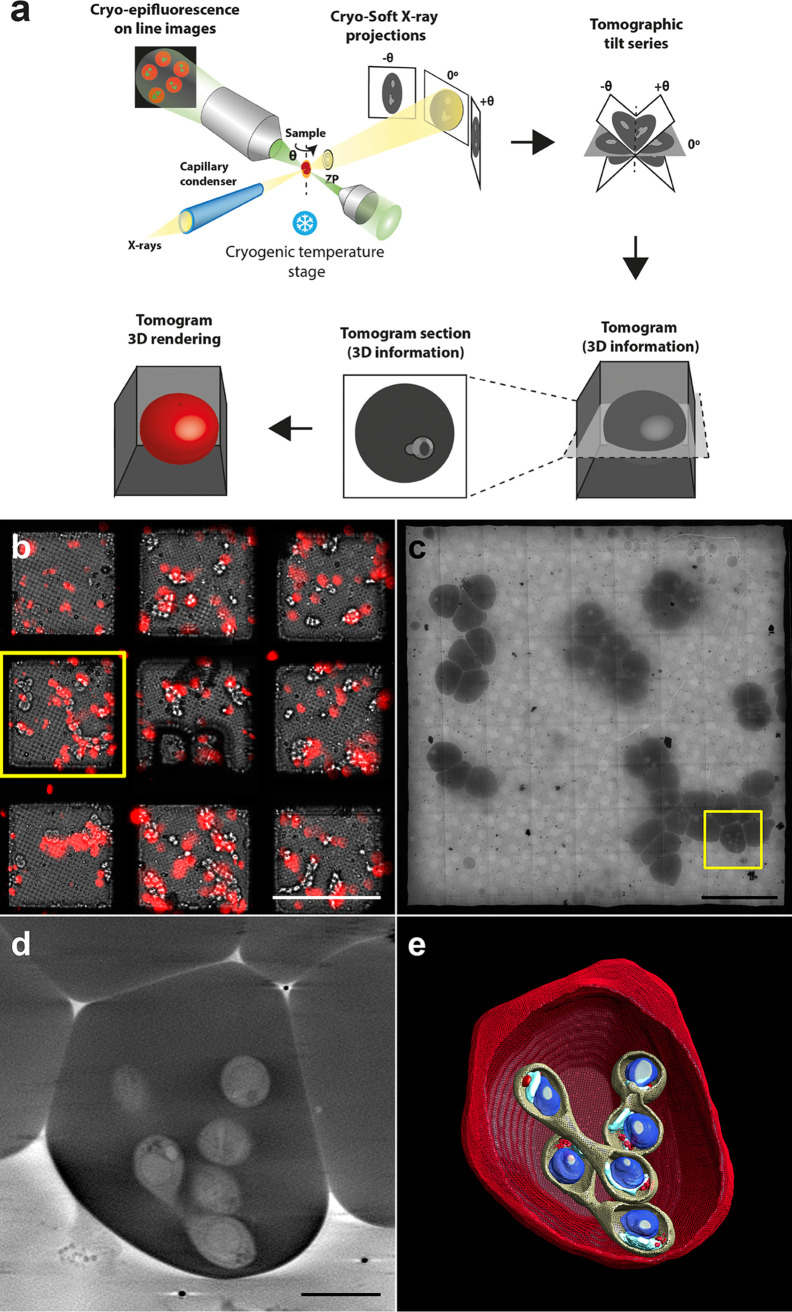
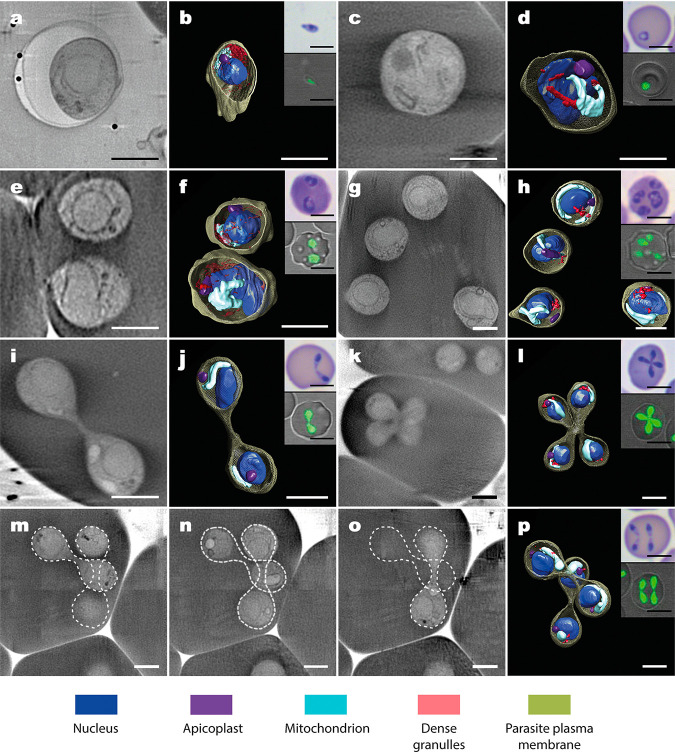
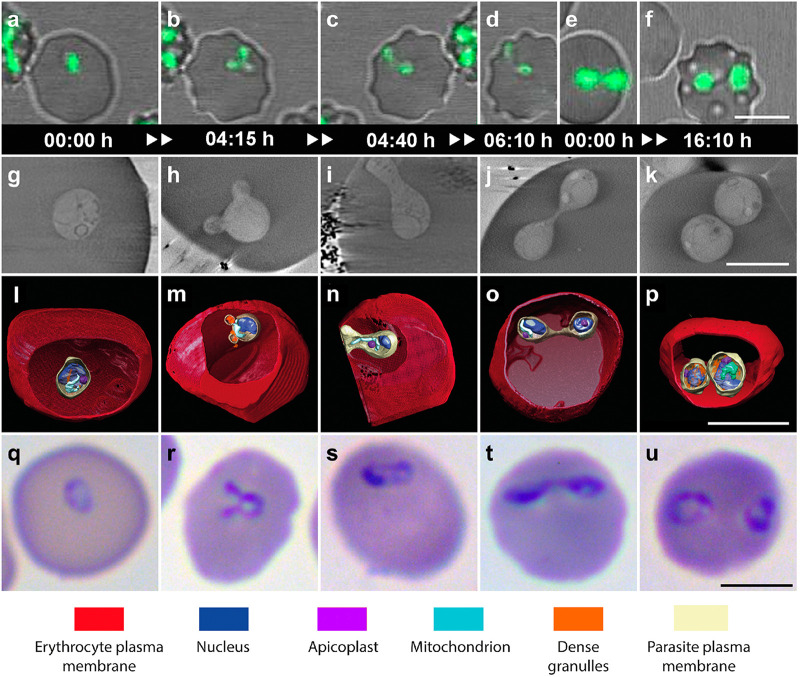
is an apicomplexan parasite of significance that causes the disease known as babesiosis in domestic and wild animals and in humans worldwide. infects vertebrate hosts and reproduces asexually by a form of binary fission within erythrocytes/red blood cells (RBCs), yielding a complex pleomorphic population of intraerythrocytic parasites. Seven of them, clearly visible in human RBCs infected with , are considered the main forms and named single, double, and quadruple trophozoites, paired and double paired pyriforms, tetrad or Maltese Cross, and multiparasite stage. However, these main intraerythrocytic forms coexist with RBCs infected with transient parasite combinations of unclear origin and development. In fact, little is understood about how builds this complex population during its asexual life cycle. By combining cryo-soft X-ray tomography and video microscopy, main and transitory parasites were characterized in a native whole cellular context and at nanometric resolution. The architecture and kinetics of the parasite population was observed in detail and provide additional data to the previous asexual life cycle model that was built on light microscopy. Importantly, the process of multiplication by binary fission, involving budding, was visualized in live parasites for the first time, revealing that fundamental changes in cell shape and continuous rounds of multiplication occur as the parasites go through their asexual multiplication cycle. A four-dimensional asexual life cycle model was built highlighting the origin of several transient morphological forms that, surprisingly, intersperse in a chronological order between one main stage and the next in the cycle. Babesiosis is a disease caused by intraerythrocytic parasites, which possess many clinical features that are similar to those of malaria. This worldwide disease is increasing in frequency and geographical range and has a significant impact on human and animal health. is one of the species responsible for human and cattle babesiosis causing death unless treated promptly. When infects its vertebrate hosts, it reproduces asexually within red blood cells. During its asexual life cycle, builds a population of numerous intraerythrocytic (IE) parasites of difficult interpretation. This complex population is largely unexplored, and we have therefore combined three- and four-dimensional imaging techniques to elucidate the origin, architecture, and kinetics of IE parasites. Unveiling the nature of these parasites has provided a vision of the asexual cycle in unprecedented detail and is a key step to develop control strategies against babesiosis.
是一种重要的顶复门寄生虫,可引起全世界家畜和野生动物以及人类的巴贝斯虫病。它感染脊椎动物宿主,并通过红细胞/红血球内的一种二分裂形式进行无性繁殖,产生复杂的多形性红细胞内寄生虫群体。在感染 的人类红细胞中,有七种形态清晰可见,被认为是主要形态,并被命名为单一、双生和四倍滋养体、成对和双对梨形虫、四联体或马耳他十字、以及多寄生虫阶段。然而,这些主要的红细胞内形态与感染来源和发育不明的短暂寄生虫组合的红细胞共存。事实上,人们对 在其无性生命周期中如何构建这种复杂群体知之甚少。通过结合冷冻软 X 射线断层摄影术和视频显微镜,在原生全细胞环境中以纳米级分辨率对主要和短暂寄生虫进行了特征描述。详细观察了寄生虫群体的结构和动力学,并为之前基于光学显微镜构建的 无性生命周期模型提供了额外的数据。重要的是,首次在活寄生虫中观察到二元分裂的增殖过程,包括出芽,这表明随着寄生虫经历无性繁殖周期,细胞形状发生根本变化,并不断进行繁殖。构建了一个四维度的无性生命周期模型,突出了几种短暂形态形式的起源,令人惊讶的是,这些形态形式在周期中的一个主要阶段和下一个阶段之间以时间顺序交织在一起。巴贝斯虫病是一种由红细胞内寄生虫引起的疾病,具有许多与疟疾相似的临床特征。这种全球性疾病的发病率和地理范围都在增加,对人类和动物健康有重大影响。 是引起人类和牛巴贝斯虫病的物种之一,如果不及时治疗,可导致死亡。当 感染其脊椎动物宿主时,它在红细胞内进行无性繁殖。在其无性生命周期中, 构建了一个难以解释的大量红细胞内(IE)寄生虫群体。这个复杂的群体在很大程度上尚未被探索,因此我们结合了三维和四维成像技术来阐明 IE 寄生虫的起源、结构和动力学。揭示这些寄生虫的本质提供了一个前所未有的细节的 无性周期的视角,是制定针对巴贝斯虫病的控制策略的关键步骤。