Giri D D, Dangerfield V J, Lonsdale R, Rogers K, Underwood J C
J Clin Pathol. 1987 Jul;40(7):734-40. doi: 10.1136/jcp.40.7.734.
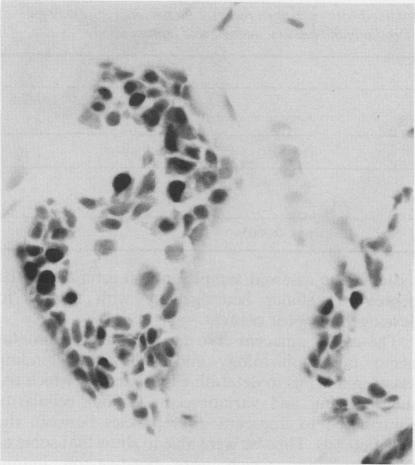
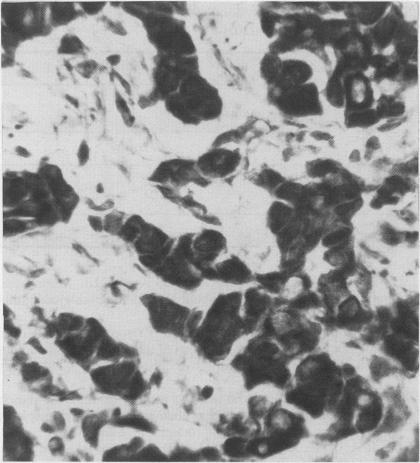
Two monoclonal antibodies recognising epitopes associated with oestrogen receptor protein were evaluated against the assayable soluble oestrogen receptor concentration in a series of 149 breast carcinomas. One antibody (anti-ER) recognises the hormone binding unit of oestrogen receptor and gives nuclear staining; the other antibody (anti-D5) was raised to a component of soluble oestrogen receptor and gives cytoplasmic staining. To minimise variations attributable to tumour heterogeneity and sampling error immunohistology using the two monoclonal antibodies, radioligand binding assays, enzyme immunoassays, and quantitative histology were done on adjacent frozen sections. Thirty nine per cent, 48%, 54%, and 43% of the tumours were found to be oestrogen receptor positive by radioligand binding assay, anti-ER and anti-D5 immunohistology, and enzyme immunoassay, respectively. Strong correlations (p less than 0.0005) were found between anti-ER immunohistology and the radioligand binding assay. Only weak correlations were found between anti-D5 immunohistology and the results of other assay methods for oestrogen receptor. Nuclear staining of human breast cancers with the anti-ER monoclonal antibody thus seems to be an acceptable alternative to biochemical assays, with the additional advantage of showing intercellular and regional heterogeneity for oestrogen receptor content.
针对一系列149例乳腺癌中可检测的可溶性雌激素受体浓度,评估了两种识别与雌激素受体蛋白相关表位的单克隆抗体。一种抗体(抗ER)识别雌激素受体的激素结合单位并产生核染色;另一种抗体(抗D5)是针对可溶性雌激素受体的一种成分产生的,产生胞质染色。为尽量减少因肿瘤异质性和取样误差导致的差异,对相邻的冰冻切片进行了使用这两种单克隆抗体的免疫组织化学、放射性配体结合测定、酶免疫测定和定量组织学分析。通过放射性配体结合测定、抗ER和抗D5免疫组织化学以及酶免疫测定,分别发现39%、48%、54%和43%的肿瘤为雌激素受体阳性。抗ER免疫组织化学与放射性配体结合测定之间存在强相关性(p小于0.0005)。抗D5免疫组织化学与雌激素受体其他测定方法的结果之间仅发现弱相关性。因此,用抗ER单克隆抗体对人乳腺癌进行核染色似乎是生化测定的一种可接受替代方法,还有显示雌激素受体含量的细胞间和区域异质性的额外优势。