Department of Virology, Institute of Microbiology, Faculty of Biology, University of Warsaw, Warsaw, Poland.
Department of Cell Biology and Molecular Genetics, University of Maryland, College Park, MD, United States of America.
PLoS One. 2020 Oct 15;15(10):e0240579. doi: 10.1371/journal.pone.0240579. eCollection 2020.
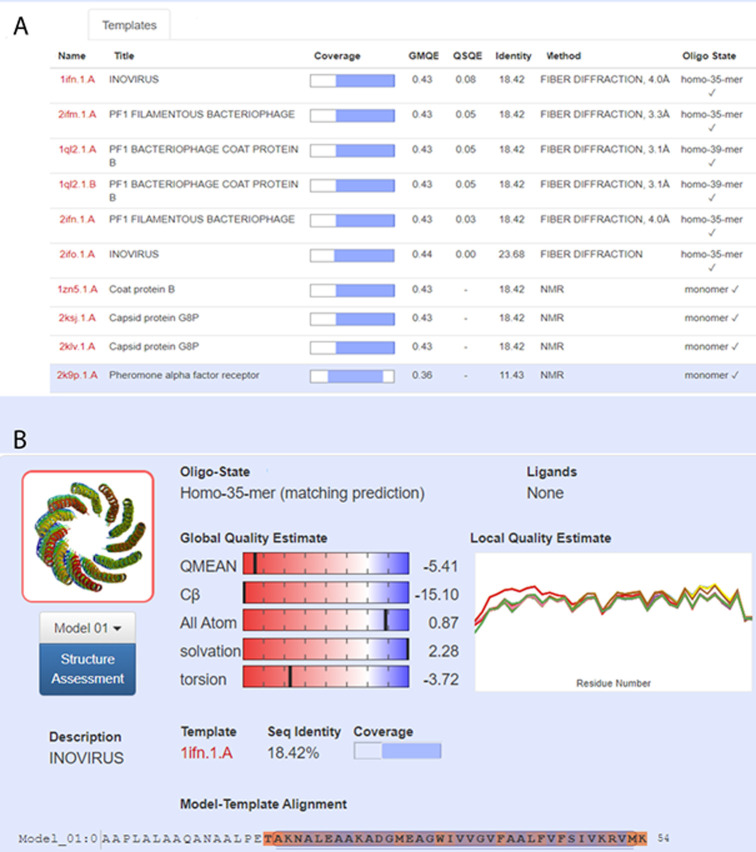
All Neisseria gonorrhoeae strains contain multiple copies of integrated filamentous phage genomes with undefined structures. In this study, we sought to characterize the capsid proteins of filamentous N. gonorrhoeae bacteriophage NgoΦ6 and phagemids propagated in different bacteria. The data demonstrate that purified phage contain phage-encoded structural proteins and bacterial host proteins; host proteins consistently copurified with the phage particles. The bacterial host proteins associated with the phage filament (as identified by mass spectrometry) tended to be one of the predominant outer membrane components of the host strain, plus minor additional host proteins. We were able to copurify a functional ß-lactamase, a phagemid-encoded protein, with phage filaments. We used protein modeling and immunological analysis to identify the major phage encoded structural proteins. The antigenic properties of these proteins depended on the bacterium where the phages were propagated. Polyclonal antibodies against N. gonorrhoeae phage NgoΦ6 recognized phage-encoded proteins if the phage was propagated in N. gonorrhoeae or H. influenzae cells but not if it was propagated in Salmonella or E. coli. We show that the phage filaments isolated from gonococci and Haemophilus are glycosylated, and this may explain the antigenic diversity seen. Taken en toto, the data demonstrate that while the neisserial filamentous phage are similar to other Inovirus with respect to overall genomic organization, their ability to closely associate with host proteins suggests that they have unique surface properties and are secreted by a here-to-fore unknown secretory pathway.
所有淋病奈瑟菌菌株都含有结构未知的整合丝状噬菌体基因组的多个拷贝。在这项研究中,我们试图描述在不同细菌中繁殖的丝状淋病奈瑟菌噬菌体 NgoΦ6 和噬菌粒的衣壳蛋白。数据表明,纯化的噬菌体含有噬菌体编码的结构蛋白和细菌宿主蛋白;宿主蛋白始终与噬菌体颗粒共纯化。与噬菌体丝(通过质谱鉴定)相关的细菌宿主蛋白往往是宿主菌株的主要外膜成分之一,加上少量其他宿主蛋白。我们能够与噬菌体丝共纯化一种功能性β-内酰胺酶,这是一种噬菌粒编码的蛋白。我们使用蛋白质建模和免疫分析来鉴定主要的噬菌体编码结构蛋白。这些蛋白的抗原特性取决于繁殖噬菌体的细菌。针对淋病奈瑟菌噬菌体 NgoΦ6 的多克隆抗体如果在淋病奈瑟菌或流感嗜血杆菌细胞中繁殖,则可识别噬菌体编码的蛋白,但如果在沙门氏菌或大肠杆菌中繁殖则不能识别。我们表明,从淋球菌和流感嗜血杆菌中分离出的噬菌体丝是糖基化的,这可能解释了所观察到的抗原多样性。总的来说,这些数据表明,虽然奈瑟氏菌丝状噬菌体在整体基因组组织方面与其他 Inovirus 相似,但它们与宿主蛋白密切相关的能力表明它们具有独特的表面特性,并通过迄今为止未知的分泌途径进行分泌。