Division of Informatics, Imaging and Data Sciences, The University of Manchester, Manchester, UK
NIHR School for Primary Care Research, University of Oxford, Oxford, UK.
J Epidemiol Community Health. 2021 Mar;75(3):213-223. doi: 10.1136/jech-2020-214764. Epub 2020 Oct 15.
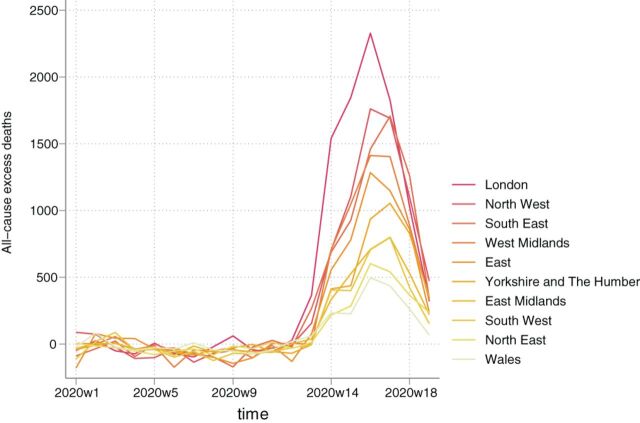
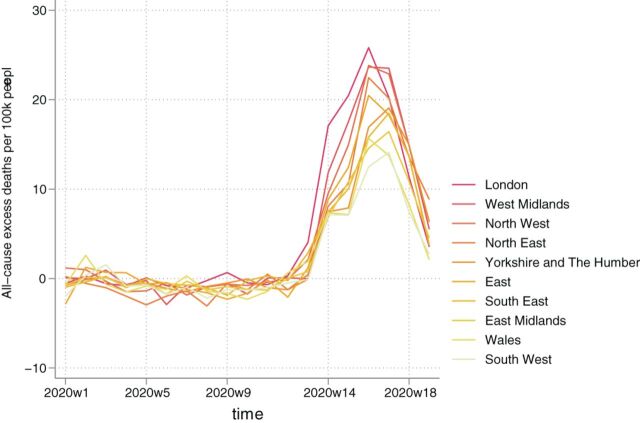
Deaths during the COVID-19 pandemic result directly from infection and exacerbation of other diseases and indirectly from deferment of care for other conditions, and are socially and geographically patterned. We quantified excess mortality in regions of England and Wales during the pandemic, for all causes and for non-COVID-19-associated deaths.
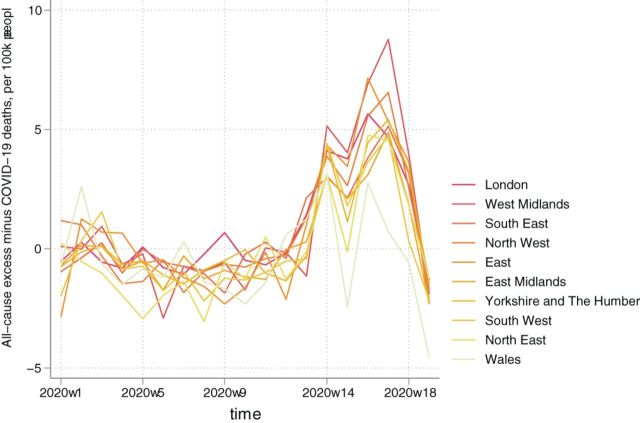
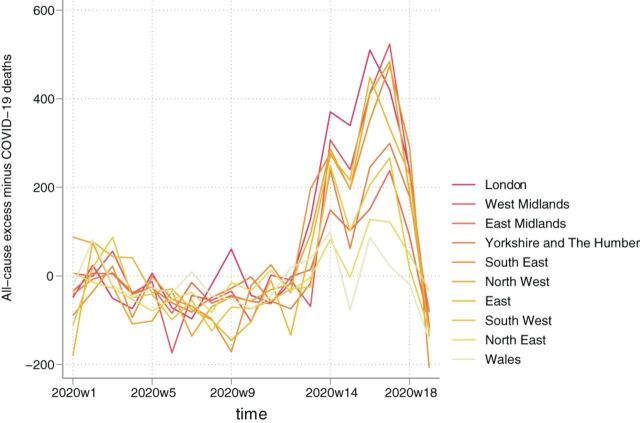
Weekly mortality data for 1 January 2010 to 1 May 2020 for England and Wales were obtained from the Office of National Statistics. Mean-dispersion negative binomial regressions were used to model death counts based on pre-pandemic trends and exponentiated linear predictions were subtracted from: (i) all-cause deaths and (ii) all-cause deaths minus COVID-19 related deaths for the pandemic period (week starting 7 March, to week ending 8 May).
Between 7 March and 8 May 2020, there were 47 243 (95% CI: 46 671 to 47 815) excess deaths in England and Wales, of which 9948 (95% CI: 9376 to 10 520) were not associated with COVID-19. Overall excess mortality rates varied from 49 per 100 000 (95% CI: 49 to 50) in the South West to 102 per 100 000 (95% CI: 102 to 103) in London. Non-COVID-19 associated excess mortality rates ranged from -1 per 100 000 (95% CI: -1 to 0) in Wales (ie, mortality rates were no higher than expected) to 26 per 100 000 (95% CI: 25 to 26) in the West Midlands.
The COVID-19 pandemic has had markedly different impacts on the regions of England and Wales, both for deaths directly attributable to COVID-19 infection and for deaths resulting from the national public health response.
在 COVID-19 大流行期间,死亡直接源于感染和其他疾病的恶化,间接源于对其他疾病的治疗延误,且具有社会和地理分布模式。我们量化了大流行期间英格兰和威尔士各地区的超额死亡率,包括所有原因和与 COVID-19 无关的死亡。
从英国国家统计局获得了 2010 年 1 月 1 日至 2020 年 5 月 1 日期间英格兰和威尔士的每周死亡率数据。使用平均分散负二项式回归根据大流行前的趋势对死亡人数进行建模,并从以下两个方面减去外推线性预测值:(i)所有原因的死亡人数,以及(ii)大流行期间(从 3 月 7 日开始的那一周到 5 月 8 日结束的那一周)所有原因的死亡人数减去与 COVID-19 相关的死亡人数。
在 2020 年 3 月 7 日至 5 月 8 日期间,英格兰和威尔士共有 47 243 人(95%CI:46 671 人至 47 815 人)的死亡人数超过预期,其中 9948 人(95%CI:9376 人至 10 520 人)与 COVID-19 无关。总体超额死亡率从西南部的每 100 000 人 49 人(95%CI:49 人至 50 人)到伦敦的每 100 000 人 102 人(95%CI:102 人至 103 人)不等。与 COVID-19 无关的超额死亡率范围从威尔士的-1 人(95%CI:-1 人至 0 人)到西米德兰兹郡的 26 人(95%CI:25 人至 26 人)不等。
COVID-19 大流行对英格兰和威尔士各地区的影响明显不同,包括直接归因于 COVID-19 感染的死亡人数和国家公共卫生应对措施导致的死亡人数。