Sensory & Motor System Medicine, Graduate School of Medicine, The University of Tokyo, 7-3-1 Hongo, Bunkyo-ku, Tokyo 113-8655, Japan.
Sensory Department of Pathology and Microbiology, Faculty of Medicine, Saga University, Saga 849-8501, Japan.
Biomed Res Int. 2020 Oct 1;2020:5639651. doi: 10.1155/2020/5639651. eCollection 2020.
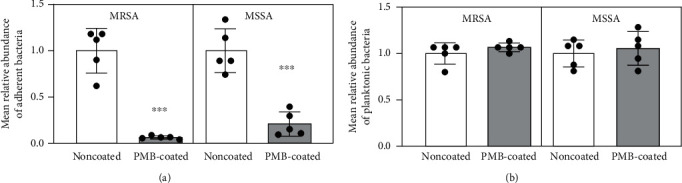
Initial bacterial adhesion to medical devices and subsequent biofilm formation are known as the leading causes of surgical site infection (SSI). Therefore, inhibition of bacterial adhesion and biofilm formation on the surface of medical devices can reduce the risk of SSIs. In this study, a highly hydrophilic, antibiofouling surface was prepared by coating the bioabsorbable suture surface with poly(2-methacryloyloxyethyl phosphorylcholine (MPC)-co-n-butyl methacrylate) (PMB). The PMB-coated and noncoated sutures exhibited similar mechanical strength and surface morphology. The effectiveness of the PMB coating on the suture to suppress adhesion and biofilm formation of methicillin-resistant and methicillin-susceptible was investigated both and . The bacterial adhesion test revealed that PMB coating significantly reduced the number of adherent bacteria, with no difference in the number of planktonic bacteria. Moreover, fluorescence microscopy and scanning electron microscopy observations of adherent bacteria on the suture surface after contact with bacterial suspension confirmed PMB coating-mediated inhibition of biofilm formation. Additionally, we found that the PMB-coated sutures exhibited significant antibiofouling effects . In conclusion, PMB-coated sutures demonstrated bacteriostatic effects associated with a highly hydrophilic, antibiofouling surface and inhibited bacterial adhesion and biofilm formation. Therefore, PMB-coated sutures could be a new alternative to reduce the risk of SSIs.
初始细菌黏附于医疗器械并随后形成生物膜是手术部位感染(SSI)的主要原因。因此,抑制医疗器械表面的细菌黏附和生物膜形成可以降低 SSI 的风险。在这项研究中,通过在可吸收缝线表面涂覆聚(2-甲基丙烯酰氧乙基磷酸胆碱(MPC)-共-正丁基甲基丙烯酸酯)(PMB)制备了高度亲水、抗生物污损的表面。PMB 涂层和未涂层缝线具有相似的机械强度和表面形貌。通过接触细菌悬浮液后在缝线表面观察黏附细菌的荧光显微镜和扫描电子显微镜,研究了 PMB 涂层对耐甲氧西林金黄色葡萄球菌和甲氧西林敏感金黄色葡萄球菌的缝线抑制黏附和生物膜形成的有效性。结果表明,PMB 涂层显著减少了黏附细菌的数量,而浮游细菌的数量没有差异。此外,荧光显微镜和扫描电子显微镜观察黏附在缝线表面的细菌证实了 PMB 涂层介导的生物膜形成抑制作用。此外,我们发现 PMB 涂层缝线具有显著的抗生物污损效果。综上所述,PMB 涂层缝线具有抑制细菌黏附和生物膜形成的作用,表现出与高亲水、抗生物污损表面相关的抑菌效果。因此,PMB 涂层缝线可能是降低 SSI 风险的一种新选择。