Department of Microbiology, University of Illinois at Urbana-Champaign, Urbana, IL, United States of America.
Department of Biology, Emory University, Atlanta, GA, United States of America.
PLoS Pathog. 2020 Oct 16;16(10):e1008974. doi: 10.1371/journal.ppat.1008974. eCollection 2020 Oct.
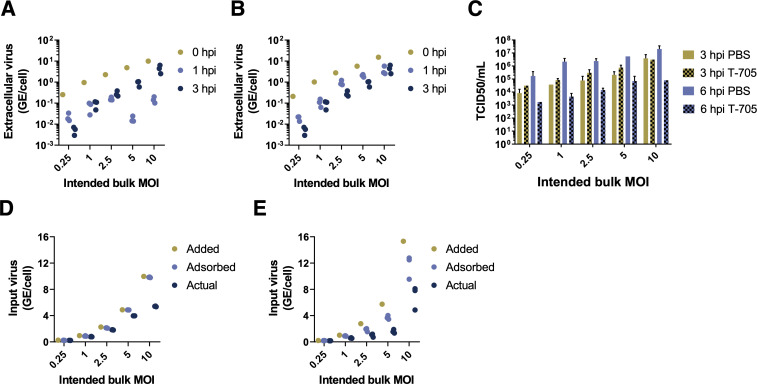
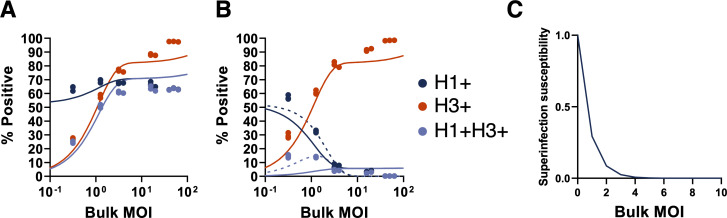
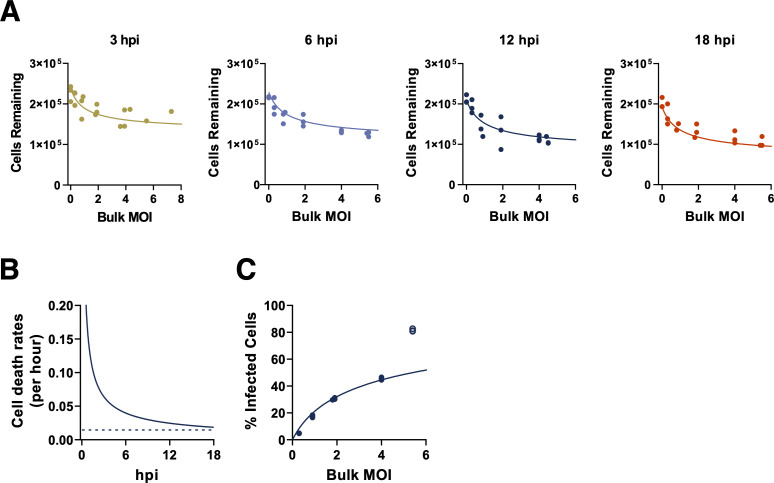
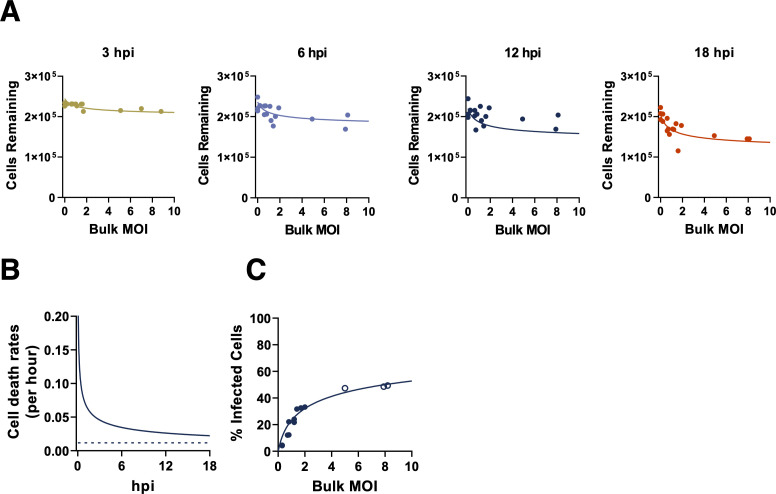
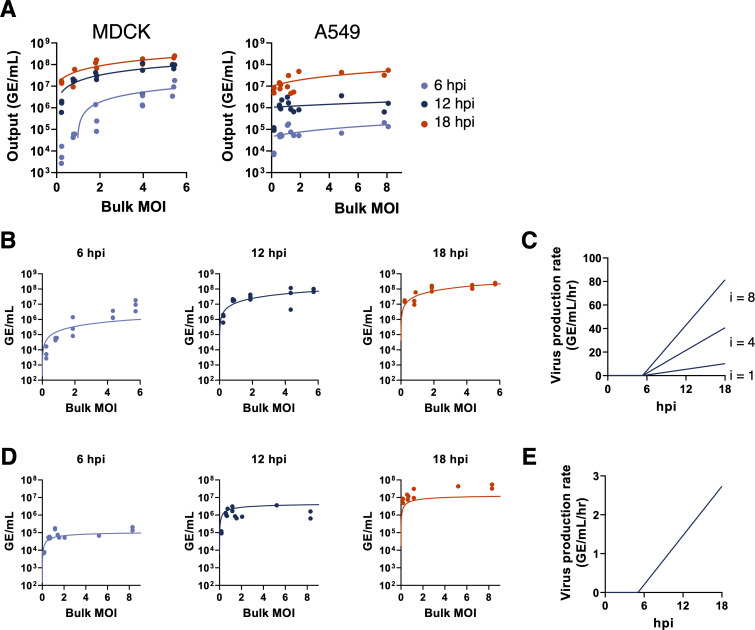
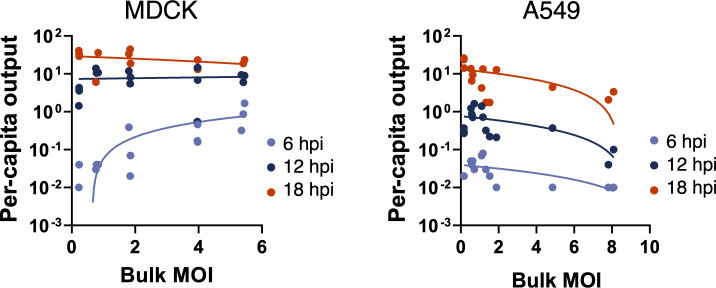
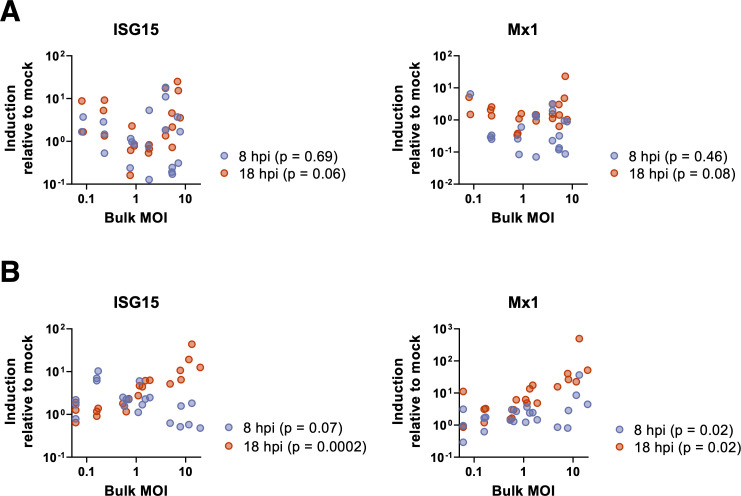
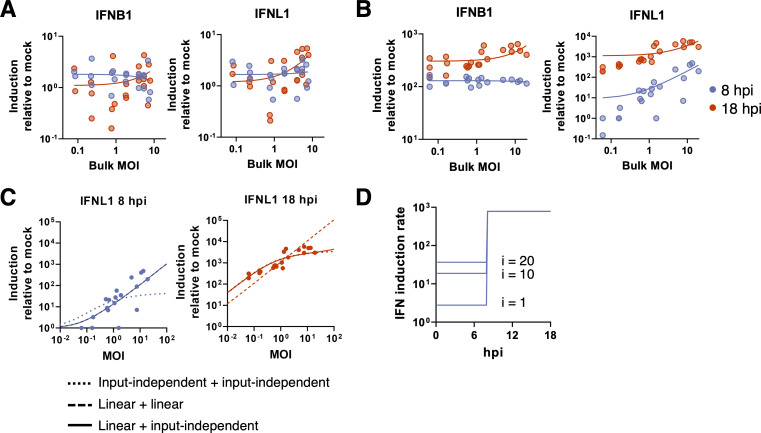
During viral infection, the numbers of virions infecting individual cells can vary significantly over time and space. The functional consequences of this variation in cellular multiplicity of infection (MOI) remain poorly understood. Here, we rigorously quantify the phenotypic consequences of cellular MOI during influenza A virus (IAV) infection over a single round of replication in terms of cell death rates, viral output kinetics, interferon and antiviral effector gene transcription, and superinfection potential. By statistically fitting mathematical models to our data, we precisely define specific functional forms that quantitatively describe the modulation of these phenotypes by MOI at the single cell level. To determine the generality of these functional forms, we compare two distinct cell lines (MDCK cells and A549 cells), both infected with the H1N1 strain A/Puerto Rico/8/1934 (PR8). We find that a model assuming that infected cell death rates are independent of cellular MOI best fits the experimental data in both cell lines. We further observe that a model in which the rate and efficiency of virus production increase with cellular co-infection best fits our observations in MDCK cells, but not in A549 cells. In A549 cells, we also find that induction of type III interferon, but not type I interferon, is highly dependent on cellular MOI, especially at early timepoints. This finding identifies a role for cellular co-infection in shaping the innate immune response to IAV infection. Finally, we show that higher cellular MOI is associated with more potent superinfection exclusion, thus limiting the total number of virions capable of infecting a cell. Overall, this study suggests that the extent of cellular co-infection by influenza viruses may be a critical determinant of both viral production kinetics and cellular infection outcomes in a host cell type-dependent manner.
在病毒感染过程中,单个细胞感染的病毒数量在时间和空间上可能会有很大的差异。这种细胞感染复数(MOI)变化的功能后果仍然知之甚少。在这里,我们在流感 A 病毒(IAV)感染的单个复制周期内,严格量化了细胞 MOI 对细胞死亡率、病毒产量动力学、干扰素和抗病毒效应基因转录以及再感染潜力的表型后果。通过将数学模型拟合到我们的数据中,我们精确地定义了特定的功能形式,这些功能形式定量描述了 MOI 在单细胞水平上对这些表型的调制。为了确定这些功能形式的普遍性,我们比较了两种不同的细胞系(MDCK 细胞和 A549 细胞),它们都感染了 H1N1 株 A/Puerto Rico/8/1934(PR8)。我们发现,假设感染细胞死亡率与细胞 MOI 无关的模型最适合两种细胞系的实验数据。我们进一步观察到,在 MDCK 细胞中,病毒产量的速率和效率随细胞共感染而增加的模型最符合我们的观察结果,但在 A549 细胞中则不然。在 A549 细胞中,我们还发现 III 型干扰素的诱导,而不是 I 型干扰素的诱导,高度依赖于细胞 MOI,尤其是在早期。这一发现确定了细胞共感染在塑造宿主细胞对 IAV 感染的先天免疫反应中的作用。最后,我们表明,较高的细胞 MOI 与更强的再感染排除相关,从而限制了能够感染细胞的病毒总数。总的来说,这项研究表明,流感病毒的细胞共感染程度可能是宿主细胞类型依赖性的病毒产生动力学和细胞感染结果的关键决定因素。