Apostolova Elisaveta, Lukova Paolina, Baldzhieva Alexandra, Katsarov Plamen, Nikolova Mariana, Iliev Ilia, Peychev Lyudmil, Trica Bogdan, Oancea Florin, Delattre Cédric, Kokova Vesela
Department of Pharmacology and Drug Toxicology, Faculty of Pharmacy, Medical University-Plovdiv, Vasil Aprilov Str. 15A, 4002 Plovdiv, Bulgaria.
Department of Pharmacognosy and Pharmaceutical Chemistry, Faculty of Pharmacy, Medical University - Plovdiv, Vasil Aprilov Str. 15A, 4002 Plovdiv, Bulgaria.
Polymers (Basel). 2020 Oct 13;12(10):2338. doi: 10.3390/polym12102338.
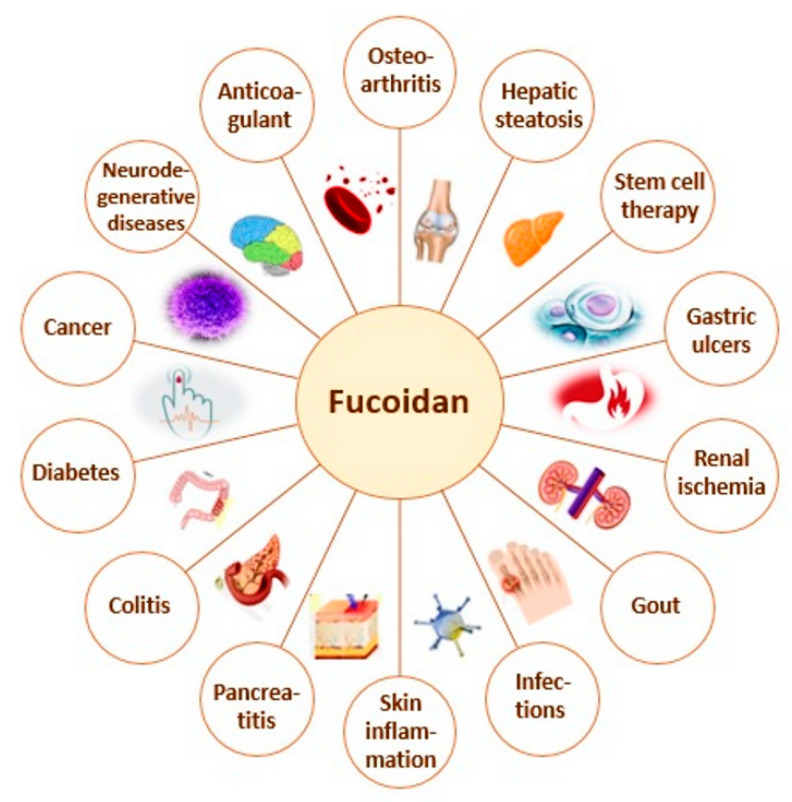
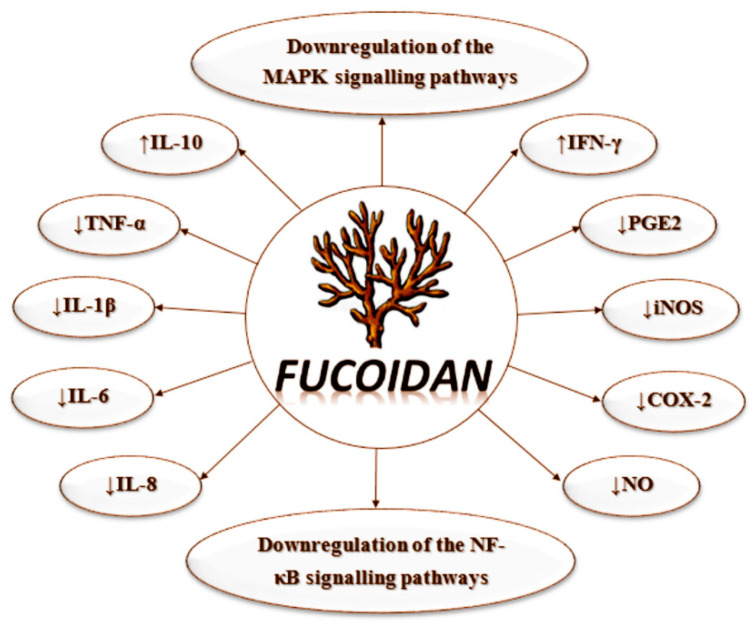
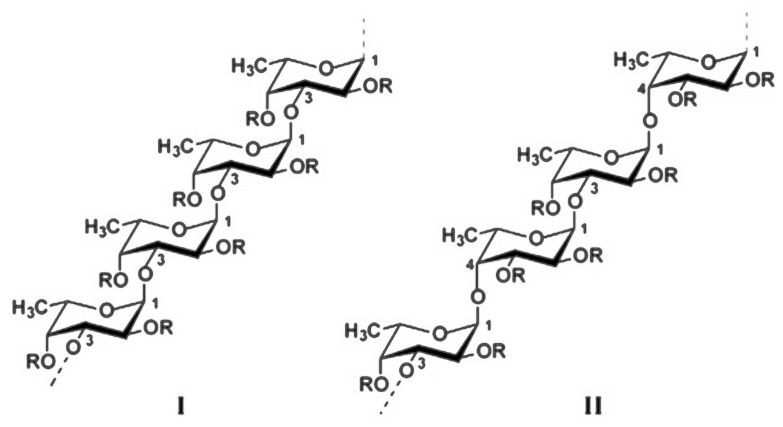
Inflammation is the initial response of the immune system to potentially harmful stimuli (e.g., injury, stress, and infections). The process involves activation of macrophages and neutrophils, which produce mediators, such as nitric oxide (NO), prostaglandin E2 (PGE2), pro-inflammatory and anti-inflammatory cytokines. The pro-inflammatory cytokines interleukin-1β (IL-1β), interleukin 6 (IL-6), and tumor necrosis factor-α (TNF-α) are considered as biomarkers of inflammation. Even though it occurs as a physiological defense mechanism, its involvement in the pathogenesis of various diseases is reported. Rheumatoid arthritis, inflammatory bowel disease, Alzheimer's disease, and cardiovascular diseases are only a part of the diseases, in which pathogenesis the chronic inflammation is involved. Fucoidans are complex polysaccharides from brown seaweeds and some marine invertebrates, composed mainly of -fucose and sulfate ester groups and minor amounts of neutral monosaccharides and uronic acids. Algae-derived fucoidans are studied intensively during the last years regarding their multiple biological activities and possible therapeutic potential. However, the source, species, molecular weight, composition, and structure of the polysaccharides, as well as the route of administration of fucoidans, could be crucial for their effects. Fucoidan is reported to act on different stages of the inflammatory process: (i) blocking of lymphocyte adhesion and invasion, (ii) inhibition of multiple enzymes, and (iii) induction of apoptosis. In this review, we focused on the immunemodulating and anti-inflammatory effects of fucoidans derived from macroalgae and the models used for their evaluation. Additional insights on the molecular structure of the compound are included.
炎症是免疫系统对潜在有害刺激(如损伤、应激和感染)的初始反应。该过程涉及巨噬细胞和中性粒细胞的激活,它们会产生介质,如一氧化氮(NO)、前列腺素E2(PGE2)、促炎和抗炎细胞因子。促炎细胞因子白细胞介素-1β(IL-1β)、白细胞介素6(IL-6)和肿瘤坏死因子-α(TNF-α)被视为炎症的生物标志物。尽管炎症作为一种生理防御机制而发生,但据报道它参与了各种疾病的发病过程。类风湿性关节炎、炎症性肠病、阿尔茨海默病和心血管疾病只是涉及慢性炎症发病机制的部分疾病。岩藻聚糖是来自褐藻和一些海洋无脊椎动物的复杂多糖,主要由岩藻糖和硫酸酯基团以及少量中性单糖和糖醛酸组成。近年来,人们对藻类来源的岩藻聚糖的多种生物活性和可能的治疗潜力进行了深入研究。然而,多糖的来源、种类、分子量、组成和结构以及岩藻聚糖的给药途径可能对其效果至关重要。据报道,岩藻聚糖作用于炎症过程的不同阶段:(i)阻断淋巴细胞粘附和侵袭,(ii)抑制多种酶,以及(iii)诱导细胞凋亡。在本综述中,我们重点关注大型藻类来源的岩藻聚糖的免疫调节和抗炎作用及其评估模型。还包括对该化合物分子结构的更多见解。