Department of Radiology and Research Institute of Radiology, University of Ulsan College of Medicine, Asan Medical Center, 86 Asanbyeongwon-Gil, Songpa-Gu, Seoul, 05505, Republic of Korea.
Department of Medicine, University of Ulsan College of Medicine, Asan Medical Center, Seoul, Republic of Korea.
Sci Rep. 2020 Oct 16;10(1):17525. doi: 10.1038/s41598-020-74479-x.
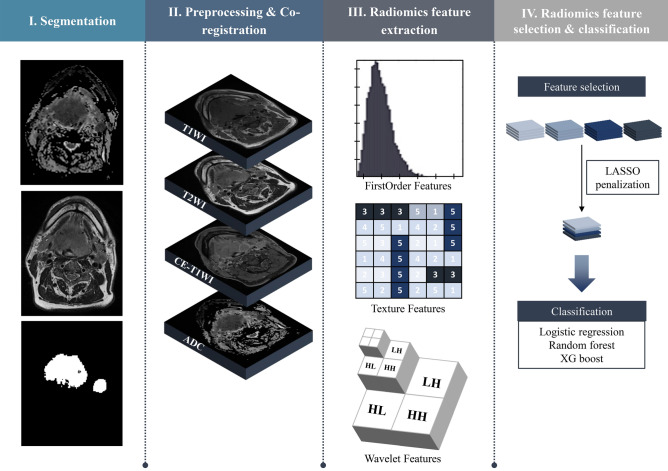
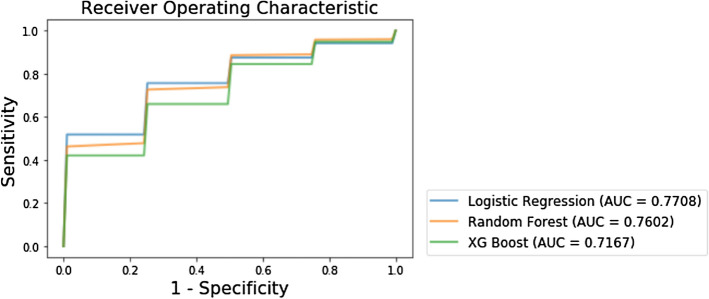
We investigated the ability of machine-learning classifiers on radiomics from pre-treatment multiparametric magnetic resonance imaging (MRI) to accurately predict human papillomavirus (HPV) status in patients with oropharyngeal squamous cell carcinoma (OPSCC). This retrospective study collected data of 60 patients (48 HPV-positive and 12 HPV-negative) with newly diagnosed histopathologically proved OPSCC, who underwent head and neck MRIs consisting of axial T1WI, T2WI, CE-T1WI, and apparent diffusion coefficient (ADC) maps from diffusion-weighted imaging (DWI). The median age was 59 years (the range being 35 to 85 years), and 83.3% of patients were male. The imaging data were randomised into a training set (32 HPV-positive and 8 HPV-negative OPSCC) and a test set (16 HPV-positive and 4 HPV-negative OPSCC) in each fold. 1618 quantitative features were extracted from manually delineated regions-of-interest of primary tumour and one definite lymph node in each sequence. After feature selection by using the least absolute shrinkage and selection operator (LASSO), three different machine-learning classifiers (logistic regression, random forest, and XG boost) were trained and compared in the setting of various combinations between four sequences. The highest diagnostic accuracies were achieved when using all sequences, and the difference was significant only when the combination did not include the ADC map. Using all sequences, logistic regression and the random forest classifier yielded higher accuracy compared with the that of the XG boost classifier, with mean area under curve (AUC) values of 0.77, 0.76, and 0.71, respectively. The machine-learning classifier of non-invasive and quantitative radiomics signature could guide the classification of the HPV status.
我们研究了机器学习分类器在预测 HPV 状态中的能力,这些分类器基于预处理的多参数磁共振成像(MRI)中的放射组学特征,用于预测头颈部鳞状细胞癌(OPSCC)患者的 HPV 状态。本回顾性研究收集了 60 名新诊断的组织学证实的 OPSCC 患者的数据,这些患者均接受了头颈部 MRI 检查,包括轴位 T1WI、T2WI、CE-T1WI 和扩散加权成像(DWI)的表观扩散系数(ADC)图。患者的中位年龄为 59 岁(范围为 35 至 85 岁),83.3%的患者为男性。影像数据在每个折叠中随机分为训练集(32 名 HPV 阳性和 8 名 HPV 阴性 OPSCC)和测试集(16 名 HPV 阳性和 4 名 HPV 阴性 OPSCC)。从每个序列的原发性肿瘤和一个明确的淋巴结的手动勾画 ROI 中提取了 1618 个定量特征。通过使用最小绝对收缩和选择算子(LASSO)进行特征选择后,在四个序列的各种组合下,训练并比较了三种不同的机器学习分类器(逻辑回归、随机森林和 XG boost)。当使用所有序列时,获得了最高的诊断准确率,只有当组合不包括 ADC 图时,差异才具有统计学意义。使用所有序列时,逻辑回归和随机森林分类器的准确性高于 XG boost 分类器,其平均曲线下面积(AUC)值分别为 0.77、0.76 和 0.71。非侵入性和定量放射组学特征的机器学习分类器可以指导 HPV 状态的分类。