Department of Life Sciences and Bioethics, Graduate School of Medical and Dental Sciences, Tokyo Medical and Dental University (TMDU), 1-5-45, Yushima, Bunkyo-ku, Tokyo, 113-8510, Japan.
Department of Nutrition and Metabolism in Cardiovascular Disease, Graduate School of Medical and Dental Sciences, Tokyo Medical and Dental University (TMDU), Tokyo, Japan.
Sci Rep. 2020 Oct 16;10(1):17593. doi: 10.1038/s41598-020-74617-5.
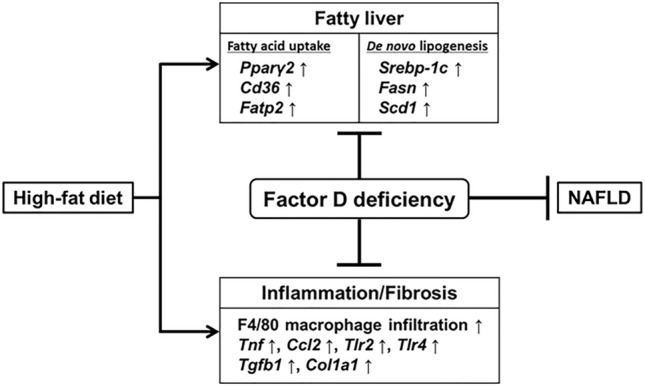
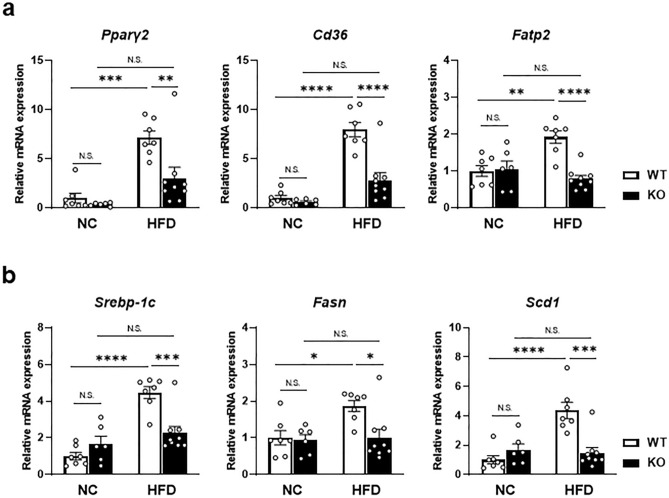
Excessive intake of fat causes accumulation of fat in liver, leading to non-alcoholic fatty liver disease (NAFLD). High-fat diet (HFD) upregulates the expression of Factor D, a complement pathway component, in the liver of mice. However, the functions of Factor D in liver are not well known. Therefore, the current study investigated the relationship between Factor D and hepatic lipid accumulation using CRISPR/Cas9-mediated Factor D knockout (FD-KO) mice. Factor D deficiency downregulated expression of genes related to fatty acid uptake and de novo lipogenesis in the liver. Furthermore, Factor D deficiency reduced the expression of inflammatory factors (Tnf and Ccl2) and fibrosis markers and decreased accumulation of F4/80-positive macrophages. These data suggest that the Factor D deficiency improved hepatic lipid accumulation and hepatic inflammation in HFD-fed mice.
过量的脂肪摄入会导致肝脏脂肪堆积,从而引发非酒精性脂肪肝(NAFLD)。高脂肪饮食(HFD)会使小鼠肝脏中补体途径成分因子 D 的表达上调。然而,因子 D 在肝脏中的功能尚不清楚。因此,本研究使用 CRISPR/Cas9 介导的因子 D 敲除(FD-KO)小鼠来研究因子 D 与肝脂质积累之间的关系。因子 D 缺乏会下调肝脏中与脂肪酸摄取和从头合成相关的基因表达。此外,因子 D 缺乏还会降低炎症因子(TNF 和 CCL2)和纤维化标志物的表达,并减少 F4/80 阳性巨噬细胞的积累。这些数据表明,因子 D 缺乏可改善 HFD 喂养小鼠的肝脂质积累和肝炎症。