Hussain Sultan, Zeb Anwar, Rasheed Akhter, Saeed Tareq
Department of Mathematics, COMSATS University Islamabad, Abbottabad Campus, Abbottabad, 22060 Khyber Pakhtunkhwa Pakistan.
Department of Mathematics, King Abdulaziz University, Jeddah, 41206 Saudi Arabia.
Adv Differ Equ. 2020;2020(1):574. doi: 10.1186/s13662-020-03029-6. Epub 2020 Oct 14.
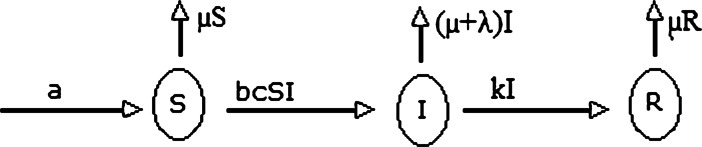
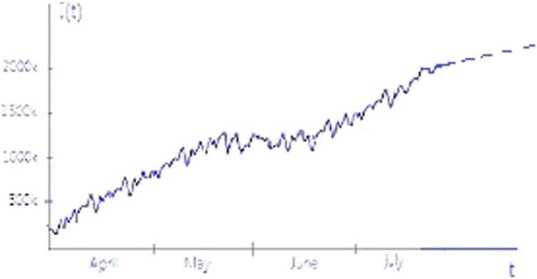
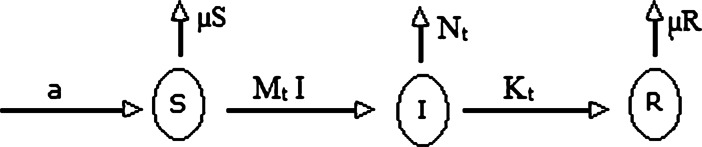
This work is devoted to a stochastic model on the spread and control of corona virus (COVID-19), in which the total population of a corona infected area is divided into susceptible, infected, and recovered classes. In reality, the number of individuals who get disease, the number of deaths due to corona virus, and the number of recovered are stochastic, because nobody can tell the exact value of these numbers in the future. The models containing these terms must be stochastic. Such numbers are estimated and counted by a random process called a Poisson process (or birth process). We construct an SIR-type model in which the above numbers are stochastic and counted by a Poisson process. To understand the spread and control of corona virus in a better way, we first study the stability of the corresponding deterministic model, investigate the unique nonnegative strong solution and an inequality managing of which leads to control of the virus. After this, we pass to the stochastic model and show the existence of a unique strong solution. Next, we use the supermartingale approach to investigate a bound managing of which also leads to decrease of the number of infected individuals. Finally, we use the data of the COVOD-19 in USA to calculate the intensity of Poisson processes and verify our results.
这项工作致力于研究冠状病毒(COVID - 19)传播与控制的随机模型,其中新冠感染区域的总人口被分为易感、感染和康复三类。在现实中,患病个体数量、因冠状病毒导致的死亡人数以及康复人数都是随机的,因为未来没人能确切说出这些数字的值。包含这些项的模型必定是随机的。这类数字通过一种称为泊松过程(或出生过程)的随机过程来估计和计数。我们构建了一个SIR型模型,其中上述数字是随机的且由泊松过程计数。为了更好地理解冠状病毒的传播与控制,我们首先研究相应确定性模型的稳定性,研究其唯一的非负强解以及一个不等式管理,该管理可实现对病毒的控制。在此之后,我们转向随机模型并证明存在唯一的强解。接下来,我们使用上鞅方法研究一个界的管理,该管理也会导致感染个体数量的减少。最后,我们使用美国COVID - 19的数据来计算泊松过程的强度并验证我们的结果。