Bridge Joshua, Harding Simon, Zheng Yalin
Department of Eye and Vision Science, University of Liverpool, Liverpool, UK.
BMJ Open Ophthalmol. 2020 Oct 15;5(1):e000569. doi: 10.1136/bmjophth-2020-000569. eCollection 2020.
To develop a prognostic tool to predict the progression of age-related eye disease progression using longitudinal colour fundus imaging.
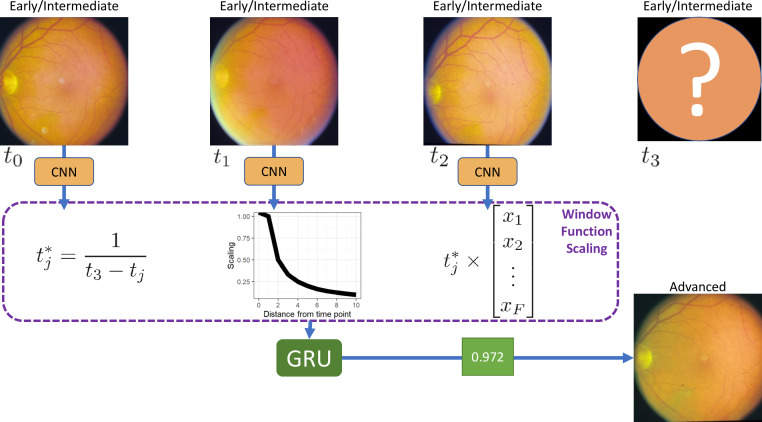
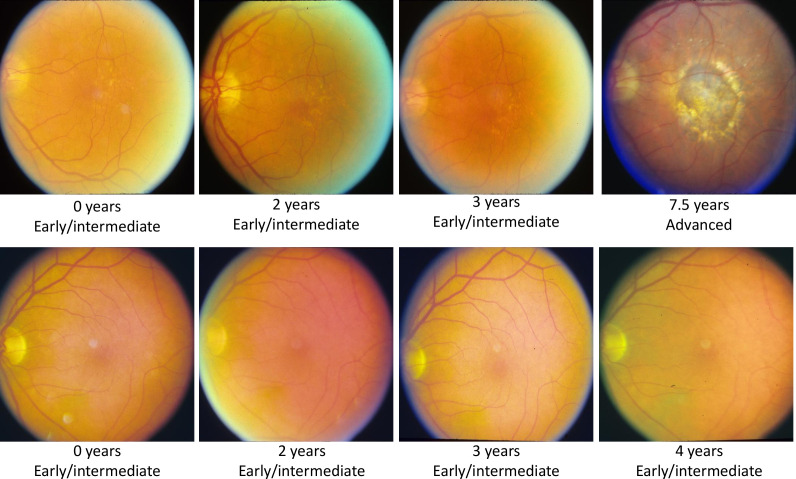
Previous prognostic models using deep learning with imaging data require annotation during training or only use a single time point. We propose a novel deep learning method to predict the progression of diseases using longitudinal imaging data with uneven time intervals, which requires no prior feature extraction. Given previous images from a patient, our method aims to predict whether the patient will progress onto the next stage of the disease. The proposed method uses InceptionV3 to produce feature vectors for each image. In order to account for uneven intervals, a novel interval scaling is proposed. Finally, a recurrent neural network is used to prognosticate the disease. We demonstrate our method on a longitudinal dataset of colour fundus images from 4903 eyes with age-related macular degeneration (AMD), taken from the Age-Related Eye Disease Study, to predict progression to late AMD.
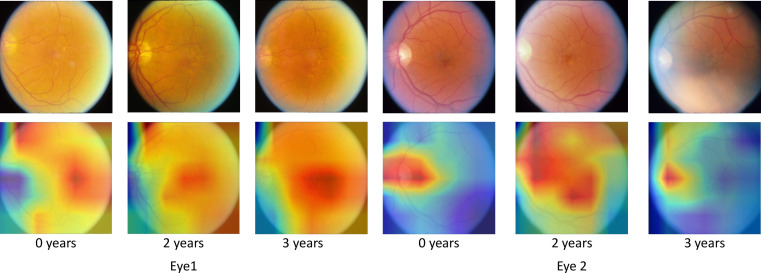
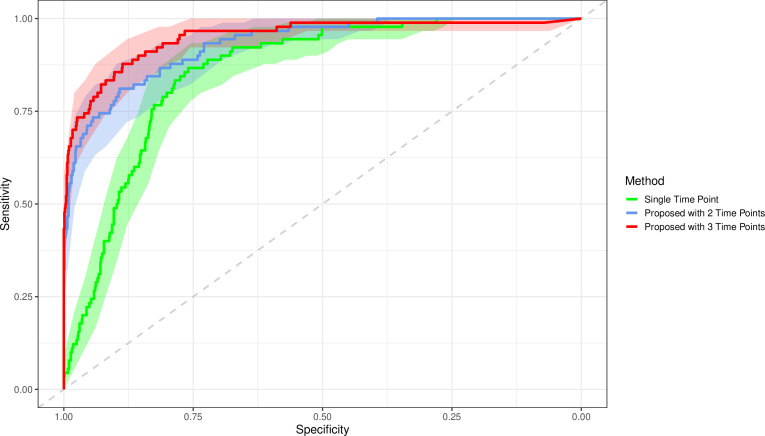
Our method attains a testing sensitivity of 0.878, a specificity of 0.887 and an area under the receiver operating characteristic of 0.950. We compare our method to previous methods, displaying superior performance in our model. Class activation maps display how the network reaches the final decision.
The proposed method can be used to predict progression to advanced AMD at some future visit. Using multiple images at different time points improves predictive performance.
利用纵向彩色眼底成像技术开发一种预测年龄相关性眼病进展的预后工具。
以往使用深度学习和成像数据的预后模型在训练期间需要注释,或者仅使用单个时间点的数据。我们提出一种新颖的深度学习方法,利用时间间隔不均匀的纵向成像数据预测疾病进展,该方法无需事先进行特征提取。给定患者之前的图像,我们的方法旨在预测患者是否会进展到疾病的下一阶段。所提出的方法使用InceptionV3为每张图像生成特征向量。为了考虑不均匀的时间间隔,提出了一种新颖的间隔缩放方法。最后,使用循环神经网络对疾病进行预后预测。我们在来自年龄相关性眼病研究的4903只患有年龄相关性黄斑变性(AMD)眼睛的纵向彩色眼底图像数据集上验证了我们的方法,以预测进展为晚期AMD的情况。
我们的方法测试敏感度达到0.878,特异度为0.887,受试者工作特征曲线下面积为0.950。我们将我们的方法与之前的方法进行比较,结果显示我们的模型具有更优的性能。类别激活图展示了网络是如何做出最终决策的。
所提出的方法可用于预测未来某一时刻进展为晚期AMD的情况。使用不同时间点的多张图像可提高预测性能。