Münch Mirjam, Wirz-Justice Anna, Brown Steven A, Kantermann Thomas, Martiny Klaus, Stefani Oliver, Vetter Céline, Wright Kenneth P, Wulff Katharina, Skene Debra J
Sleep/Wake Research Centre, Massey University Wellington, Wellington 6021, New Zealand.
Centre for Chronobiology, Psychiatric Hospital of the University of Basel, 4002 Basel, Switzerland;
Clocks Sleep. 2020 Feb 28;2(1):61-85. doi: 10.3390/clockssleep2010008. eCollection 2020 Mar.
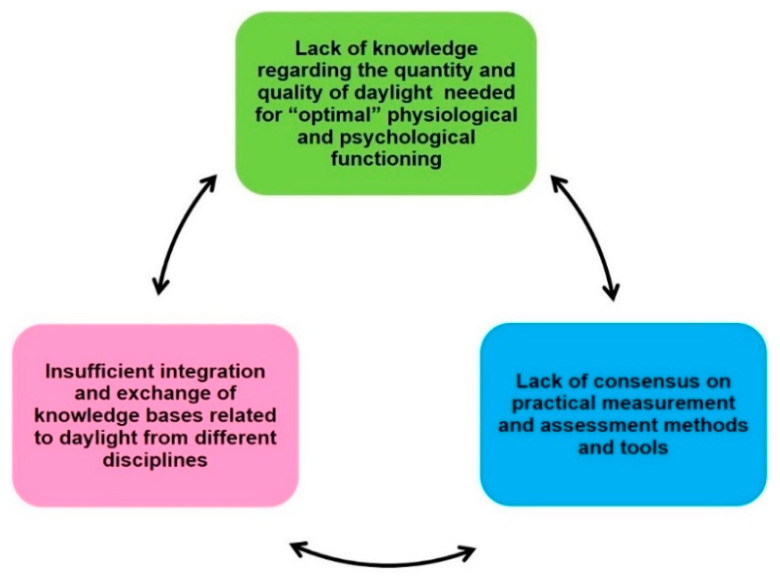
Daylight stems solely from direct, scattered and reflected sunlight, and undergoes dynamic changes in irradiance and spectral power composition due to latitude, time of day, time of year and the nature of the physical environment (reflections, buildings and vegetation). Humans and their ancestors evolved under these natural day/night cycles over millions of years. Electric light, a relatively recent invention, interacts and competes with the natural light-dark cycle to impact human biology. What are the consequences of living in industrialised urban areas with much less daylight and more use of electric light, throughout the day (and at night), on general health and quality of life? In this workshop report, we have classified key gaps of knowledge in daylight research into three main groups: (I) uncertainty as to daylight quantity and quality needed for "optimal" physiological and psychological functioning, (II) lack of consensus on practical measurement and assessment methods and tools for monitoring real (day) light exposure across multiple time scales, and (III) insufficient integration and exchange of daylight knowledge bases from different disciplines. Crucial short and long-term objectives to fill these gaps are proposed.
日光仅源于直射、散射和反射的阳光,并且由于纬度、一天中的时间、一年中的时间以及物理环境(反射、建筑物和植被)的性质,其辐照度和光谱功率组成会发生动态变化。人类及其祖先在数百万年的这些自然昼夜循环中进化。电灯是一项相对较新的发明,它与自然明暗循环相互作用并相互竞争,从而影响人类生物学。在工业化城市地区,白天(和晚上)的日光少得多且更多地使用电灯,这对总体健康和生活质量会有什么影响?在本研讨会报告中,我们将日光研究中的关键知识差距分为三大类:(I)对于“最佳”生理和心理功能所需的日光数量和质量存在不确定性,(II)对于跨多个时间尺度监测实际(白天)光照暴露的实际测量和评估方法及工具缺乏共识,以及(III)不同学科的日光知识库整合和交流不足。提出了填补这些差距的关键短期和长期目标。