Nowozin Claudia, Wahnschaffe Amely, de Zeeuw Jan, Papakonstantinou Alexandra, Hädel Sven, Rodenbeck Andrea, Bes Frederik, Kunz Dieter
Institute of Physiology, Sleep Research & Clinical Chronobiology, Charité - Universitätsmedizin Berlin, Berlin, Germany.
Clinic Sleep & Chronomedicine, St. Hedwig-Krankenhaus, Berlin, Germany.
Eur J Neurosci. 2025 Jan;61(2):e16647. doi: 10.1111/ejn.16647.
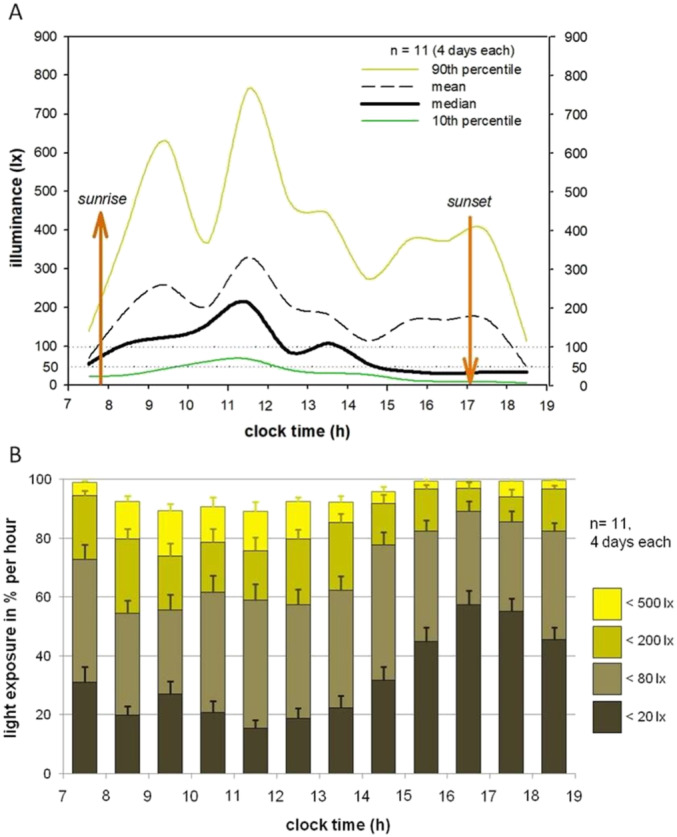
Timing and architecture of sleep are co-driven by circadian rhythms modulated by their major Zeitgeber light and darkness. In a natural environment, one is exposed to 3.000 lx (cloudy winter sky) to 100.000 lx (bright sunny sky). The aim of the study was to assess (1) habitual daytime light exposure in urban winter and (2) impact of daytime urban light on objective night-time sleep. Eleven healthy participants (mean age ± SD: 25.4 ± 2.8 years; 6 male) wore eyeglass frames continuously recording daytime illuminance levels vertically to the eye by mounted sensors (range: 1-40.000 lx) during four consecutive days in winter 2008 in Berlin, Germany. In-lab polysomnography was performed over two nights in nine participants. Median light exposure over 4 days was the following: full day 7:00-19:00 h: 23 lx (12-37 lx); morning 7:00-11:00 h: 81 lx (19-201 lx); midday 11:00-15:00 h: 68 lx (19-164 lx); afternoon 15:00-19:00 h: 22 lx (6-58 lx), resulting in only 36 min > 500 lx per day. Timing of daytime light intensity was significantly associated with subsequent sleep: lower midday illuminance with shorter REM latency (Rho = 0.817; p = 0.049) and earlier REM polarity (less prevalence of REM at end-of-sleep; Rho = 0.817; p = 0.049). Humans, living in an urban environment, appear to be exposed to extremely low light levels, which we named as 'Living in Biological Darkness'. Most fascinating, physiology seems to adapt and responds to variation in light intensity on such low levels. Interestingly, the observed changes in sleep architecture with low light levels are reminiscent of those suspected to constitute biological markers of depression some 40-50 years ago.
睡眠的时间安排和结构由昼夜节律共同驱动,而昼夜节律则受其主要授时因子——光与暗的调节。在自然环境中,人们会接触到3000勒克斯(多云的冬日天空)至100000勒克斯(阳光明媚的明亮天空)的光照。本研究的目的是评估:(1)城市冬季习惯性的日间光照暴露情况;(2)日间城市光照对夜间客观睡眠的影响。2008年冬季,在德国柏林,11名健康参与者(平均年龄±标准差:25.4±2.8岁;6名男性)连续四天佩戴装有传感器的眼镜框,该传感器可垂直记录眼睛处的日间光照强度水平(范围:1 - 40000勒克斯)。9名参与者在实验室进行了两晚的多导睡眠监测。4天的光照暴露中位数如下:全天7:00 - 19:00:23勒克斯(12 - 37勒克斯);上午7:00 - 11:00:81勒克斯(19 - 201勒克斯);中午11:00 - 15:00:68勒克斯(19 - 164勒克斯);下午15:00 - 19:00:22勒克斯(6 - 58勒克斯),结果是每天仅有36分钟的光照强度大于500勒克斯。日间光照强度的时间安排与随后的睡眠显著相关:中午光照强度较低时,快速眼动睡眠潜伏期较短(相关系数=0.817;p = 0.049)且快速眼动睡眠极性出现得更早(睡眠结束时快速眼动睡眠的发生率较低;相关系数=0.817;p = 0.049)。生活在城市环境中的人类似乎暴露于极低的光照水平下,我们将其称为“生活在生物黑暗中”。最令人着迷的是,生理机能似乎能够适应并对如此低水平的光照强度变化做出反应。有趣的是,观察到的低光照水平下睡眠结构的变化让人想起大约40 - 50年前那些被怀疑构成抑郁症生物学标志物的变化。