Department of Neurology, Institute of Medical Sciences, Banaras Hindu University, Varanasi, India.
Department of Neurology, PGIMER, Chandigarh, India.
Neurol Sci. 2020 Dec;41(12):3437-3470. doi: 10.1007/s10072-020-04801-y. Epub 2020 Oct 21.
Coronaviruses mainly affect the respiratory system; however, there are reports of SARS-CoV and MERS-CoV causing neurological manifestations. We aimed at discussing the various neurological manifestations of SARS-CoV-2 infection and to estimate the prevalence of each of them.
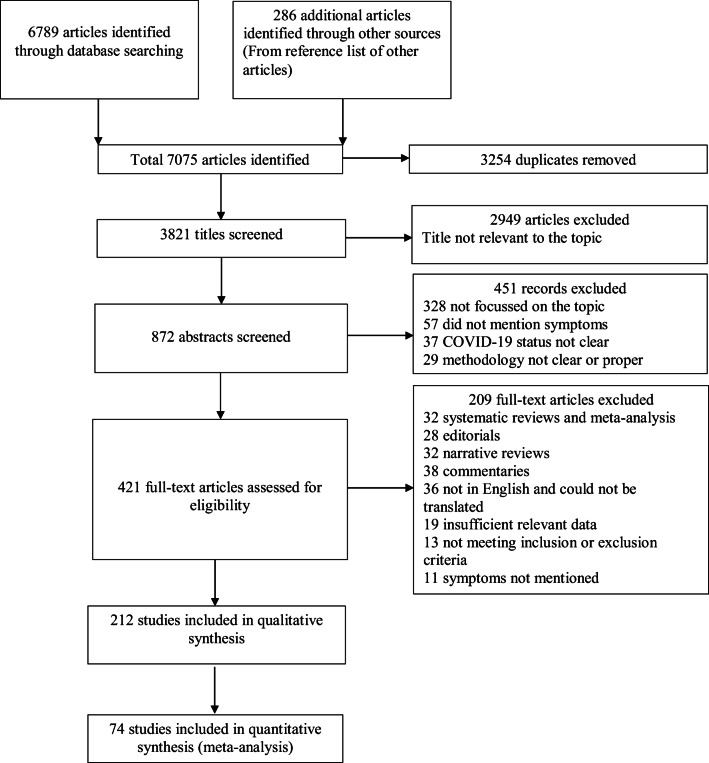
We searched the following electronic databases; PubMed, MEDLINE, Scopus, EMBASE, Google Scholar, EBSCO, Web of Science, Cochrane Library, WHO database, and ClinicalTrials.gov . Relevant MeSH terms for COVID-19 and neurological manifestations were used. Randomized controlled trials, non-randomized controlled trials, case-control studies, cohort studies, cross-sectional studies, case series, and case reports were included in the study. To estimate the overall proportion of each neurological manifestations, the study employed meta-analysis of proportions using a random-effects model.
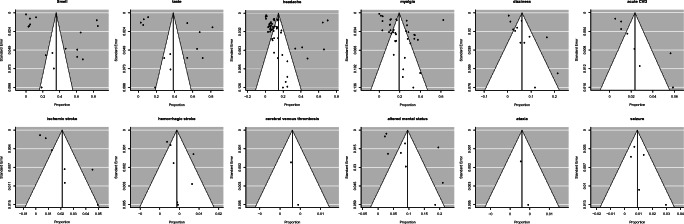
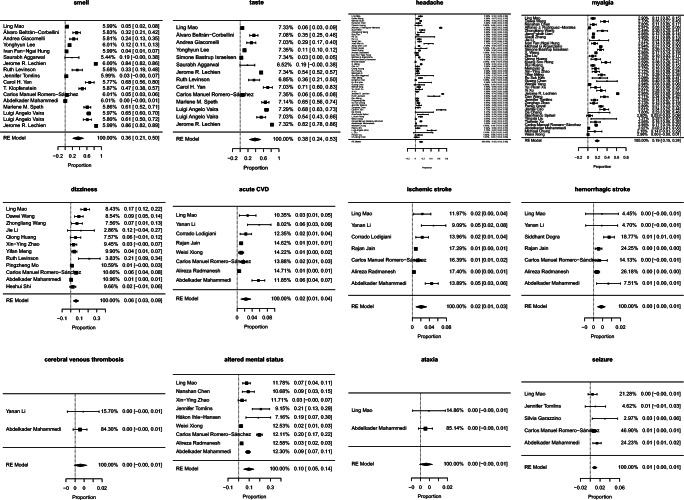
Pooled prevalence of each neurological manifestations are, smell disturbances (35.8%; 95% CI 21.4-50.2), taste disturbances (38.5%; 95%CI 24.0-53.0), myalgia (19.3%; 95% CI 15.1-23.6), headache (14.7%; 95% CI 10.4-18.9), dizziness (6.1%; 95% CI 3.1-9.2), and syncope (1.8%; 95% CI 0.9-4.6). Pooled prevalence of acute cerebrovascular disease was (2.3%; 95%CI 1.0-3.6), of which majority were ischaemic stroke (2.1%; 95% CI 0.9-3.3), followed by haemorrhagic stroke (0.4%; 95% CI 0.2-0.6), and cerebral venous thrombosis (0.3%; 95% CI 0.1-0.6).
Neurological symptoms are common in SARS-CoV-2 infection, and from the large number of cases reported from all over the world daily, the prevalence of neurological features might increase again. Identifying some neurological manifestations like smell and taste disturbances can be used to screen patients with COVID-19 so that early identification and isolation is possible.
冠状病毒主要影响呼吸系统;然而,有报道称 SARS-CoV 和 MERS-CoV 可引起神经系统表现。我们旨在讨论 SARS-CoV-2 感染的各种神经系统表现,并估计每种表现的流行率。
我们在以下电子数据库中进行了搜索:PubMed、MEDLINE、Scopus、EMBASE、Google Scholar、EBSCO、Web of Science、Cochrane 图书馆、世界卫生组织数据库和 ClinicalTrials.gov。使用了与 COVID-19 和神经系统表现相关的 MeSH 术语。本研究纳入了随机对照试验、非随机对照试验、病例对照研究、队列研究、横断面研究、病例系列和病例报告。为了估计每种神经系统表现的总体比例,采用随机效应模型对比例进行荟萃分析。
每种神经系统表现的汇总患病率分别为:嗅觉障碍(35.8%;95%CI 21.4-50.2)、味觉障碍(38.5%;95%CI 24.0-53.0)、肌痛(19.3%;95%CI 15.1-23.6)、头痛(14.7%;95%CI 10.4-18.9)、头晕(6.1%;95%CI 3.1-9.2)和晕厥(1.8%;95%CI 0.9-4.6)。急性脑血管病的汇总患病率为(2.3%;95%CI 1.0-3.6),其中大部分为缺血性脑卒中(2.1%;95%CI 0.9-3.3),其次为出血性脑卒中(0.4%;95%CI 0.2-0.6)和脑静脉血栓形成(0.3%;95%CI 0.1-0.6)。
神经系统症状在 SARS-CoV-2 感染中很常见,而且从世界各地每天报告的大量病例来看,神经系统表现的患病率可能再次增加。识别嗅觉和味觉障碍等一些神经系统表现可以用于筛查 COVID-19 患者,以便早期识别和隔离。