Boston University, Department of Biomedical Engineering, Boston, Massachusetts, United States.
J Biomed Opt. 2020 Oct;25(10). doi: 10.1117/1.JBO.25.10.102703.
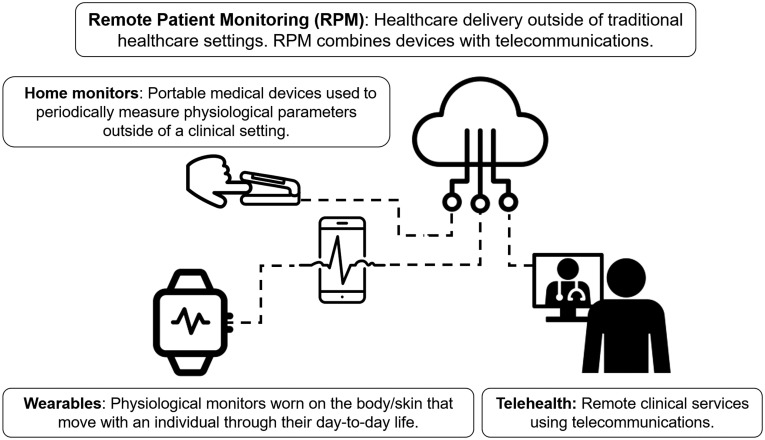
The COVID-19 pandemic is changing the landscape of healthcare delivery in many countries, with a new shift toward remote patient monitoring (RPM).
The goal of this perspective is to highlight the existing and future role of wearable and RPM optical technologies in an increasingly at-home healthcare and research environment.
First, the specific changes occurring during the COVID-19 pandemic in healthcare delivery, regulations, and technological innovations related to RPM technologies are reviewed. Then, a review of the current state and potential future impact of optical physiological monitoring in portable and wearable formats is outlined.
New efforts from academia, industry, and regulatory agencies are advancing and encouraging at-home, portable, and wearable physiological monitors as a growing part of healthcare delivery. It is hoped that these shifts will assist with disease diagnosis, treatment, management, recovery, and rehabilitation with minimal in-person contact. Some of these trends are likely to persist for years to come. Optical technologies already account for a large portion of RPM platforms, with a good potential for future growth.
The biomedical optics community has a potentially large role to play in developing, testing, and commercializing new wearable and RPM technologies to meet the changing healthcare and research landscape in the COVID-19 era and beyond.
COVID-19 大流行正在许多国家改变医疗保健服务的格局,远程患者监测(RPM)出现了新的转变。
本观点的目的是强调可穿戴式和 RPM 光学技术在日益普及的家庭医疗保健和研究环境中的现有和未来作用。
首先,回顾了 COVID-19 大流行期间医疗保健服务、法规以及与 RPM 技术相关的技术创新方面发生的具体变化。然后,概述了光学生理监测在便携式和可穿戴式格式中的当前状态和潜在的未来影响。
学术界、工业界和监管机构的新努力正在推进和鼓励家庭、便携式和可穿戴式生理监测器作为医疗保健服务的重要组成部分。人们希望这些转变将有助于通过最小的身体接触进行疾病诊断、治疗、管理、康复和康复。其中一些趋势可能会在未来几年持续存在。光学技术已经占据了 RPM 平台的很大一部分,未来有很大的增长潜力。
生物医学光学界在开发、测试和商业化新的可穿戴式和 RPM 技术方面具有潜在的重要作用,以满足 COVID-19 时代及以后不断变化的医疗保健和研究格局。