Chandrasekaran Ranganathan, Katthula Vipanchi, Moustakas Evangelos
Department of Information & Decision Sciences, University of Illinois at Chicago, Chicago, IL, United States.
Middlesex University Dubai, Dubai, United Arab Emirates.
J Med Internet Res. 2020 Oct 16;22(10):e22443. doi: 10.2196/22443.
Despite the growing popularity of wearable health care devices (from fitness trackes such as Fitbit to smartwatches such as Apple Watch and more sophisticated devices that can collect information on metrics such as blood pressure, glucose levels, and oxygen levels), we have a limited understanding about the actual use and key factors affecting the use of these devices by US adults.
The main objective of this study was to examine the use of wearable health care devices and the key predictors of wearable use by US adults.
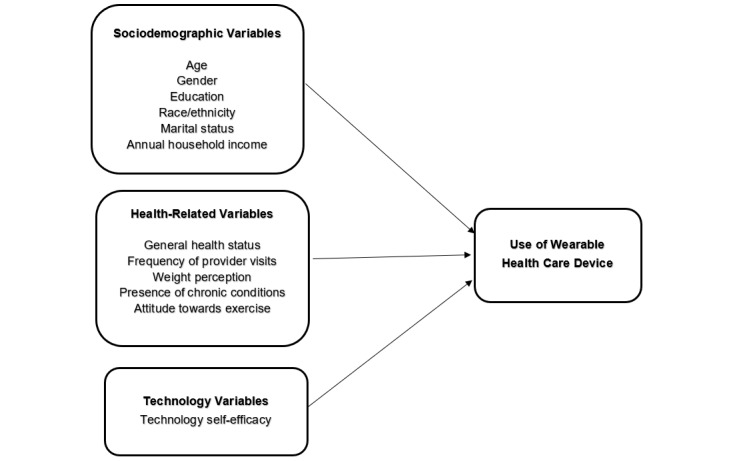
Using a national survey of 4551 respondents, we examined the usage patterns of wearable health care devices (use of wearables, frequency of their use, and willingness to share health data from a wearable with a provider) and a set of predictors that pertain to personal demographics (age, gender, race, education, marital status, and household income), individual health (general health, presence of chronic conditions, weight perceptions, frequency of provider visits, and attitude towards exercise), and technology self-efficacy using logistic regression analysis.
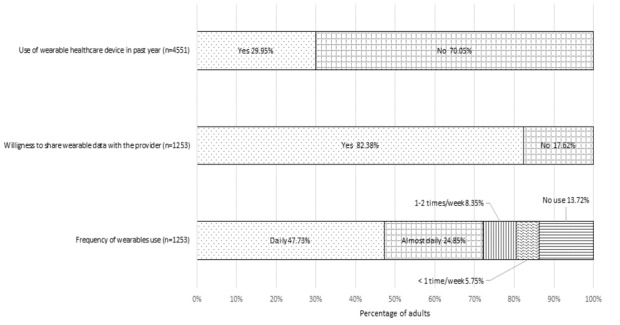
About 30% (1266/4551) of US adults use wearable health care devices. Among the users, nearly half (47.33%) use the devices every day, with a majority (82.38% weighted) willing to share the health data from wearables with their care providers. Women (16.25%), White individuals (19.74%), adults aged 18-50 years (19.52%), those with some level of college education or college graduates (25.60%), and those with annual household incomes greater than US $75,000 (17.66%) were most likely to report using wearable health care devices. We found that the use of wearables declines with age: Adults aged >50 years were less likely to use wearables compared to those aged 18-34 years (odds ratios [OR] 0.46-0.57). Women (OR 1.26, 95% CI 0.96-1.65), White individuals (OR 1.65, 95% CI 0.97-2.79), college graduates (OR 1.05, 95% CI 0.31-3.51), and those with annual household incomes greater than US $75,000 (OR 2.6, 95% CI 1.39-4.86) were more likely to use wearables. US adults who reported feeling healthier (OR 1.17, 95% CI 0.98-1.39), were overweight (OR 1.16, 95% CI 1.06-1.27), enjoyed exercise (OR 1.23, 95% CI 1.06-1.43), and reported higher levels of technology self-efficacy (OR 1.33, 95% CI 1.21-1.46) were more likely to adopt and use wearables for tracking or monitoring their health.
The potential of wearable health care devices is under-realized, with less than one-third of US adults actively using these devices. With only younger, healthier, wealthier, more educated, technoliterate adults using wearables, other groups have been left behind. More concentrated efforts by clinicians, device makers, and health care policy makers are needed to bridge this divide and improve the use of wearable devices among larger sections of American society.
尽管可穿戴医疗设备越来越受欢迎(从如Fitbit这样的健身追踪器到如苹果手表等智能手表,以及更复杂的能够收集血压、血糖水平和血氧水平等指标信息的设备),但我们对美国成年人实际使用这些设备的情况以及影响其使用的关键因素了解有限。
本研究的主要目的是调查美国成年人对可穿戴医疗设备的使用情况以及可穿戴设备使用的关键预测因素。
通过对4551名受访者进行全国性调查,我们研究了可穿戴医疗设备的使用模式(可穿戴设备的使用情况、使用频率以及与医疗服务提供者分享可穿戴设备健康数据的意愿),以及一系列与个人人口统计学特征(年龄、性别、种族、教育程度、婚姻状况和家庭收入)、个人健康状况(总体健康状况、慢性病的存在情况、体重认知、就医频率以及对运动的态度)和技术自我效能感相关的预测因素,并使用逻辑回归分析。
约30%(1266/4551)的美国成年人使用可穿戴医疗设备。在使用者中,近一半(47.33%)每天使用这些设备,大多数人(加权后为82.38%)愿意与他们的医疗服务提供者分享可穿戴设备的健康数据。女性(16.25%)、白人(19.74%)、18至50岁的成年人(19.52%)、有一定大学教育程度或大学毕业的人(25.60%)以及家庭年收入超过75000美元的人(17.66%)最有可能报告使用可穿戴医疗设备。我们发现可穿戴设备的使用随着年龄增长而减少:50岁以上的成年人相比18至34岁的成年人使用可穿戴设备的可能性更低(优势比[OR]为0.46 - 0.57)。女性(OR 1.26,95%置信区间0.96 - 1.65)、白人(OR 1.65,95%置信区间0.97 - 2.79)、大学毕业生(OR 1.05,95%置信区间0.31 - 3.51)以及家庭年收入超过75000美元的人(OR 2.6,95%置信区间1.39 - 4.86)更有可能使用可穿戴设备。报告感觉更健康(OR 1.17,95%置信区间0.98 - 1.39)、超重(OR 1.16,95%置信区间1.06 - 1.27)、喜欢运动(OR 1.23,95%置信区间1.06 - 1.43)以及报告技术自我效能感水平较高(OR 1.33,95%置信区间1.21 - 1.46)的美国成年人更有可能采用和使用可穿戴设备来追踪或监测他们的健康状况。
可穿戴医疗设备的潜力尚未得到充分发挥,不到三分之一的美国成年人积极使用这些设备。由于只有更年轻、更健康、更富有、受教育程度更高、精通技术的成年人使用可穿戴设备,其他群体被落下了。临床医生、设备制造商和医疗保健政策制定者需要做出更集中的努力来弥合这一差距,并提高可穿戴设备在美国社会更广泛人群中的使用率。