Tvrdá Eva, Debacker Mégane, Ďuračka Michal, Kováč Ján, Bučko Ondřej
Department of Animal Physiology, Faculty of Biotechnology and Food Sciences, Slovak University of Agriculture, Tr. A. Hlinku 2, 949 76 Nitra, Slovakia.
Condorcet-Hainaut Provincial High School, Chemin du Champ de Mars 17, 7000 Mons, Belgium.
Animals (Basel). 2020 Oct 21;10(10):1930. doi: 10.3390/ani10101930.
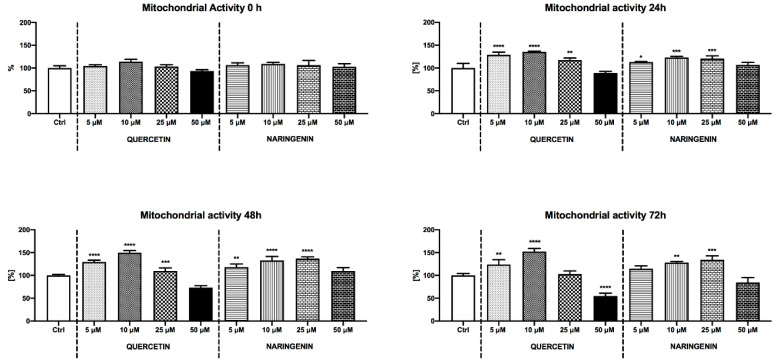
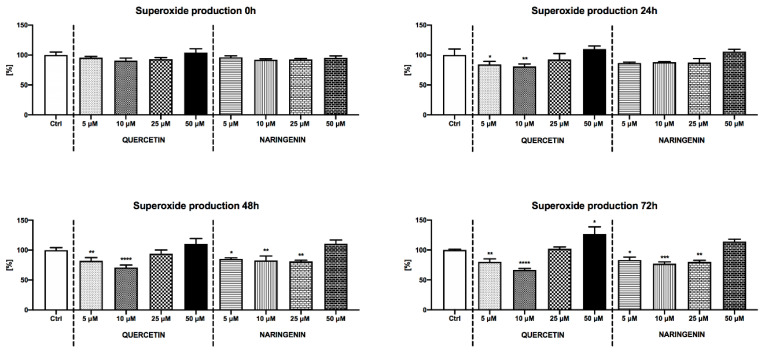
In this study, we evaluated the impact of 5-50 μM quercetin (QUE) and naringenin (NAR) on extended boar spermatozoa in the BTS (Beltsville Thawing Solution) medium for 72 h. Spermatozoa motion, membrane, acrosome, and DNA integrity were investigated immediately after sample dilution (0 h) as well as after 24 h, 48 h, and 72 h of semen storage. Furthermore, reactive oxygen species (ROS) and superoxide production, as well as the extent of oxidative damage to the sperm proteins and lipids, were assessed to determine the potential of QUE and NAR to prevent a potential loss of sperm vitality due to oxidative stress development. Our results indicate that the most notable parameter influenced by QUE was the mitochondrial activity, which remained significantly higher throughout the experiment ( < 0.001 and < 0.0001; 10 μM), and which correlated with the most prominent maintenance of sperm motility ( < 0.01, 48 h; < 0.05, 72 h). A significant membrane stabilization ( < 0.01, 24 h and 48 h; < 0.0001, 72 h) and prevention of lipid peroxidation ( < 0.05, 24 h and 48 h; < 0.01, 72 h) was primarily observed following administration of 10 and 25 μM NAR; respectively. Administration of 10 μM QUE led to a significant decrease of superoxide ( < 0.0001, 48 h and 72 h) while the most notable decline of ROS generation was recorded in the case of 10 and 25 μM NAR ( < 0.001). This study may provide new information on the specific mechanisms of action involved in the favorable effects of natural biomolecules on spermatozoa.
在本研究中,我们评估了5 - 50 μM槲皮素(QUE)和柚皮素(NAR)对保存在BTS(贝尔茨维尔解冻液)培养基中的公猪延长精子活力72小时的影响。在样品稀释后立即(0小时)以及精液保存24小时、48小时和72小时后,对精子运动、膜、顶体和DNA完整性进行了研究。此外,还评估了活性氧(ROS)和超氧化物的产生,以及精子蛋白质和脂质的氧化损伤程度,以确定QUE和NAR预防由于氧化应激发展导致精子活力潜在损失的潜力。我们的结果表明,受QUE影响最显著的参数是线粒体活性,在整个实验过程中该活性显著更高(< 0.001和< 0.0001;10 μM),并且与精子活力的最显著维持相关(< 0.01,48小时;< 0.05,72小时)。主要在分别施用10和25 μM NAR后观察到显著的膜稳定作用(< 0.01,24小时和48小时;< 0.0001,72小时)和脂质过氧化的预防(< 0.05,24小时和48小时;< 0.01,72小时)。施用10 μM QUE导致超氧化物显著减少(< 0.0001,48小时和72小时),而在10和25 μM NAR的情况下记录到ROS产生的最显著下降(< 0.001)。本研究可能为天然生物分子对精子有益作用所涉及的具体作用机制提供新信息。