
内生放线菌制备的银纳米颗粒(Ag-NPs)的杀菌和体外细胞毒性功效及其作为织物涂层的应用
Bactericidal and In-Vitro Cytotoxic Efficacy of Silver Nanoparticles (Ag-NPs) Fabricated by Endophytic Actinomycetes and Their Use as Coating for the Textile Fabrics.
作者信息
Salem Salem S, El-Belely Ehab F, Niedbała Gniewko, Alnoman Maryam M, Hassan Saad El-Din, Eid Ahmed Mohamed, Shaheen Tharwat I, Elkelish Amr, Fouda Amr
机构信息
Department of Botany and Microbiology, Faculty of Science, Al-Azhar University, Nasr City, Cairo 11884, Egypt.
Department of Biosystems Engineering, Faculty of Environmental Engineering and Mechanical Engineering, Poznań University of Life Sciences, Wojska Polskiego 50, 60-627 Poznań, Poland.
出版信息
Nanomaterials (Basel). 2020 Oct 21;10(10):2082. doi: 10.3390/nano10102082.
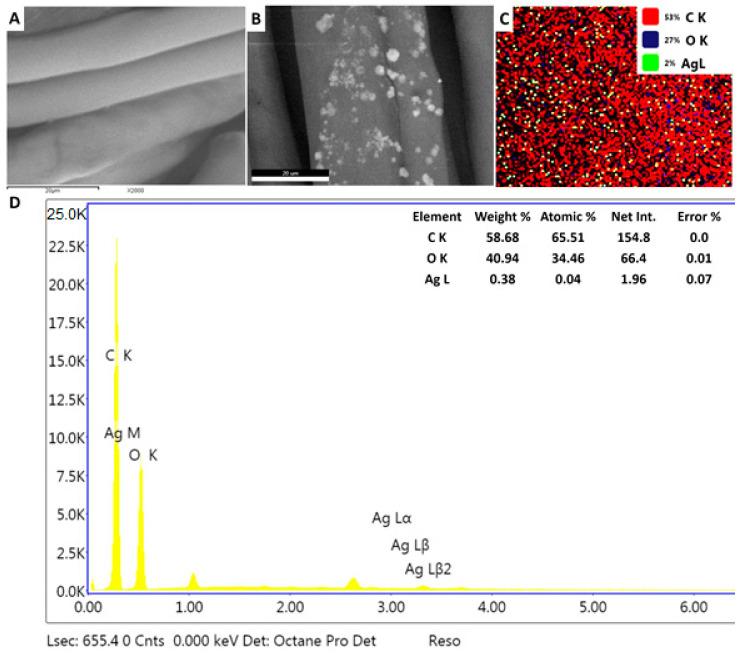
An endophytic strain of L-1 was isolated from healthy medicinal plant leaves of L. and used for the green synthesis of silver nanoparticles (Ag-NPs), through the use of secreted enzymes and proteins. UV-vis spectroscopy, Fourier-transform infrared (FT-IR), transmission electron microscopy (TEM), X-ray diffraction (XRD), and dynamic light scattering (DLS) analyses of the Ag-NPs were carried out. The XRD, TEM, and FT-IR analysis results demonstrated the successful biosynthesis of crystalline, spherical Ag-NPs with a particle size of 13-40 nm. Further, the stability of the Ag-NPs was assessed by detecting the surface Plasmon resonance (SPR) at 415 nm for one month or by measuring the NPs surface charge (-19.2 mV) by zeta potential analysis (ζ). The green-synthesized Ag-NPs exhibited broad-spectrum antibacterial activity at different concentrations (6.25-100 ppm) against the pathogens and with a clear inhibition zone ranging from (9.5 ± 0.4) nm to (21.7 ± 1.0) mm. Furthermore, the green-synthesized Ag-NPs displayed high efficacy against the Caco-2 cancerous cell line (the half maximal inhibitory concentration (IC) = 5.7 ± 0.2 ppm). With respect to antibacterial and in-vitro cytotoxicity analyses, the Ag-NPs concentration of 100 ppm was selected as a safe dose for loading onto cotton fabrics. The scanning electron microscopy connected with energy-dispersive X-ray spectroscopy (SEM-EDX) for the nano-finished fabrics showed the distribution of Ag-NPs as 2% of the total fabric elements. Moreover, the nano-finished fabrics exhibited more activity against pathogenic Gram-positive and Gram-negative bacteria, even after 10 washing cycles, indicating the stability of the treated fabrics.
从健康的L.药用植物叶片中分离出内生菌株L-1,并利用其分泌的酶和蛋白质用于绿色合成银纳米颗粒(Ag-NPs)。对Ag-NPs进行了紫外可见光谱、傅里叶变换红外光谱(FT-IR)、透射电子显微镜(TEM)、X射线衍射(XRD)和动态光散射(DLS)分析。XRD、TEM和FT-IR分析结果表明成功生物合成了粒径为13-40nm的结晶球形Ag-NPs。此外,通过检测415nm处的表面等离子体共振(SPR)持续一个月或通过zeta电位分析(ζ)测量NPs表面电荷(-19.2mV)来评估Ag-NPs的稳定性。绿色合成的Ag-NPs在不同浓度(6.25-100ppm)下对病原体表现出广谱抗菌活性,抑菌圈清晰,范围为(9.5±0.4)nm至(21.7±1.0)mm。此外,绿色合成的Ag-NPs对Caco-2癌细胞系显示出高效性(半数最大抑制浓度(IC)=5.7±0.2ppm)。关于抗菌和体外细胞毒性分析,选择100ppm的Ag-NPs浓度作为负载到棉织物上的安全剂量。与能量色散X射线光谱仪联用的扫描电子显微镜(SEM-EDX)对纳米整理织物的分析表明,Ag-NPs的分布占织物总元素的2%。此外,即使经过10次洗涤循环,纳米整理织物对致病性革兰氏阳性和革兰氏阴性细菌仍表现出更强的活性,表明处理后织物的稳定性。


 Zotero 插件