Abdel-Kareem Marwa M, Ali Maysa M A, Hesham Abd El-Latif, Abdel-Raheam Hossam E F, Obiedallah Marwa
Botany & Microbiology Department, Faculty of Science, Sohag University, Sohag, Egypt.
Botany & Microbiology Department, Faculty of Science, Assuit University, Assuit, Egypt.
BMC Biotechnol. 2025 Jun 11;25(1):46. doi: 10.1186/s12896-025-00982-6.
Regarding their distinct physico-chemical and bioactivity characteristics, silver nanoparticles 'AgNPs' are extensively utilized in numerous scientific purposes.
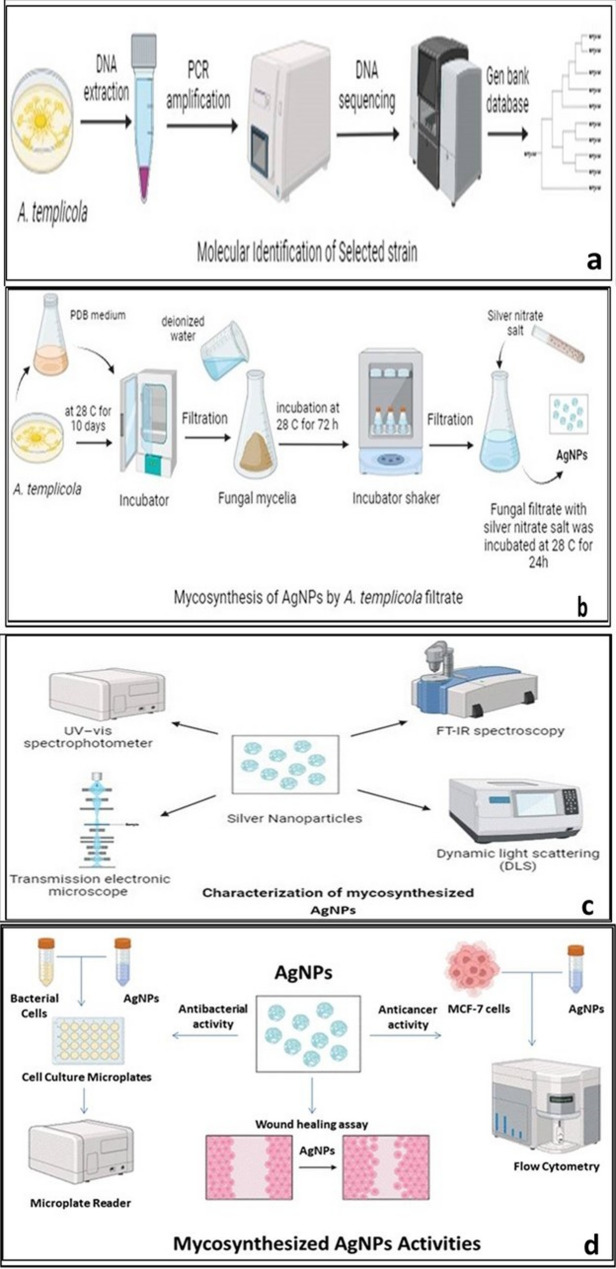
Within this current investigation, for the first time, we evaluated how the extracellular extract of the isolate MAK223 generated exceptionally fixed AgNPs. The isolate was genetically identified as Aspergillus templicola OR480102. The generated AgNPs' physico-chemical characteristics were assessed using ultraviolet-vis spectroscopy, transmission electron microscopy (TEM), and Fourier transform infrared spectrometry (FT-IR). The maximum absorption in the UV-vis spectrum was obtained at 420 nm, matching the silver nanoparticles' surface plasmon absorbance. A. templicola OR480102 produced uniformly dispersed AgNPs between 5 and 25 nm with a mean dimension of 17.78537 ± 1.36 nm using TEM. FT-IR analysis identified functional groups (e.g., -OH, C = O) in the fungal filtrate that mediate AgNP synthesis and capping. To verify AgNPs stability, the dynamic light scattering (DLS) approach is employed. Optimal conditions for AgNPs synthesis were 10 days of incubation, one mM silver nitrate concentration, pH 11, and elevated temperatures. AgNPs demonstrated efficacy against clinically relevant pathogens: S. typhimurium 'ATCC 14028', B. subtilis 'ATCC 6633', S. aureus 'ATCC 25923', and E. coli 'ATCC 29213' were used in the study. Also, using AgNPs derived from the filtrate of A. templicola OR480102 shows significant potential as a novel therapeutic approach against breast cancer cells 'MCF-7'. The scratch assay of 'MCF-7' cells demonstrates the suppressive impact of AgNPs for these cell lines during proliferation by promoting apoptosis and reducing cell migration.
Based on physico-chemical characteristics of AgNPs' and their antimicrobial and anticancer activities, it cleared that the selected strain Aspergillus templicola OR480102 is a promising producer of stable AgNPs' with significant bioactivities which could be applicable in different fields.
鉴于其独特的物理化学和生物活性特征,银纳米颗粒(AgNPs)被广泛应用于众多科学目的。
在本次研究中,我们首次评估了分离株MAK223的细胞外提取物如何生成异常稳定的AgNPs。该分离株经基因鉴定为温特曲霉OR480102。使用紫外可见光谱、透射电子显微镜(TEM)和傅里叶变换红外光谱(FT-IR)对生成的AgNPs的物理化学特征进行了评估。紫外可见光谱中的最大吸收峰出现在420nm处,与银纳米颗粒的表面等离子体吸收相匹配。使用TEM观察发现,温特曲霉OR480102产生的AgNPs均匀分散,粒径在5至25nm之间,平均尺寸为17.78537±1.36nm。FT-IR分析确定了真菌滤液中介导AgNP合成和包覆的官能团(如-OH、C=O)。为验证AgNPs的稳定性,采用了动态光散射(DLS)方法。AgNPs合成的最佳条件为孵育10天、硝酸银浓度为1mM、pH值为11以及升高温度。AgNPs对临床相关病原体具有抗菌活性:研究中使用了鼠伤寒沙门氏菌(ATCC 14028)、枯草芽孢杆菌(ATCC 6633)、金黄色葡萄球菌(ATCC 25923)和大肠杆菌(ATCC 29213)。此外,使用源自温特曲霉OR480102滤液的AgNPs显示出作为一种针对乳腺癌细胞(MCF-7)的新型治疗方法的巨大潜力。对MCF-7细胞进行的划痕试验表明,AgNPs通过促进细胞凋亡和减少细胞迁移,对这些细胞系的增殖具有抑制作用。
基于AgNPs的物理化学特征及其抗菌和抗癌活性,明确所选菌株温特曲霉OR480102是一种有前景的稳定AgNPs生产者,具有显著的生物活性,可应用于不同领域。