• 文献检索
  • 文档翻译
  • 深度研究
  • 学术资讯
  • Suppr Zotero 插件Zotero 插件
  • 邀请有礼
  • 套餐&价格
  • 历史记录
应用&插件
Suppr Zotero 插件Zotero 插件浏览器插件Mac 客户端Windows 客户端微信小程序
定价
高级版会员购买积分包购买API积分包
服务
文献检索文档翻译深度研究API 文档MCP 服务
关于我们
关于 Suppr公司介绍联系我们用户协议隐私条款
关注我们

Suppr 超能文献

核心技术专利:CN118964589B侵权必究
粤ICP备2023148730 号-1Suppr @ 2026

文献检索

告别复杂PubMed语法,用中文像聊天一样搜索,搜遍4000万医学文献。AI智能推荐,让科研检索更轻松。

立即免费搜索

文件翻译

保留排版,准确专业,支持PDF/Word/PPT等文件格式,支持 12+语言互译。

免费翻译文档

深度研究

AI帮你快速写综述,25分钟生成高质量综述,智能提取关键信息,辅助科研写作。

立即免费体验

CoVA:一种用于门诊筛查的敏锐度评分,可预测 2019 冠状病毒病的预后。

CoVA: An Acuity Score for Outpatient Screening that Predicts Coronavirus Disease 2019 Prognosis.

机构信息

Department of Neurology, Massachusetts General Hospital, Boston, Massachusetts, USA.

Harvard Medical School, Boston, Massachusetts, USA.

出版信息

J Infect Dis. 2021 Jan 4;223(1):38-46. doi: 10.1093/infdis/jiaa663.

DOI:10.1093/infdis/jiaa663
PMID:33098643
原文链接:https://pmc.ncbi.nlm.nih.gov/articles/PMC7665643/
Abstract

BACKGROUND

We sought to develop an automatable score to predict hospitalization, critical illness, or death for patients at risk for coronavirus disease 2019 (COVID-19) presenting for urgent care.

METHODS

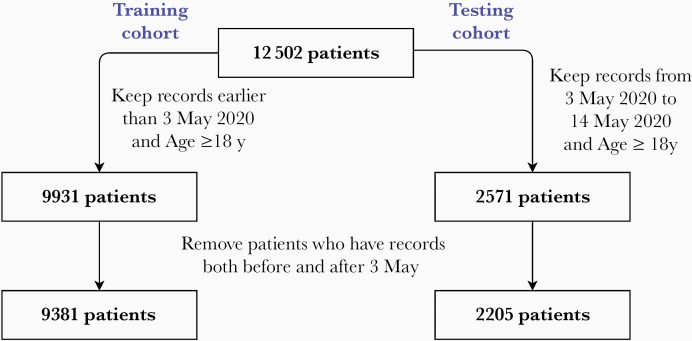
We developed the COVID-19 Acuity Score (CoVA) based on a single-center study of adult outpatients seen in respiratory illness clinics or the emergency department. Data were extracted from the Partners Enterprise Data Warehouse, and split into development (n = 9381, 7 March-2 May) and prospective (n = 2205, 3-14 May) cohorts. Outcomes were hospitalization, critical illness (intensive care unit or ventilation), or death within 7 days. Calibration was assessed using the expected-to-observed event ratio (E/O). Discrimination was assessed by area under the receiver operating curve (AUC).

RESULTS

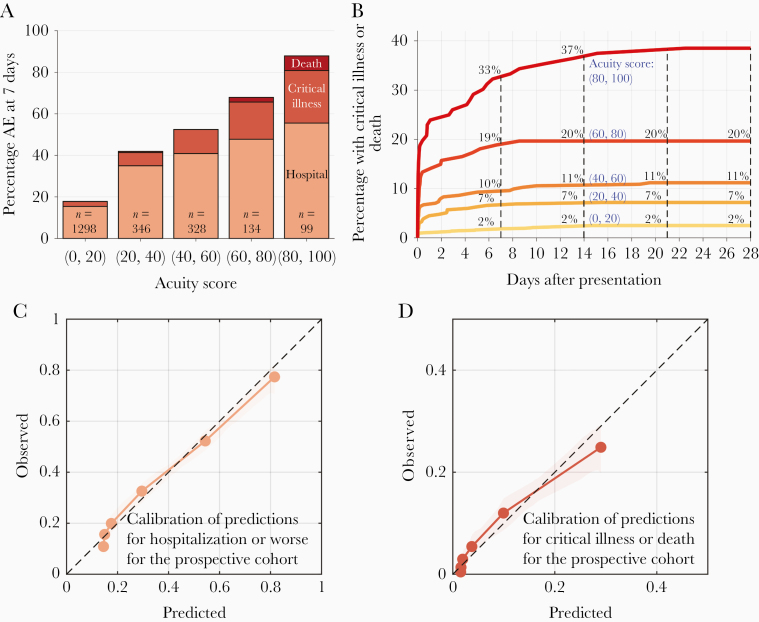
In the prospective cohort, 26.1%, 6.3%, and 0.5% of patients experienced hospitalization, critical illness, or death, respectively. CoVA showed excellent performance in prospective validation for hospitalization (expected-to-observed ratio [E/O]: 1.01; AUC: 0.76), for critical illness (E/O: 1.03; AUC: 0.79), and for death (E/O: 1.63; AUC: 0.93). Among 30 predictors, the top 5 were age, diastolic blood pressure, blood oxygen saturation, COVID-19 testing status, and respiratory rate.

CONCLUSIONS

CoVA is a prospectively validated automatable score for the outpatient setting to predict adverse events related to COVID-19 infection.

摘要

背景

我们旨在开发一种自动化评分系统,以预测因患 2019 冠状病毒病(COVID-19)而有风险的患者在紧急护理就诊时的住院、重症或死亡情况。

方法

我们基于单中心成年门诊患者的研究开发了 COVID-19 严重程度评分(CoVA),这些患者在呼吸疾病诊所或急诊就诊。数据从合作伙伴企业数据仓库中提取,并分为开发(n = 9381,3 月 7 日至 5 月 2 日)和前瞻性(n = 2205,5 月 3 日至 14 日)队列。结局为 7 天内住院、重症(重症监护病房或通气)或死亡。校准通过预期与观察事件比(E/O)评估。通过接受者操作特征曲线下面积(AUC)评估区分度。

结果

在前瞻性队列中,分别有 26.1%、6.3%和 0.5%的患者经历了住院、重症或死亡。CoVA 在前瞻性验证中对住院(E/O:1.01;AUC:0.76)、重症(E/O:1.03;AUC:0.79)和死亡(E/O:1.63;AUC:0.93)具有出色的性能。在 30 个预测因素中,前 5 位是年龄、舒张压、血氧饱和度、COVID-19 检测状态和呼吸频率。

结论

CoVA 是一种针对门诊环境的前瞻性验证的自动化评分系统,可预测与 COVID-19 感染相关的不良事件。
https://cdn.ncbi.nlm.nih.gov/pmc/blobs/3052/7781459/91a843057fe5/jiaa663f0002.jpg
https://cdn.ncbi.nlm.nih.gov/pmc/blobs/3052/7781459/1c5e71c52fa7/jiaa663f0001.jpg
https://cdn.ncbi.nlm.nih.gov/pmc/blobs/3052/7781459/91a843057fe5/jiaa663f0002.jpg
https://cdn.ncbi.nlm.nih.gov/pmc/blobs/3052/7781459/1c5e71c52fa7/jiaa663f0001.jpg
https://cdn.ncbi.nlm.nih.gov/pmc/blobs/3052/7781459/91a843057fe5/jiaa663f0002.jpg

相似文献

1
CoVA: An Acuity Score for Outpatient Screening that Predicts Coronavirus Disease 2019 Prognosis.CoVA:一种用于门诊筛查的敏锐度评分,可预测 2019 冠状病毒病的预后。
J Infect Dis. 2021 Jan 4;223(1):38-46. doi: 10.1093/infdis/jiaa663.
2
COVID-19 Outpatient Screening: a Prediction Score for Adverse Events.2019冠状病毒病门诊筛查:不良事件预测评分
medRxiv. 2020 Jun 22:2020.06.17.20134262. doi: 10.1101/2020.06.17.20134262.
3
Model-based Prediction of Critical Illness in Hospitalized Patients with COVID-19.基于模型的 COVID-19 住院患者危重症预测。
Radiology. 2021 Jan;298(1):E46-E54. doi: 10.1148/radiol.2020202723. Epub 2020 Aug 13.
4
Development and Validation of a Clinical Risk Score to Predict the Occurrence of Critical Illness in Hospitalized Patients With COVID-19.开发和验证一种临床风险评分,以预测 COVID-19 住院患者发生危重症的情况。
JAMA Intern Med. 2020 Aug 1;180(8):1081-1089. doi: 10.1001/jamainternmed.2020.2033.
5
The COVID-19 Worsening Score (COWS)-a predictive bedside tool for critical illness.COVID-19 恶化评分(COWS)——一种用于预测危重症的床边工具。
Echocardiography. 2021 Feb;38(2):207-216. doi: 10.1111/echo.14962. Epub 2021 Jan 24.
6
Prediction of critical illness during out-of-hospital emergency care.院外急救中危重症的预测。
JAMA. 2010 Aug 18;304(7):747-54. doi: 10.1001/jama.2010.1140.
7
Community-acquired pneumonia severity assessment tools in patients hospitalized with COVID-19: a validation and clinical applicability study.COVID-19 住院患者社区获得性肺炎严重程度评估工具:验证和临床适用性研究。
Clin Microbiol Infect. 2021 Jul;27(7):1037.e1-1037.e8. doi: 10.1016/j.cmi.2021.03.002. Epub 2021 Apr 2.
8
Performance of the Obstetric Early Warning Score in critically ill patients for the prediction of maternal death.产科早期预警评分在危重症患者中预测孕产妇死亡的效能
Am J Obstet Gynecol. 2017 Jan;216(1):58.e1-58.e8. doi: 10.1016/j.ajog.2016.09.103. Epub 2016 Oct 15.
9
Machine Learning-Based Prediction of COVID-19 Severity and Progression to Critical Illness Using CT Imaging and Clinical Data.基于机器学习的 CT 影像学与临床数据预测 COVID-19 严重程度及向危重症的进展。
Korean J Radiol. 2021 Jul;22(7):1213-1224. doi: 10.3348/kjr.2020.1104. Epub 2021 Mar 9.
10
Neutrophil-to-lymphocyte ratio predicts critical illness patients with 2019 coronavirus disease in the early stage.中性粒细胞与淋巴细胞比值可预测 2019 冠状病毒病重症患者的早期病情。
J Transl Med. 2020 May 20;18(1):206. doi: 10.1186/s12967-020-02374-0.

引用本文的文献

1
COVID-19 symptom severity and duration among outpatients, July 2021-May 2023: The PROTECT observational study.2021年7月至2023年5月门诊患者中新冠病毒病的症状严重程度和持续时间:PROTECT观察性研究
PLoS One. 2025 Feb 21;20(2):e0314518. doi: 10.1371/journal.pone.0314518. eCollection 2025.
2
Comparative Analysis of Fusion Strategies for Imaging and Non-imaging Data - Use-case of Hospital Discharge Prediction.成像与非成像数据融合策略的对比分析——以医院出院预测为例
AMIA Jt Summits Transl Sci Proc. 2024 May 31;2024:652-661. eCollection 2024.
3
COVID-19: An evaluation of predictive scoring systems in South Africa.

本文引用的文献

1
A fully automatic deep learning system for COVID-19 diagnostic and prognostic analysis.一种用于 COVID-19 诊断和预后分析的全自动深度学习系统。
Eur Respir J. 2020 Aug 6;56(2). doi: 10.1183/13993003.00775-2020. Print 2020 Aug.
2
Obesity and COVID-19 Severity in a Designated Hospital in Shenzhen, China.肥胖与 2019 年冠状病毒病严重程度在深圳市某定点医院的相关性研究
Diabetes Care. 2020 Jul;43(7):1392-1398. doi: 10.2337/dc20-0576. Epub 2020 May 14.
3
Neurological Complications of Coronavirus Disease (COVID-19): Encephalopathy.冠状病毒病(COVID-19)的神经系统并发症:脑病
新型冠状病毒肺炎:南非预测评分系统评估
Heliyon. 2023 Nov 4;9(11):e21733. doi: 10.1016/j.heliyon.2023.e21733. eCollection 2023 Nov.
4
Fusion of imaging and non-imaging data for disease trajectory prediction for coronavirus disease 2019 patients.融合成像和非成像数据以预测2019冠状病毒病患者的疾病轨迹
J Med Imaging (Bellingham). 2023 May;10(3):034004. doi: 10.1117/1.JMI.10.3.034004. Epub 2023 Jun 28.
5
Sample Size Analysis for Machine Learning Clinical Validation Studies.机器学习临床验证研究的样本量分析
Biomedicines. 2023 Feb 23;11(3):685. doi: 10.3390/biomedicines11030685.
6
Development of a Risk Score for AKI onset in COVID-19 Patients: COV-AKI Score.COV-AKI 评分:一种用于预测 COVID-19 患者急性肾损伤发病风险的评分系统的建立。
BMC Nephrol. 2023 Mar 2;24(1):46. doi: 10.1186/s12882-023-03095-4.
7
PEGALUS: predictivity of elderly age, arterial gas analysis, and lung ultrasound. A new prognostic score for COVID-19 patients in the emergency department-an observational prospective study.PEGALUS:老年预测、动脉血气分析和肺部超声。急诊 COVID-19 患者的新预后评分:一项观察性前瞻性研究。
Intern Emerg Med. 2022 Nov;17(8):2357-2365. doi: 10.1007/s11739-022-03047-0. Epub 2022 Jul 27.
8
A Convenient Risk Prediction Score for COVID-19 for Determining Whether or Not Hospitalization Is Recommended: Kanagawa Admission Priority Assessment Score.一种用于 COVID-19 的便捷风险预测评分,用于确定是否推荐住院:神奈川入院优先级评估评分。
Intern Med. 2022 Jul 15;61(14):2135-2141. doi: 10.2169/internalmedicine.9262-21. Epub 2022 May 14.
9
Domain Shifts in Machine Learning Based Covid-19 Diagnosis From Blood Tests.基于血液检测的机器学习新冠病毒诊断中的域转移
J Med Syst. 2022 Mar 29;46(5):23. doi: 10.1007/s10916-022-01807-1.
10
The AIFELL Score as a Predictor of Coronavirus Disease 2019 (COVID-19) Severity and Progression in Hospitalized Patients.AIFELL评分作为住院患者2019冠状病毒病(COVID-19)严重程度和病情进展的预测指标
Diagnostics (Basel). 2022 Feb 27;12(3):604. doi: 10.3390/diagnostics12030604.
Cureus. 2020 Mar 21;12(3):e7352. doi: 10.7759/cureus.7352.
4
Presenting Characteristics, Comorbidities, and Outcomes Among 5700 Patients Hospitalized With COVID-19 in the New York City Area.在纽约市地区,5700 名因 COVID-19 住院的患者的特征、合并症和结局。
JAMA. 2020 May 26;323(20):2052-2059. doi: 10.1001/jama.2020.6775.
5
Temporal dynamics in viral shedding and transmissibility of COVID-19.新冠病毒脱落和传播的时间动态。
Nat Med. 2020 May;26(5):672-675. doi: 10.1038/s41591-020-0869-5. Epub 2020 Apr 15.
6
Neurologic Manifestations of Hospitalized Patients With Coronavirus Disease 2019 in Wuhan, China.中国武汉住院的 2019 年冠状病毒病患者的神经系统表现。
JAMA Neurol. 2020 Jun 1;77(6):683-690. doi: 10.1001/jamaneurol.2020.1127.
7
Nervous system involvement after infection with COVID-19 and other coronaviruses.感染 COVID-19 和其他冠状病毒后的神经系统并发症。
Brain Behav Immun. 2020 Jul;87:18-22. doi: 10.1016/j.bbi.2020.03.031. Epub 2020 Mar 30.
8
Severe Outcomes Among Patients with Coronavirus Disease 2019 (COVID-19) - United States, February 12-March 16, 2020.2020 年 2 月 12 日至 3 月 16 日,美国 2019 冠状病毒病(COVID-19)患者的严重结局。
MMWR Morb Mortal Wkly Rep. 2020 Mar 27;69(12):343-346. doi: 10.15585/mmwr.mm6912e2.
9
Association of radiologic findings with mortality of patients infected with 2019 novel coronavirus in Wuhan, China.中国武汉 2019 年新型冠状病毒感染患者的放射学表现与死亡率的相关性研究。
PLoS One. 2020 Mar 19;15(3):e0230548. doi: 10.1371/journal.pone.0230548. eCollection 2020.
10
Host susceptibility to severe COVID-19 and establishment of a host risk score: findings of 487 cases outside Wuhan.宿主对重症新型冠状病毒肺炎的易感性及宿主风险评分的建立:武汉以外地区487例病例的研究结果
Crit Care. 2020 Mar 18;24(1):108. doi: 10.1186/s13054-020-2833-7.