Joseph Sahayarayan Jesudass, Udayakumar Rajangam, Arun Muthukrishnan, Ganapathi Andy, Alwahibi Mona S, Aldosari Norah Salim, Morgan Abubaker M A
Department of Bioinformatics, Alagappa University, Karaikudi, Tamil Nadu, India.
Department of Biochemistry, Government Arts College (Autonomous), Kumbakonam, Tamil Nadu, India.
Saudi J Biol Sci. 2020 Nov;27(11):2972-2979. doi: 10.1016/j.sjbs.2020.08.050. Epub 2020 Sep 6.
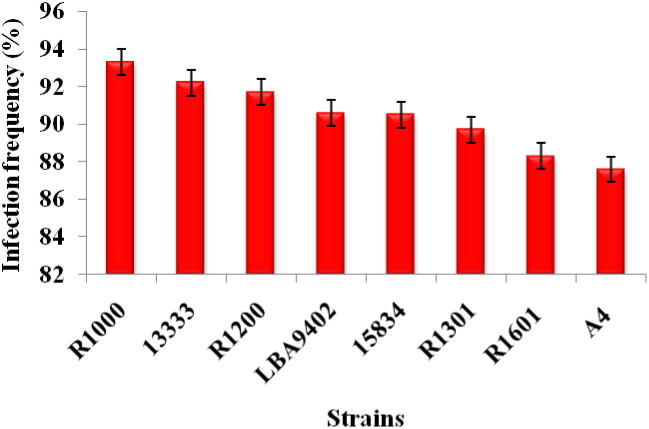
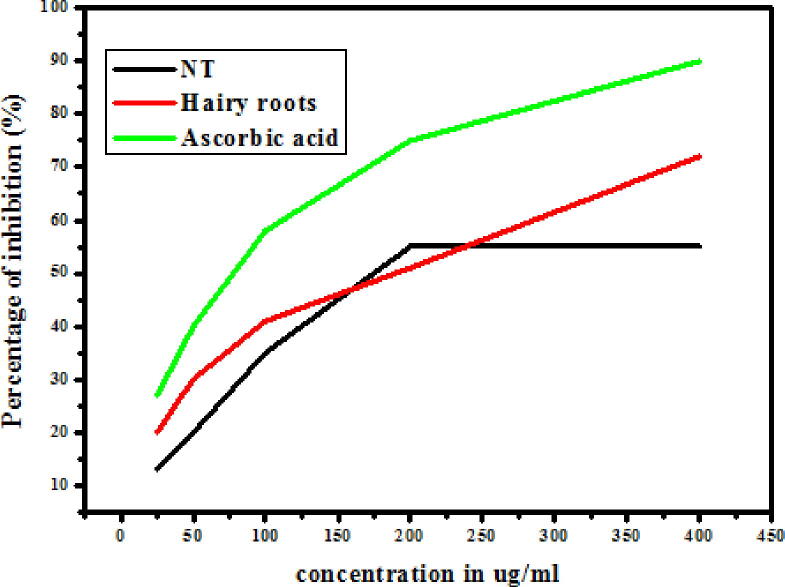
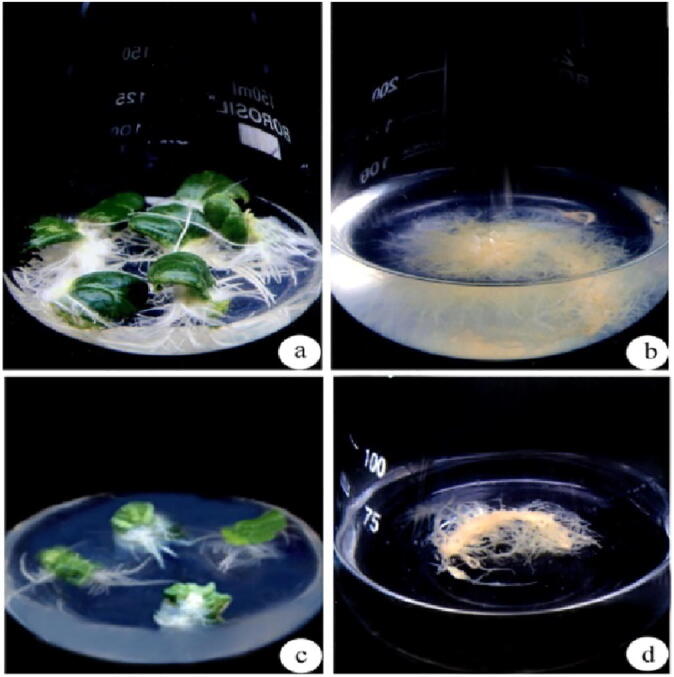
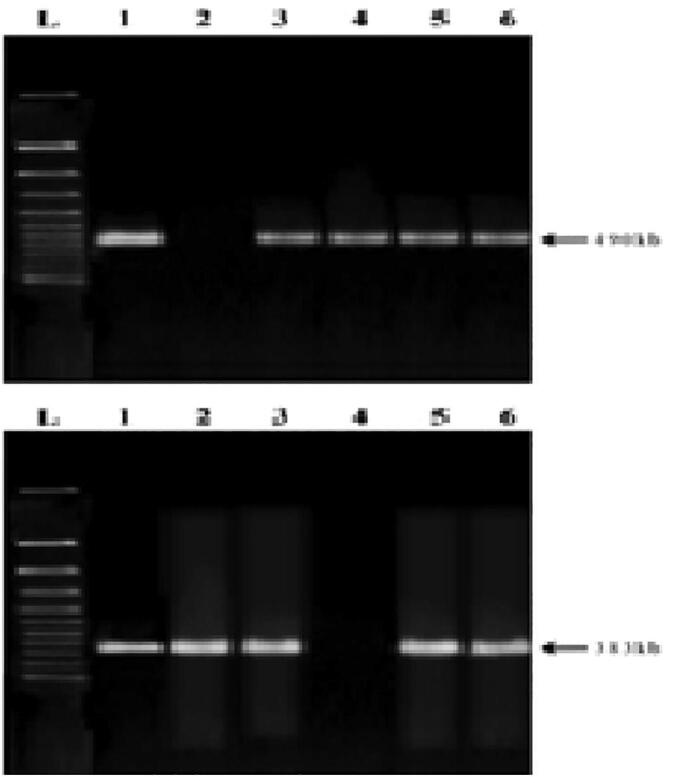
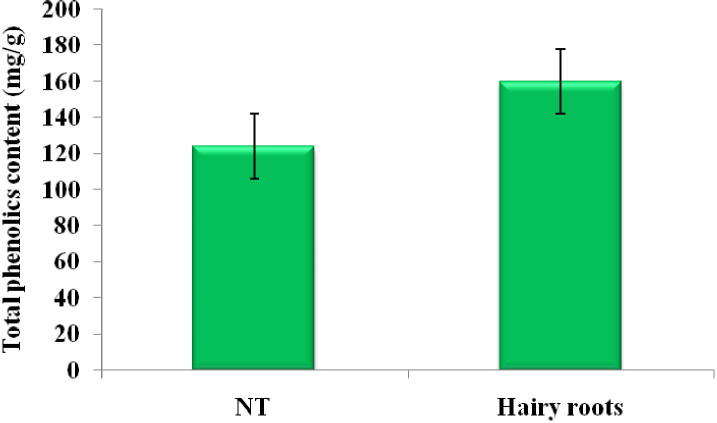
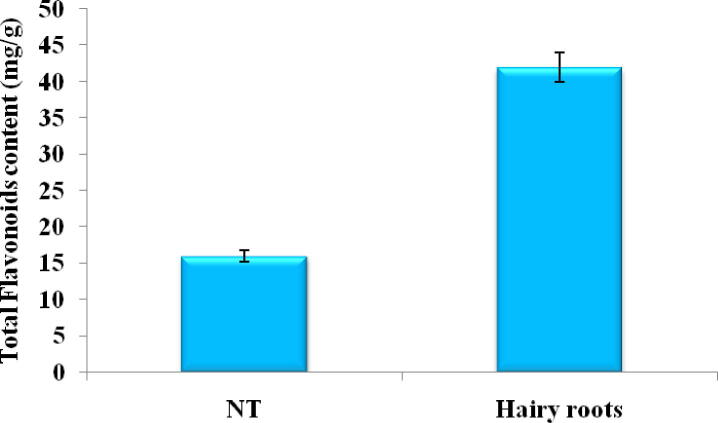
The present study aimed to investigate the effect of different on the induction of hairy root of and determine its total phenolic, flavonoids contents, antibacterial and antioxidant activity. In this investigation strains such as, 15834, 13333, A4, R1200, R1000, LBA9402, R1301 and R1601 are all investigated, were developing hairy root conception in cotyledon and leaf tissue explants. Polymerase chain response (PCR) and the converse transcription-PCR are transgenic clones of hairy roots has been utilized A and B particular primers. In the middle of the different attention of better regulators the extreme transformation frequency was achieved in (IBA + NAA) cotyledon explant. Transgenic hairy roots increase in MS liquid medium added to with IBA + NAA (2.46 + 1.07) displayed the maximum accumulation of biomass 0.68 g/l dry weight (DW) and 6.52 ± 0.49 g/l fresh weight (FW) were obtained at the 21 days of cotyledon explant. The flavonoid and total phenolic contents were estimated using aluminium chloride method and Folin-Ciocalteu method. The amount of phenolic compounds in L non transformed root (124.46 ± 6.13 mg GA/g) was lower than that in the methanol extracts of L. hairy roots (160.38 ± 5.0 mg GA/g), being was L non transformed root lower (42.93 ± 1.58 mg rutin/g) than that in the concentration of total flavonoids in L. hairy root (16.26 ± 1.84 mg rutin/g). Additionally, transgenic hairy roots professionally produced various phenolic and flavonoid composites. The total antimicrobial activity, phenolics, flavonoids content and antioxidant were more in the hairy roots related to non-transformed roots. In our discovery, the R1000 is promising candidate for hairy root initiation of from cotyledone explants were realized large number of hairy roots compared with leaf explants. The antioxidant potential of methanol extracts of flavonoid and phenolic compounds from the hairy roots have great potential to treat various diseases.
本研究旨在探究不同因素对诱导[植物名称]毛状根的影响,并测定其总酚、黄酮含量、抗菌和抗氧化活性。在本研究中,对诸如15834、13333、A4、R1200、R1000、LBA9402、R1301和R1601等菌株进行了研究,这些菌株在子叶和叶片组织外植体中诱导毛状根形成。利用聚合酶链反应(PCR)和逆转录PCR以及A和B特异性引物对毛状根的转基因克隆进行了鉴定。在不同浓度的较好调节剂中,(IBA + NAA)处理的子叶外植体获得了最高的转化频率。添加IBA + NAA(2.46 + 1.07)的MS液体培养基中,转基因毛状根生物量积累最大,在子叶外植体培养21天时,干重达到0.68 g/l,鲜重达到6.52 ± 0.4 g/l。采用氯化铝法和福林 - 酚法测定黄酮和总酚含量。[植物名称]L非转化根中酚类化合物含量(124.46 ± 6.13 mg GA/g)低于毛状根甲醇提取物中的含量(160.38 ± 5.0 mg GA/g),L非转化根中总黄酮浓度(42.93 ± 1.58 mg芦丁/g)低于毛状根中的浓度(16.26 ± 1.84 mg芦丁/g)。此外,转基因毛状根能专业合成各种酚类和黄酮类化合物。与非转化根相比,毛状根中的总抗菌活性、酚类、黄酮类含量和抗氧化能力更高。在我们的研究中,R1000是从子叶外植体诱导[植物名称]毛状根的有潜力的候选菌株,与叶片外植体相比,能产生大量毛状根。毛状根中黄酮类和酚类化合物甲醇提取物的抗氧化潜力在治疗各种疾病方面具有巨大潜力。