Pratama Prawira Yudha, Nurmandi Achmad
Department of Government Affairs and Administration, Universitas Muhammadiyah Yogyakarta, Yogyakarta, Indonesia.
Jamba. 2020 Sep 15;12(1):927. doi: 10.4102/jamba.v12i1.927. eCollection 2020.
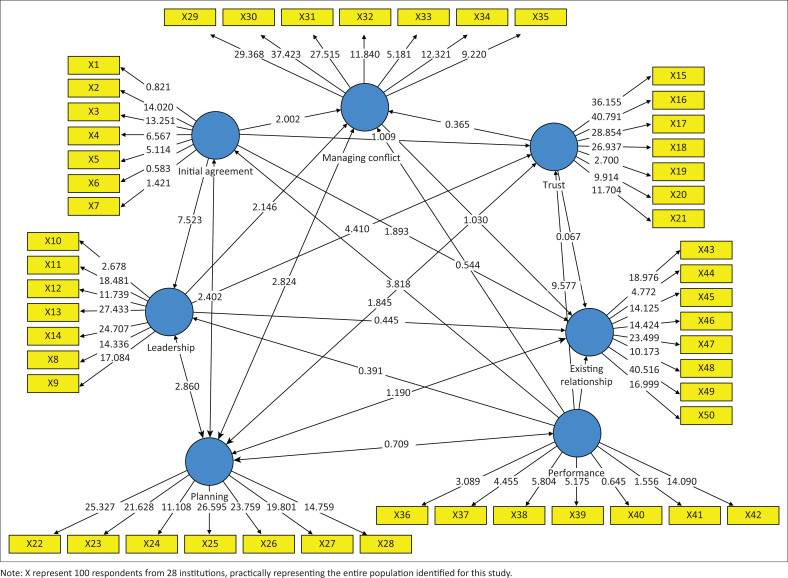
Collaborative governance and social capital can help to form a resilient community in the wake of a disaster, such as the eruptions of Mount Merapi in Indonesia. This study examines the successfulness of the handling of disasters in Indonesia, with particular focus on eruptions of Mount Merapi. Disasters foster a close relationship between the government and the community in response to the emergency. This study uses a mixed method to analyse social networks in evaluating the structure of disaster networks in Indonesia and their implications for disaster management. Data were collected via a survey of 100 respondents from 28 institutions representing, for practical purposes, each population identified by each institution (government, non-governmental organisations and volunteers) that participated in handling the Merapi eruption disaster. The findings revealed that considerable miscommunication between institutions reduced the effectiveness of disaster management so that close discussion about conflict resolution was needed to develop more mature and systematic planning. Inter-agency trust is also felt to be necessary in disaster management. Trust between agency members and other institutions strongly supports the success of systematic disaster management. Meanwhile, every institution must foster open leadership by giving individuals with precise knowledge of the situation and the condition of the disaster area a mandate to lead directly in the field. Disaster governance is carried out through the agreement of each institution formed in the Disaster Emergency Planning (Rencana Penanggulangan Kedaruratan Bencana - RPKB) guidelines. These guidelines expect the Government and the community to coordinate with each other in a structured and systematic manner in the process of disaster management.
协同治理和社会资本有助于在灾难发生后形成一个有复原力的社区,比如印度尼西亚默拉皮火山的喷发。本研究考察了印度尼西亚灾害应对的成效,特别关注默拉皮火山的喷发。灾害促使政府与社区在应对紧急情况时建立密切关系。本研究采用混合方法分析社会网络,以评估印度尼西亚灾害网络的结构及其对灾害管理的影响。通过对来自28个机构的100名受访者进行调查收集数据,出于实际目的,这些机构代表了参与默拉皮火山喷发灾害应对工作的每一类人群(政府、非政府组织和志愿者)。研究结果显示,机构之间存在大量沟通不畅的情况,降低了灾害管理的有效性,因此需要就冲突解决进行深入讨论,以制定更成熟、系统的规划。机构间信任在灾害管理中也被认为是必要的。机构成员与其他机构之间的信任有力地支持了系统性灾害管理的成功。同时,每个机构都必须通过赋予对灾区情况和状况有准确了解的个人在实地直接领导的权力,来培养开放型领导。灾害治理是通过按照《灾害应急计划》(Rencana Penanggulangan Kedaruratan Bencana - RPKB)指南组建的每个机构达成的协议来实施的。这些指南期望政府和社区在灾害管理过程中以结构化、系统化的方式相互协调。