Medvedeva Vera P, Pierani Alessandra
Imagine Institute of Genetic Diseases, Université de Paris, Paris, France.
Institute of Psychiatry and Neuroscience of Paris, INSERM U1266, Université de Paris, Paris, France.
Front Cell Dev Biol. 2020 Sep 24;8:580657. doi: 10.3389/fcell.2020.580657. eCollection 2020.
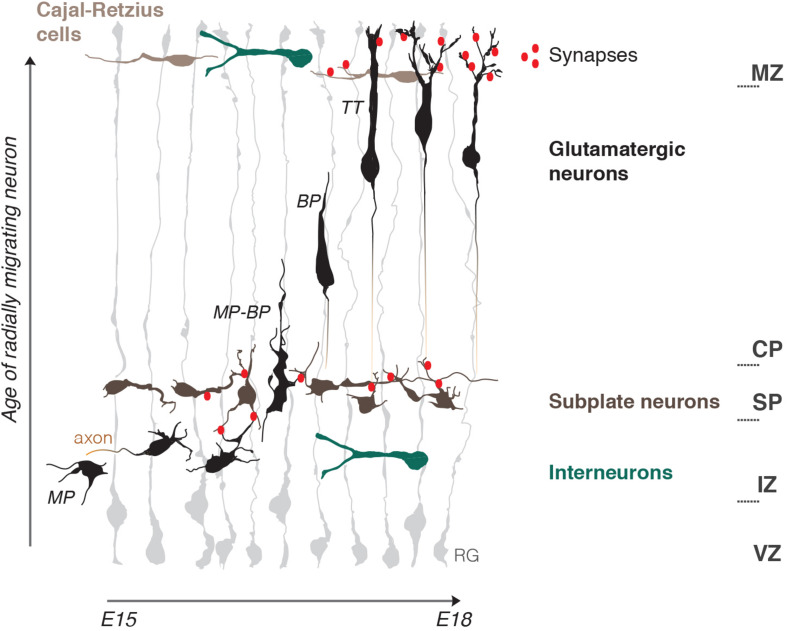
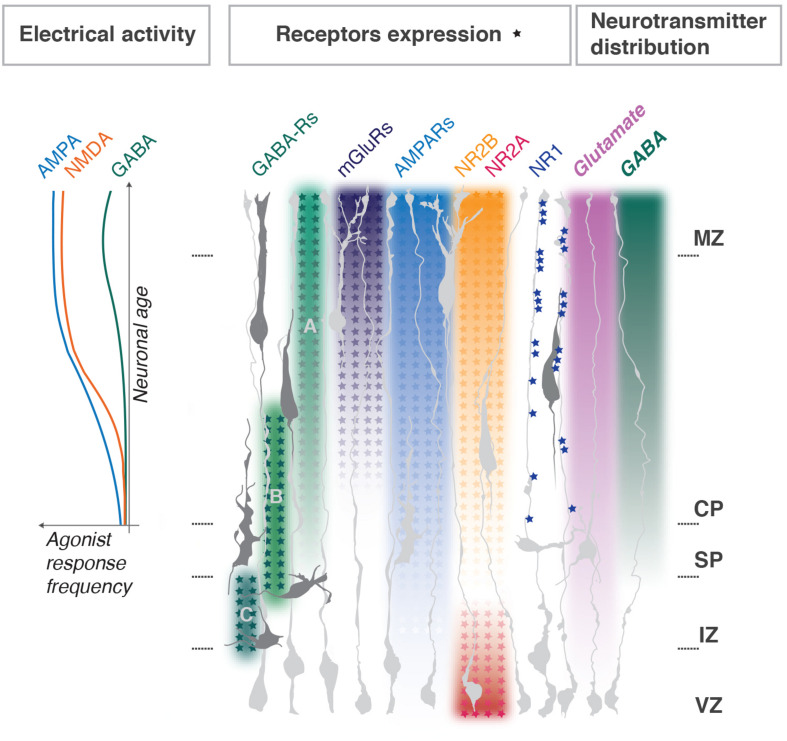
During development the vast majority of cells that will later compose the mature cerebral cortex undergo extensive migration to reach their final position. In addition to intrinsically distinct migratory behaviors, cells encounter and respond to vastly different microenvironments. These range from axonal tracts to cell-dense matrices, electrically active regions and extracellular matrix components, which may all change overtime. Furthermore, migrating neurons themselves not only adapt to their microenvironment but also modify the local niche through cell-cell contacts, secreted factors and ions. In the radial dimension, the developing cortex is roughly divided into dense progenitor and cortical plate territories, and a less crowded intermediate zone. The cortical plate is bordered by the subplate and the marginal zone, which are populated by neurons with high electrical activity and characterized by sophisticated neuritic ramifications. Neuronal migration is influenced by these boundaries resulting in dramatic changes in migratory behaviors as well as morphology and electrical activity. Modifications in the levels of any of these parameters can lead to alterations and even arrest of migration. Recent work indicates that morphology and electrical activity of migrating neuron are interconnected and the aim of this review is to explore the extent of this connection. We will discuss on one hand how the response of migrating neurons is altered upon modification of their intrinsic electrical properties and whether, on the other hand, the electrical properties of the cellular environment can modify the morphology and electrical activity of migrating cortical neurons.
在发育过程中,绝大多数后来构成成熟大脑皮层的细胞会经历广泛迁移以到达其最终位置。除了本质上不同的迁移行为外,细胞还会遇到并对截然不同的微环境做出反应。这些微环境包括轴突束、细胞密集基质、电活性区域和细胞外基质成分,它们可能都会随时间变化。此外,迁移的神经元自身不仅会适应其微环境,还会通过细胞间接触、分泌因子和离子来改变局部微环境。在径向维度上,发育中的皮层大致分为致密的祖细胞区和皮层板区,以及一个不太拥挤的中间区。皮层板以亚板层和边缘区为界,这些区域有高电活性的神经元,其特征是具有复杂的神经分支。神经元迁移受这些边界的影响,导致迁移行为以及形态和电活动发生显著变化。这些参数中任何一个水平的改变都可能导致迁移改变甚至停滞。最近的研究表明,迁移神经元的形态和电活动是相互关联的,本综述的目的是探讨这种关联的程度。一方面,我们将讨论迁移神经元的内在电特性发生改变时其反应如何变化,另一方面,细胞环境的电特性是否能改变迁移皮层神经元的形态和电活动。