Istituto Zooprofilattico Sperimentale del Lazio e della Toscana 'M. Aleandri', Via Appia Nuova, Rome, Italy.
Local Health Authority 6, Borgo Garibaldi, Albano Laziale, Italy.
J Med Entomol. 2021 Mar 12;58(2):847-856. doi: 10.1093/jme/tjaa222.
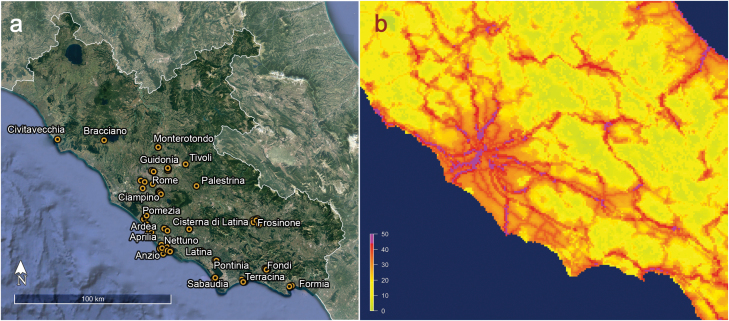
The Asian tiger mosquito Aedes albopictus (Skuse 1894) is assuming an ever-increasing importance as invasive species in Europe and consequently as human health and nuisance concern. In Central Italy, the species has been recently involved in a chikungunya outbreak. A 3 yr Ae. albopictus monitoring was carried out in 21 municipalities of the Lazio region (Central Italy), belonging to three provinces. Samplings were performed on a weekly basis using ovitraps, in order to investigate climatic and spatial variables driving egg abundance and Ae. albopictus period of activity. A temperature of 10.4°C was indicated as lower threshold for the onset of egg-laying activity, together with a photoperiod of 13:11 (L:D) h. The whole oviposition activity lasted 8 mo (May-December), with 95% of eggs laid between early June and mid-November and a peak at the end of August. Egg abundance was positively influenced by accumulated temperature (AT) of the 4 wk preceding sampling and negatively by precipitation during the week before. Egg-laying activity dropped with decreasing AT, increasing rainfall, and with a photoperiod below 10:14 (L:D) h. Our results pinpointed the importance of fine-scaled spatial features on egg abundance. Some of these fine-scaled characteristics have been highlighted, such as the presence of vegetation and human footprint index. Our model estimated an almost doubled maximum number of laid eggs for the maximum value of human footprint. Compelling evidence of the relevance of fine-scaled characteristics was reported, describing cases where human-made breeding sites driven the abundance of Ae. albopictus.
亚洲虎蚊(Aedes albopictus)(Skuse 1894)作为入侵物种在欧洲的重要性日益增加,因此对人类健康和滋扰问题构成了关注。在意大利中部,该物种最近与基孔肯雅热疫情有关。在意大利中部的拉齐奥地区的 21 个城市中,对 Aedes albopictus 进行了为期 3 年的监测,这些城市分属于三个省份。每周使用诱卵器进行采样,以调查导致卵丰度和 Aedes albopictus 活动期的气候和空间变量。10.4°C 的温度被认为是产卵活动开始的下限,同时光照周期为 13:11(L:D)小时。整个产卵活动持续了 8 个月(5 月至 12 月),95%的卵产在 6 月初至 11 月中旬之间,高峰期在 8 月底。卵丰度与采样前 4 周的累积温度(AT)呈正相关,与采样前一周的降水呈负相关。随着 AT 的降低、降雨量的增加以及光照周期低于 10:14(L:D)小时,产卵活动减少。我们的研究结果指出了精细空间特征对卵丰度的重要性。突出了一些精细空间特征,如植被和人类足迹指数的存在。我们的模型估计,在最大的人类足迹值下,产卵的最大数量几乎增加了一倍。报告了与精细空间特征相关的有力证据,描述了人为繁殖地驱动 Aedes albopictus 丰度的情况。