Istituto Zooprofilattico Sperimentale del Lazio e Della Toscana 'M. Aleandri', Via Appia Nuova 1411, 00178, Rome, Italy.
Parasit Vectors. 2022 Mar 18;15(1):92. doi: 10.1186/s13071-022-05215-9.
The Asian tiger mosquito Aedes albopictus (Skuse 1894), which is native to Southeast Asia, is among the top 100 invasive species worldwide and one of the most troubling vector species. It has become established in more than 20 European countries. Since its arrival in Italy in the 1990s, the species has colonized all the regions of the country, up to an altitude of 600 m. Nevertheless, no thorough investigation has ever been performed to confirm or extend its elevation limit (EL) in Italy.
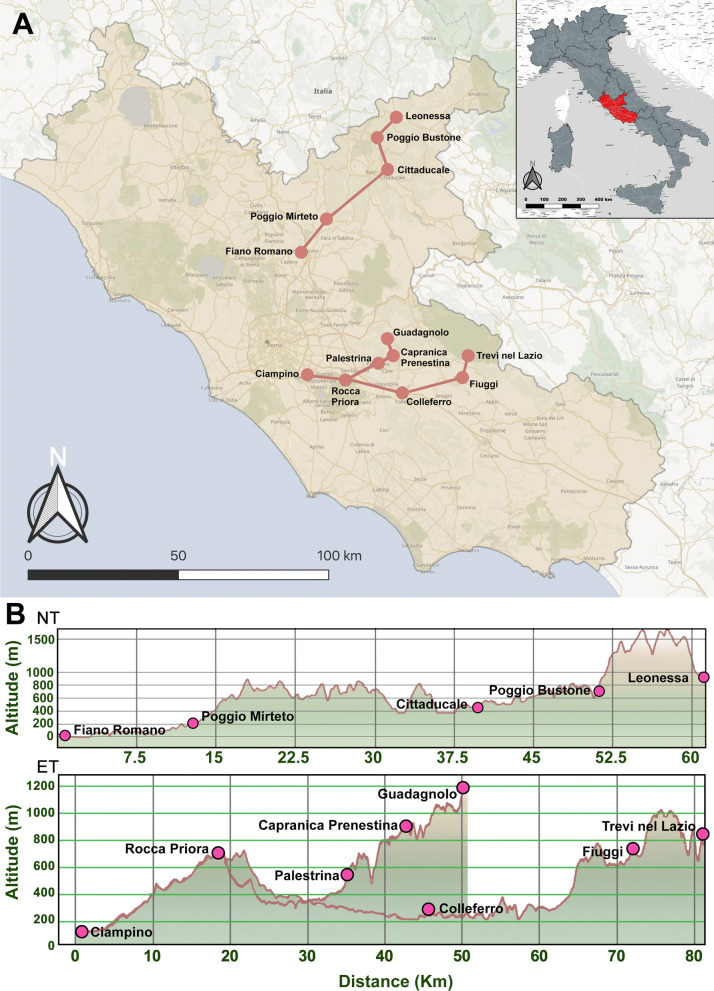
To define the EL of Ae. albopictus and analyse its phenology along an altitudinal gradient, we carried out an investigation by means of ovitraps placed in Lazio region, central Italy. Sampling was performed on a weekly basis in 13 villages within five 200-m altitudinal ranges [0-1000 m above sea level (asl)], with the addition of higher localities to the species range whenever the species was recorded in the highest range.
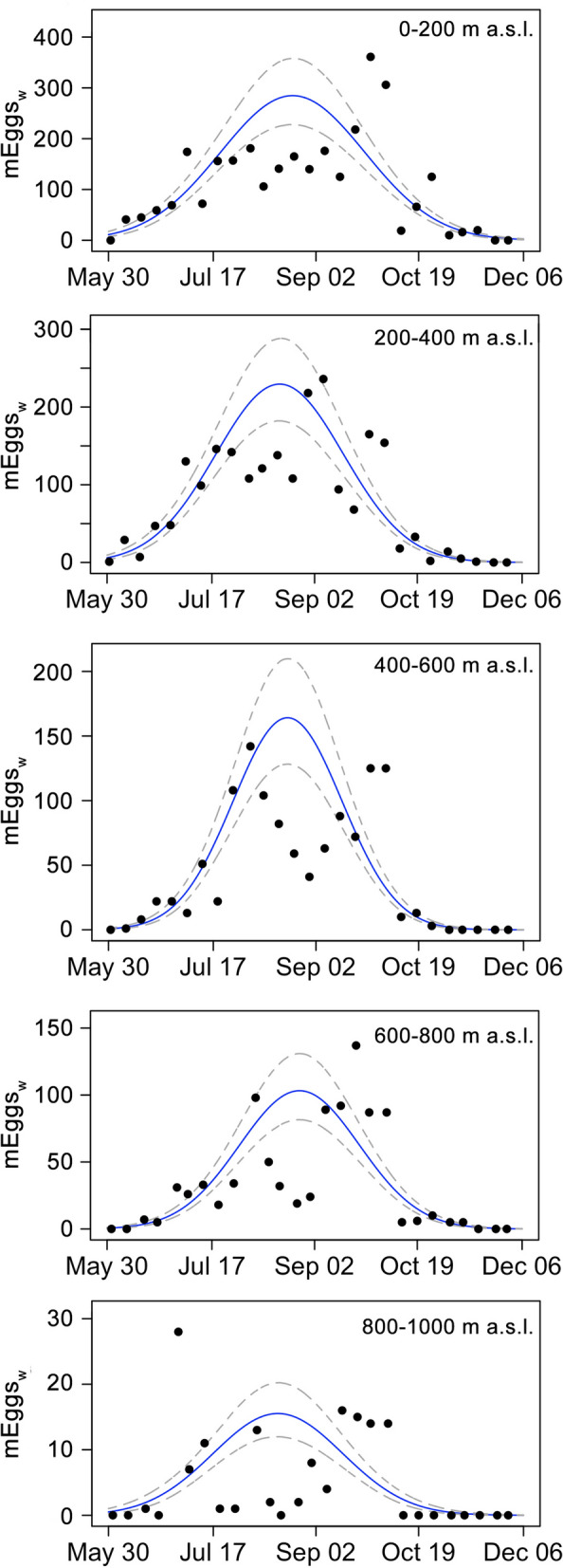
Aedes albopictus has colonized sites well beyond its known EL, with established populations at 900 m asl and positive ovitraps recorded at 1193 m asl. The relationship between egg abundance and elevation was described by an exponential decay regression, which predicted an EL for oviposition at 1015 m asl. In the active season, egg-laying started earlier at low altitude and ended earlier within the highest altitudinal range. Aedes albopictus abundance and activity period (number of days active) decreased, respectively, by 95% and 34% from the lowest to the highest altitudinal range.
Using data from the present study, the altitudinal limit of Ae. albopictus in central Italy was updated from 600 to 900 m asl. In addition, established populations were predicted to exist up to 1015 m asl. Considering that up to 99.5% of Lazio region's inhabitants could potentially be affected by Aedes-borne virus outbreaks, the surveillance area for Ae. albopictus should be expanded accordingly. However, our results also indicate that Ae. albopictus surveillance programs need to be revised in order to harmonize the resources earmarked for these with the altitudinal changes in the phenology of this species.
亚洲虎蚊(Aedes albopictus)原产于东南亚,是全球 100 种入侵物种之一,也是最令人头疼的病媒物种之一。该物种已在 20 多个欧洲国家立足。自 20 世纪 90 年代传入意大利以来,该物种已遍布全国所有地区,海拔高度可达 600 米。然而,意大利从未进行过全面调查以确认或扩大其海拔极限(EL)。
为了确定亚洲虎蚊的 EL,并分析其在海拔梯度上的物候,我们在意大利拉齐奥地区使用诱卵器进行了调查。每周在海拔 0-1000 米的 13 个村庄进行采样,在物种分布范围内的较高地区,每当在最高海拔范围内记录到该物种时,都会增加更高的地点。
亚洲虎蚊已在其已知的 EL 以外的地方建立了种群,在海拔 900 米处有固定的种群,在海拔 1193 米处有阳性诱卵器记录。卵的丰度与海拔的关系用指数衰减回归来描述,该回归预测了在海拔 1015 米处产卵的 EL。在活跃季节,低海拔地区的产卵开始得更早,而在最高海拔范围内结束得更早。亚洲虎蚊的丰度和活动期(活跃天数)分别从最低海拔范围减少到最高海拔范围减少了 95%和 34%。
使用本研究的数据,更新了意大利中部亚洲虎蚊的海拔极限,从 600 米到 900 米。此外,预测在海拔 1015 米处存在已建立的种群。考虑到拉齐奥地区 99.5%的居民可能会受到蚊媒病毒爆发的影响,因此应相应扩大对亚洲虎蚊的监测范围。然而,我们的研究结果还表明,需要修改亚洲虎蚊监测计划,以使其与该物种物候学的海拔变化相协调。