Lanzhou Institute of Husbandry and Pharmaceutical Sciences of the Chinese Academy of Agricultural Sciences, Jiangouyan Street, Lanzhou, China.
Sheep Breeding Engineering Technology Research Center of Chinese Academy of Agricultural Sciences, Jiangouyan Street, Lanzhou, China.
Sci Rep. 2020 Oct 27;10(1):18332. doi: 10.1038/s41598-020-75428-4.
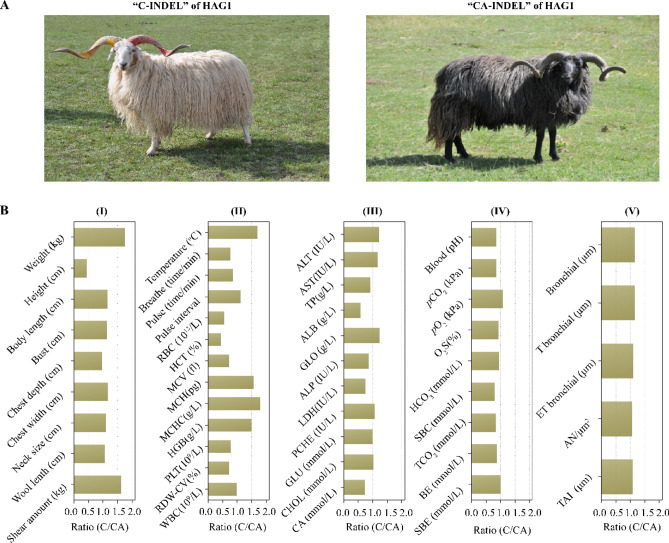
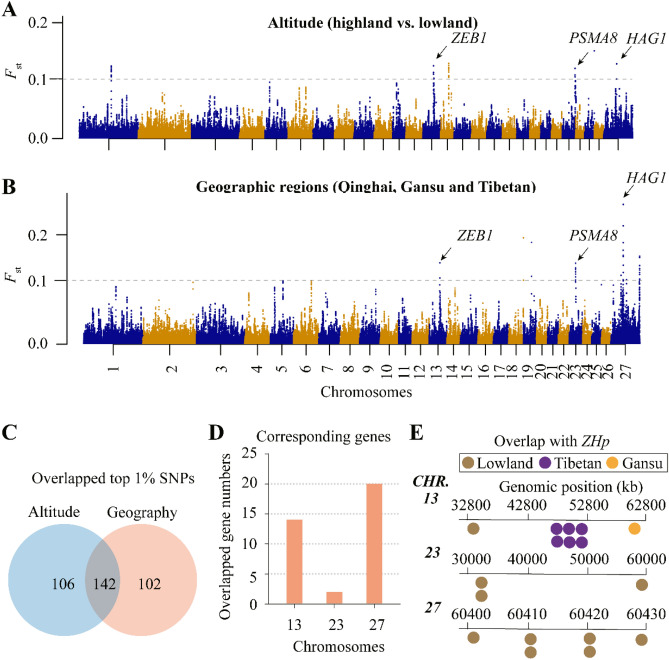
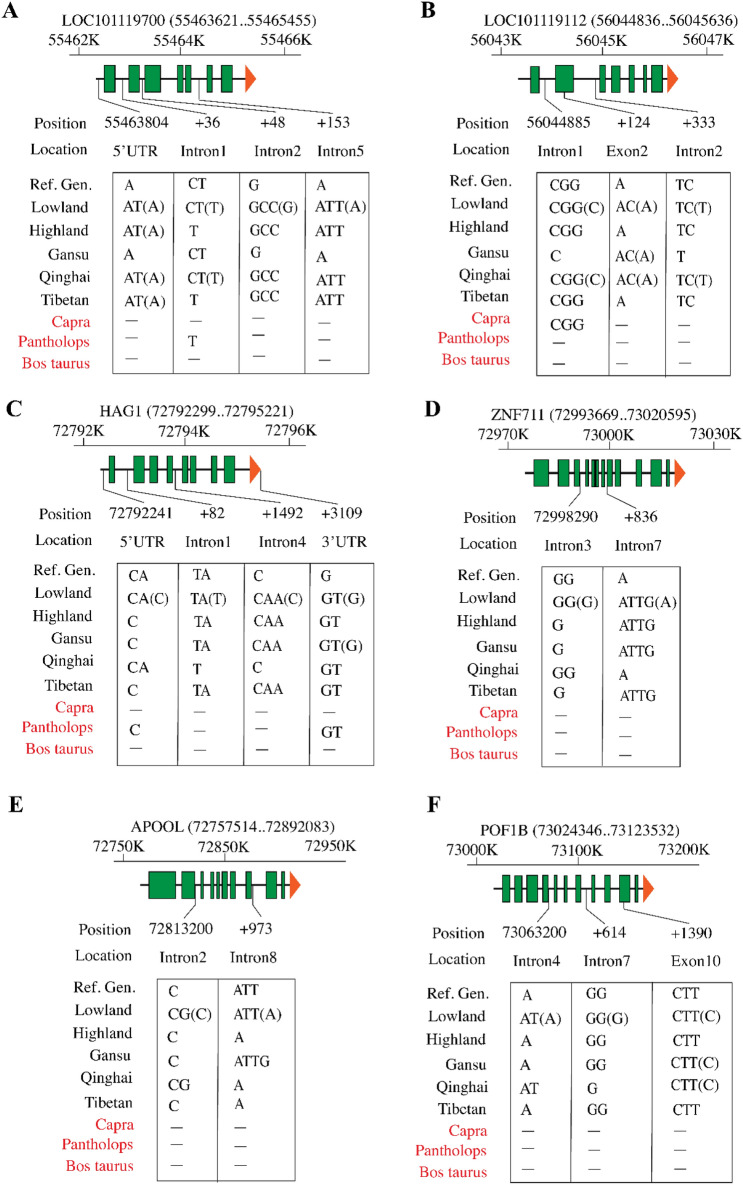
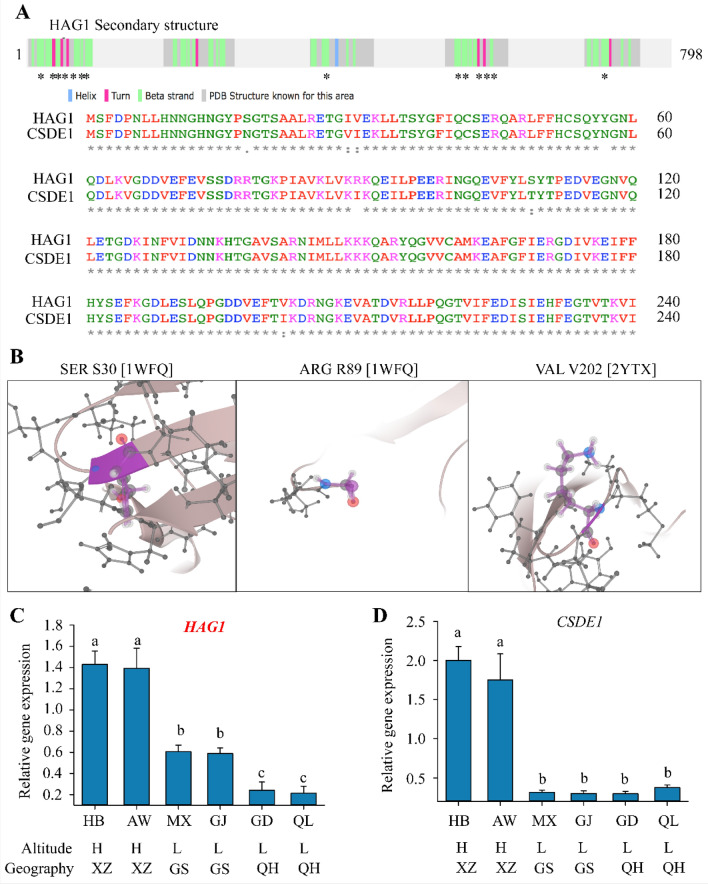
Most sheep breeding programs designed for the tropics and sub-tropics have to take into account the impacts of environmental adaptive traits. However, the genetic mechanism regulating the multiple biological processes driving adaptive responses remains unclear. In this study, we applied a selective sweep analysis by combing 1% top values of F and ZHp on both altitude and geographic subpopulations (APS) in 636 indigenous Tibetan sheep breeds. Results show that 37 genes were identified within overlapped genomic regions regarding F significantly associated with APS. Out of the 37 genes, we found that 8, 3 and 6 genes at chromosomes (chr.) 13, 23 and 27, respectively, were identified in the genomic regions with 1% top values of ZHp. We further analyzed the INDEL variation of 6 genes at chr.27 (X chromosome) in APS together with corresponding orthologs of 6 genes in Capra, Pantholops, and Bos Taurus. We found that an INDEL was located within 5'UTR region of HAG1 gene. This INDEL of HAG1 was strongly associated with the variation of APS, which was further confirmed by qPCR. Sheep breeds carrying "C-INDEL" of HAG1 have significantly greater body weight, shear amount, corpuscular hemoglobin and globulin levels, but lower body height, than those carrying "CA-INDEL" of HAG1. We concluded that "C-INDEL" variation of HAG1 gene confers better hypoxia tolerance in the highlands of Tibetan and explains well geographic distributions in this population. These results contribute to our understanding of adaptive responses to altitude and geographic adaptation in Tibetan sheep populations and will help to guide future conservation programs for Tibetan sheep native to Qinghai-Tibetan Plateau.
大多数为热带和亚热带设计的绵羊养殖计划都必须考虑环境适应特征的影响。然而,调节驱动适应反应的多个生物学过程的遗传机制仍不清楚。在这项研究中,我们通过结合海拔和地理亚种群(APS)的 F 和 ZHp 的 1%最高值,应用了选择清除分析,对 636 个本地藏绵羊品种进行了分析。结果表明,在与 APS 显著相关的 F 上,有 37 个基因在重叠的基因组区域中被鉴定出来。在这 37 个基因中,我们发现,在 ZHp 的 1%最高值的基因组区域中,分别在染色体(chr.)13、23 和 27 上鉴定出 8、3 和 6 个基因。我们进一步分析了 APS 中 chr.27(X 染色体)上的 6 个基因的 INDEL 变异以及 Capra、Pantholops 和 Bos Taurus 中的 6 个基因的对应同源物。我们发现,一个 INDEL 位于 HAG1 基因的 5'UTR 区域内。HAG1 基因的这种 INDEL 与 APS 的变异强烈相关,这通过 qPCR 进一步得到了证实。携带 HAG1 的“C-INDEL”的绵羊品种的体重、剪毛量、颗粒血红蛋白和球蛋白水平显著较高,但身高较低,而携带 HAG1 的“CA-INDEL”的绵羊品种则相反。我们得出结论,HAG1 基因的“C-INDEL”变异赋予了藏绵羊在青藏高原高海拔地区更好的耐缺氧能力,并很好地解释了该种群的地理分布。这些结果有助于我们了解藏绵羊对海拔和地理适应的适应反应,并将有助于指导未来对青藏高原特有藏绵羊的保护计划。