Zhang Chi, Zhang Hao, Zhao Minghao, Li Zhongquan, Cook Chad E, Buysse Daniel J, Zhao Yali, Yao Yao
Department of Education, Beijing Hospital, National Center of Gerontology, Beijing, China.
Institute of Geriatrics Medicine, Chinese Academy of Medical Sciences, Beijing, China.
Front Psychiatry. 2020 Aug 31;11:573530. doi: 10.3389/fpsyt.2020.573530. eCollection 2020.
The Pittsburgh Sleep Quality Index (PSQI) is a widely used self-report questionnaire that measures general sleep quality in general populations. However, its psychometric properties have yet to be thoroughly examined in longevous persons.
This study aimed to explore the reliability, validity and factor structure of the Chinese-language version of the PSQI in community-dwelling centenarians.
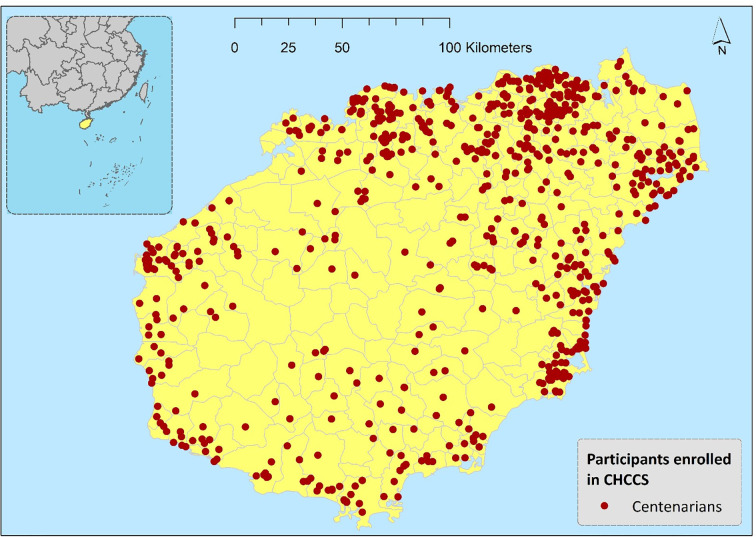
A total of 958 centenarians (mean age = 102.8 years; 81.8% females) recruited from 18 regions in Hainan, China, completed the PSQI scale. Cronbach's alpha coefficient was used to measure the internal consistency. Exploratory factor analysis (EFA) and confirmatory factor analysis (CFA) were performed to explore the validity and factor structure of the PSQI in this sample. Correlations between the global PSQI score and physical function, depression symptoms, self-reported health status and subjective well-being were used to assess divergent validity.
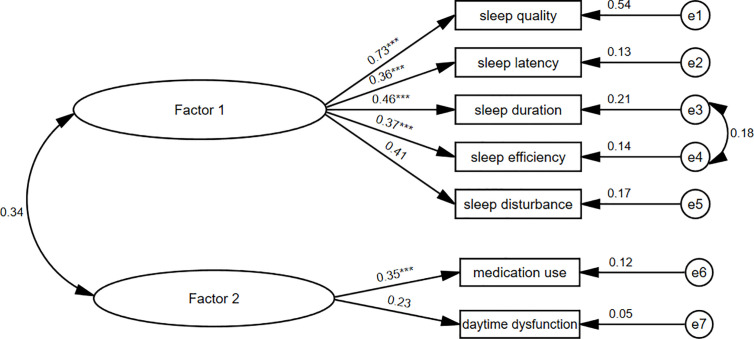
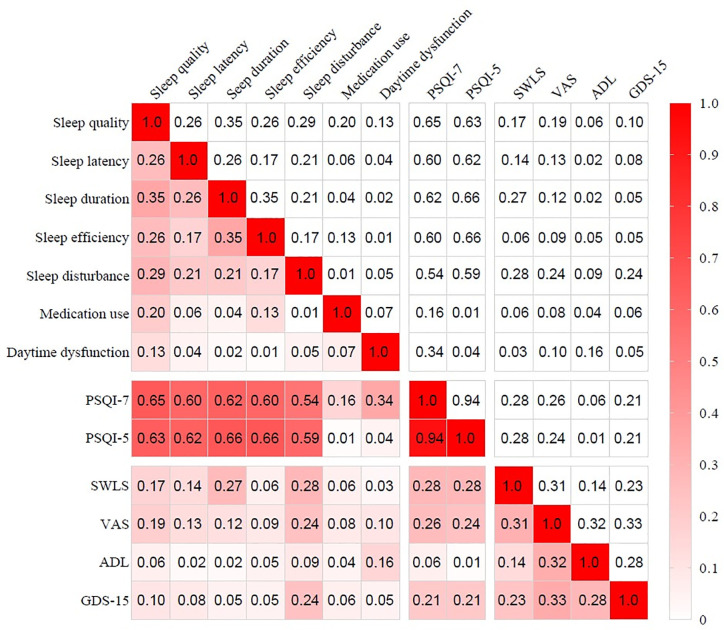
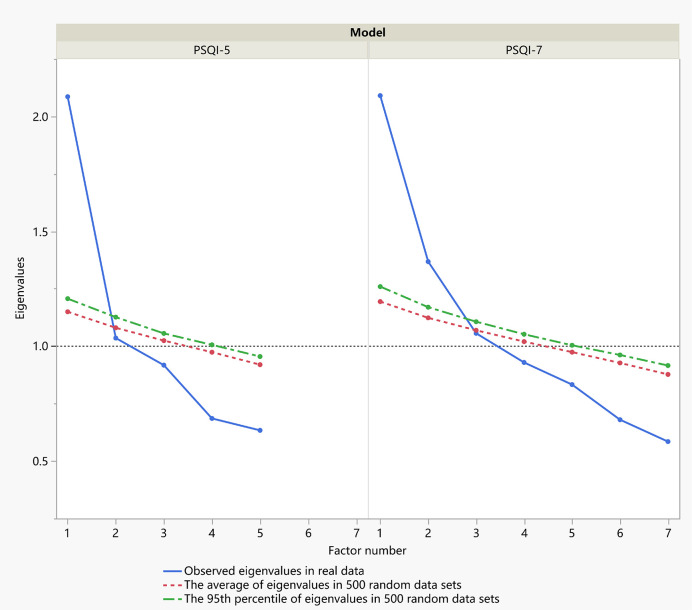
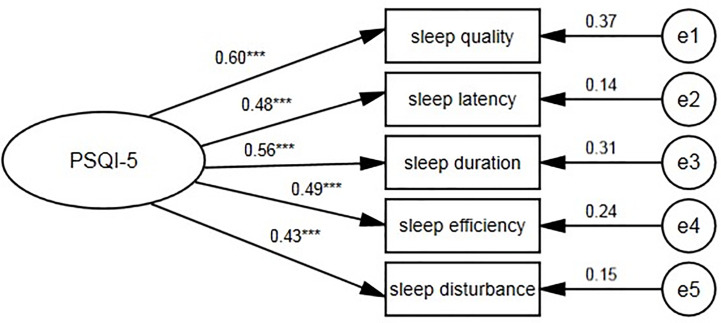
The Cronbach's α coefficient of the PSQI was 0.68, and it increased to 0.78 after two components (medication use and daytime dysfunction) were removed. The Spearman correlation coefficients of the PSQI score with each component were statistically significant (<0.01). EFA yielded a two-factor structure model of the original PSQI-7 and a one-factor structure model of the simplified PSQI-5. The one-factor model with five components (χ/ =1.59, CFI=0.99, RMSEA=0.03) fit the data well and had good configural invariance across demographic characteristics (0.53<χ<5.58, >0.05).
The original PSQI showed acceptable applicability in Chinese community-dwelling centenarians, and its psychometric characteristics moderately improved after sleeping medication and daytime dysfunction were removed. Further validation studies on PSQI are needed among centenarians from varied backgrounds.
匹兹堡睡眠质量指数(PSQI)是一种广泛使用的自我报告问卷,用于测量普通人群的总体睡眠质量。然而,其心理测量特性在长寿人群中尚未得到充分研究。
本研究旨在探讨中文版PSQI在社区百岁老人中的信度、效度和因子结构。
从中国海南18个地区招募了958名百岁老人(平均年龄 = 102.8岁;81.8%为女性),完成PSQI量表。采用Cronbach's α系数测量内部一致性。进行探索性因子分析(EFA)和验证性因子分析(CFA),以探讨PSQI在该样本中的效度和因子结构。使用PSQI总分与身体功能、抑郁症状、自我报告的健康状况和主观幸福感之间的相关性来评估区分效度。
PSQI的Cronbach's α系数为0.68,去除两个分量表(药物使用和日间功能障碍)后增至0.78。PSQI总分与各分量表的Spearman相关系数具有统计学意义(<0.01)。EFA得出了原始PSQI-7的两因子结构模型和简化PSQI-5的单因子结构模型。具有五个分量表的单因子模型(χ/ =1.59,CFI=0.9九、RMSEA=0.03)对数据拟合良好,且在不同人口统计学特征上具有良好的构型不变性(0.53<χ<5.58,>0.05)。
原始PSQI在中国社区百岁老人中显示出可接受的适用性,去除助眠药物和日间功能障碍后其心理测量特征有适度改善。需要对来自不同背景的百岁老人进行PSQI的进一步验证研究。