Institute of Geriatrics, Chinese PLA General Hospital, Fuxing Road 28, Beijing, 100853, People's Republic of China.
Beijing Key Laboratory of Aging and Geriatrics, Chinese PLA General Hospital, Beijing, China.
BMC Geriatr. 2018 Aug 29;18(1):198. doi: 10.1186/s12877-018-0886-0.
Hypovitaminosis D and depressive syndromes are common conditions in old adults. However, little is known about the relationship between vitamin D and depression in exceptional aged people. The objective of this study is to evaluate the relationship between vitamin D levels and depressive symptoms in Chinese longevous persons.
We used a dataset from a cross-sectional survey of a sample of Chinese longevous people with self-reported age 100 or older, including 175 men and 765 women, was conducted from June 2014 to December 2016 in Hainan Province, China. Data on demographics, lifestyle characteristics and health conditions were collected using a structured questionnaire. Anthropometrics and blood samples were obtained following the standard procedure. Depressive symptoms of the participants were assessed using a shortened version of the Geriatric Depression Scale (GDS-15). Serum vitamin D levels were measured using an automated radioimmunoassay.
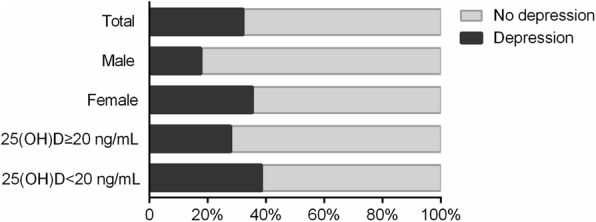
The prevalence of longevous persons with depressive symptoms among the sample was 32.2% (95% confidence interval: 29.7-34.7%). Serum vitamin D levels were lower in participants with depressive symptoms than in those without (20.8 ± 8.7 vs. 23.7 ± 9.7, ng/mL). Vitamin D deficiency was an independent risk factor for depression after controlling for the potential covariates (Odds ratio = 1.47, 95% Confidence interval = 1.08-2.00; p = 0.014). A negative relationship between serum vitamin D levels and depressive symptoms was also detected, and the relationship remained significant after adjusting for a wide range of other covariates. The multivariate adjusted odds ratio of depressive symptoms for the lowest versus highest quartiles of vitamin D levels was 1.73 (95% confidence interval: 1.10-2.72), and the adjusted odds ratio with a 5 ng/mL decrement of serum 25OHD levels was 1.10 (95% confidence interval: 1.01-1.19).
This study showed an inverse association between vitamin D levels and depressive symptoms among Chinese longevous persons. Depressive symptoms should be screened in longevous persons who had vitamin D deficiency. Further studies on vitamin D supplement and prevention along with treatment of depression are needed among very old population.
维生素 D 缺乏症和抑郁综合征在老年人中很常见。然而,关于维生素 D 与超高龄人群抑郁之间的关系知之甚少。本研究旨在评估中国长寿人群中维生素 D 水平与抑郁症状之间的关系。
我们使用了 2014 年 6 月至 2016 年 12 月在中国海南省进行的一项百岁及以上长寿人群横断面调查的数据集,其中包括 175 名男性和 765 名女性。使用结构化问卷收集人口统计学、生活方式特征和健康状况数据。按照标准程序进行人体测量和采集血样。使用老年抑郁量表(GDS-15)的简化版评估参与者的抑郁症状。使用自动放射免疫分析法测量血清维生素 D 水平。
该样本中患有抑郁症状的长寿者的患病率为 32.2%(95%置信区间:29.7-34.7%)。有抑郁症状的参与者的血清维生素 D 水平低于无抑郁症状的参与者(20.8±8.7 vs. 23.7±9.7ng/ml)。在校正潜在混杂因素后,维生素 D 缺乏是抑郁的独立危险因素(比值比=1.47,95%置信区间=1.08-2.00;p=0.014)。血清维生素 D 水平与抑郁症状之间也存在负相关关系,并且在调整了广泛的其他混杂因素后,这种关系仍然显著。血清 25-羟维生素 D 水平最低与最高四分位组之间抑郁症状的多变量调整比值比为 1.73(95%置信区间:1.10-2.72),血清 25OHD 水平每降低 5ng/ml 的调整比值比为 1.10(95%置信区间:1.01-1.19)。
本研究表明,中国长寿人群中维生素 D 水平与抑郁症状之间存在反比关系。在患有维生素 D 缺乏症的长寿人群中应筛查抑郁症状。非常高龄人群中需要进一步研究维生素 D 补充以及预防和治疗抑郁症。