School of Nursing & Health Studies, Georgetown University, Washington D.C., USA.
Shanghai Jiao Tong University School of Medicine, Shanghai, China.
J Glob Health. 2020 Dec;10(2):020421. doi: 10.7189/jogh.10.020421.
Conceptual frameworks of fiscal space for health have traditionally considered health system efficiency improvements as a means to free up resources for the sector. However, there has been no comprehensive review of the evidence to confirm the relationship between efficiency and fiscal space.
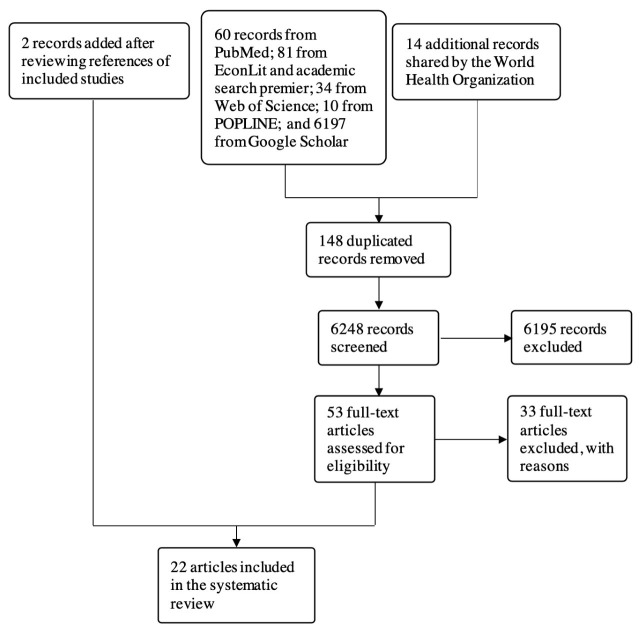
We conducted a systematic review to synthesize evidence on whether efficiency gains increase fiscal space for health. We searched bibliographic databases for specific keywords - namely, fiscal space, efficiency and health - and identified 22 articles that examined links between efficiency gains and fiscal space for health. The articles, which encapsulated 28 case studies, were included in the analysis.
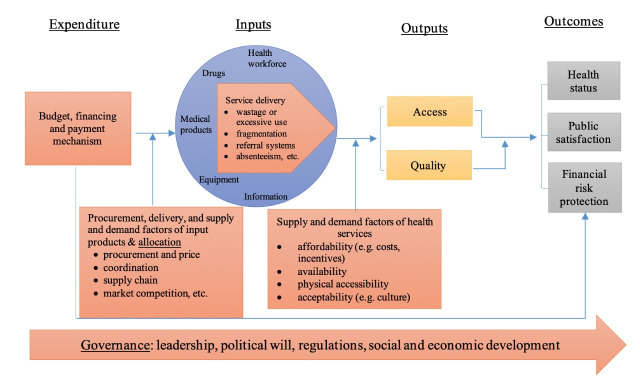
The 28 case studies varied widely with regard to how efficiency was evaluated, the extent to which efficiency was explored, and how efficiency gains could be achieved. Half of the studies assessed both technical and allocative efficiency, and the other half assessed technical efficiency only. The indicators to examine potential inefficiencies varied substantially among studies. The most frequently cited inefficiencies stemmed from public financial management (budget implementation, budget allocation and strategic purchasing) and governance issues, even though these were characterized in various ways. The second most cited set of inefficiencies that caused health systems to function poorly were those related to health service delivery. Procurement and delivery of input factors was also mentioned in some studies as a source of inefficiency. Though most studies conceded that efficiency gains were a potential means to improve fiscal space for health, very few quantified the potential gains or explored practical mechanisms to translate efficiency gains into fiscal space for health.
While the conceptual link between efficiency gains and fiscal space for health may be assumed, there is no direct empirical evidence proving that efficiency gains translate into more resources for the health sector. Mechanisms to translate efficiency gains into fiscal space are barely explored in the fiscal space literature. Public financial management rules and related rules for reallocating funds within the sector need to be further examined to guide countries in the transformation of efficiency gains into more resources for health.
传统的卫生财政空间概念框架将卫生系统效率提高视为为该部门释放资源的一种手段。然而,目前还没有对效率与财政空间之间的关系进行全面的证据审查。
我们进行了系统综述,以综合评估效率提高是否会增加卫生财政空间。我们使用特定关键字(即财政空间、效率和健康)搜索了文献数据库,并确定了 22 篇探讨效率提高与卫生财政空间之间联系的文章。这些文章包含了 28 个案例研究,被纳入了分析。
28 个案例研究在评估效率的方式、对效率的探索程度以及如何实现效率提高等方面差异很大。一半的研究评估了技术效率和配置效率,另一半仅评估了技术效率。用于检查潜在效率低下的指标在研究之间差异很大。最常被引用的效率低下源于公共财政管理(预算执行、预算分配和战略采购)和治理问题,尽管这些问题有不同的特征。导致卫生系统运行不良的第二个最常被引用的效率低下是与卫生服务提供有关的效率低下。在一些研究中,还提到了投入因素的采购和提供是效率低下的一个来源。尽管大多数研究都承认效率提高是改善卫生财政空间的一种潜在手段,但很少有研究量化潜在收益,或探讨将效率提高转化为卫生财政空间的实际机制。
虽然效率提高与卫生财政空间之间的概念联系可能是假定的,但没有直接的经验证据证明效率提高会转化为卫生部门更多的资源。在财政空间文献中,几乎没有探讨将效率提高转化为财政空间的机制。需要进一步研究公共财政管理规则和相关的部门内资金重新分配规则,以指导各国将效率提高转化为更多的卫生资源。