Health Systems Governance and Financing Department, World Health Organization, Avenue Appia 20, 1202, Switzerland.
London Hubs Coordinator, European Observatory on Health Systems and Policies, London School of Hygiene and Tropical Medicine, Cowdray House, COW 4.02, London WC2A 2AE, UK.
Health Policy Plan. 2021 Sep 9;36(8):1307-1315. doi: 10.1093/heapol/czab040.
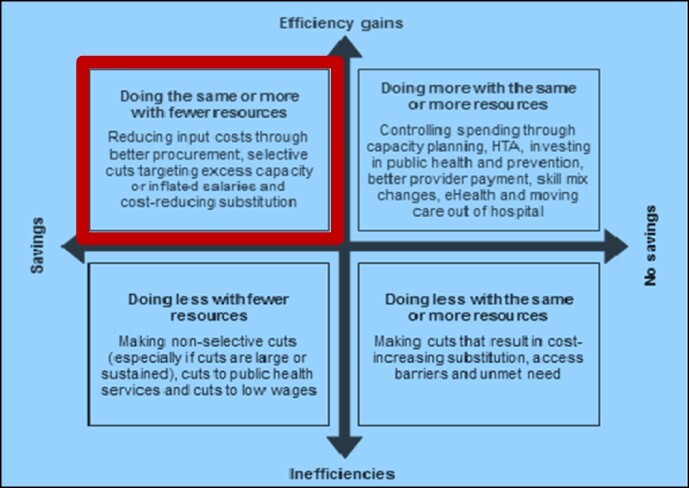
Efficiency has historically been considered a key mechanism to increase the amount of available revenues to the health sector, enabling countries to expand services and benefits to progress towards universal health coverage (UHC). Country experience indicates, however, that efficiency gains do not automatically translate into greater budget for health, to additional revenues for the sector. This article proposes a framework to assess whether and how efficiency interventions are likely to increase budgetary space in health systems Based on a review of the literature and country experiences, we suggest three enabling conditions that must be met in order to transform efficiency gains into budgetary gains for health. First there must be well-defined efficiency interventions that target health system inputs, implemented over a medium-term time frame. Second, efficiency interventions must generate financial gains that are quantifiable either pre- or post-intervention. Third, public financial management systems must allow those gains to be kept within the health sector and repurposed towards priority health needs. When these conditions are not met, efficiency gains do not lead to more budgetary space for health. Rather, the gains may instead result in budget cuts that can be detrimental to health systems' outputs and ultimately disincentivize further attempts to improve efficiency in the sector. The framework, when applied, offers an opportunity for policymakers to reconcile efficiency and budget expansion goals in health.
效率一直被视为增加卫生部门可获得收入的关键机制,使各国能够扩大服务和福利,以实现全民健康覆盖(UHC)。然而,国家经验表明,效率提高并不一定会自动转化为更多的卫生预算,也不会为该部门带来额外收入。本文提出了一个评估效率干预措施是否以及如何可能增加卫生系统预算空间的框架。基于对文献和国家经验的审查,我们提出了要将效率提高转化为卫生预算增加,必须满足的三个有利条件。首先,必须有明确界定的针对卫生系统投入的效率干预措施,并在中期实施。其次,效率干预措施必须产生可量化的财务收益,无论是在干预之前还是之后。第三,公共财政管理系统必须允许将这些收益保留在卫生部门内,并重新用于优先卫生需求。当这些条件得不到满足时,效率提高不会为卫生带来更多的预算空间。相反,这些收益可能导致预算削减,这可能对卫生系统的产出产生不利影响,并最终阻碍进一步努力提高该部门的效率。该框架在应用时为政策制定者提供了一个机会,以协调卫生方面的效率和预算扩张目标。