Feng Xiaobo, Ma Liang, Liang Hang, Liu Xiaoming, Lei Jie, Li Wenqiang, Wang Kun, Song Yu, Wang Bingjin, Li Gaocai, Li Shuai, Yang Cao
Department of Orthopaedics, Union Hospital, Tongji Medical College, Huazhong University of Science and Technology, Wuhan 430022, China.
Department of Radiology, Union Hospital, Tongji Medical College, Huazhong University of Science and Technology, Wuhan 430022, China.
ACS Omega. 2020 Oct 7;5(41):26655-26666. doi: 10.1021/acsomega.0c03489. eCollection 2020 Oct 20.
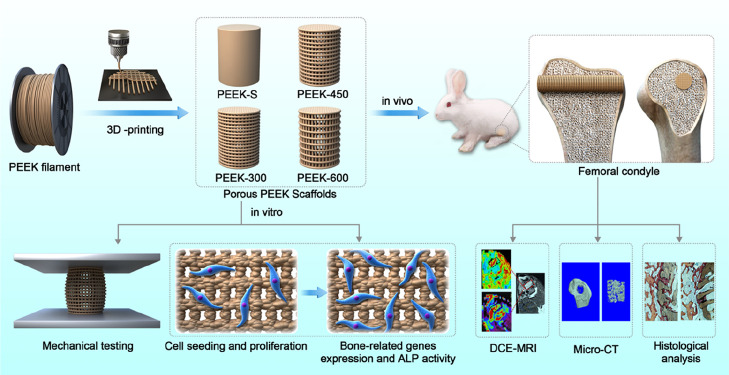
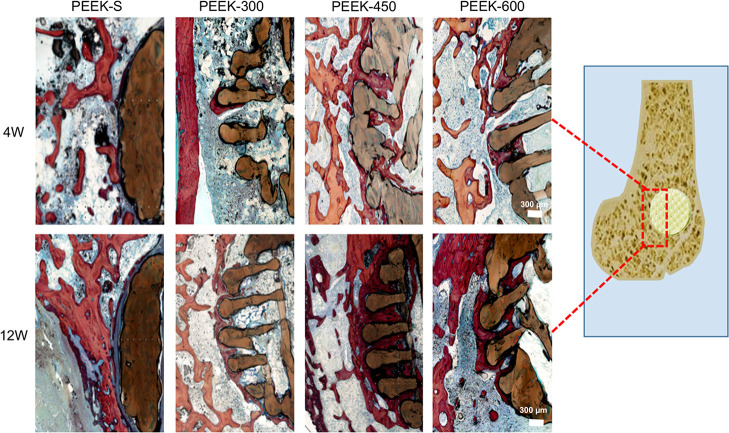
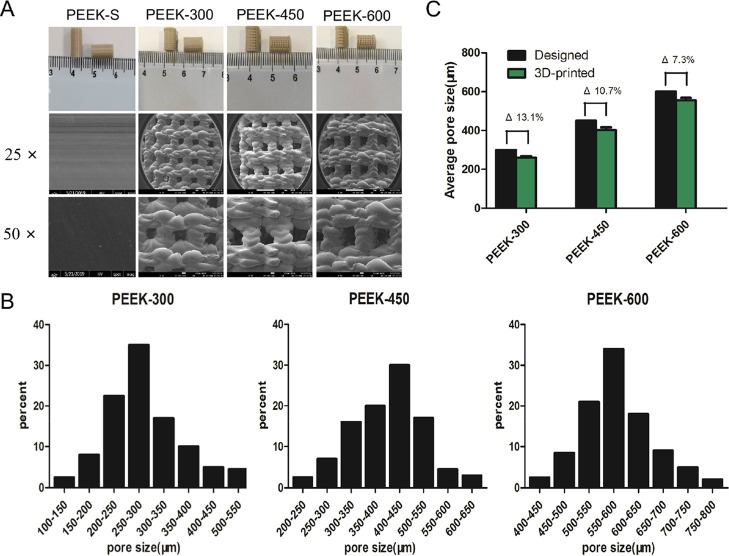
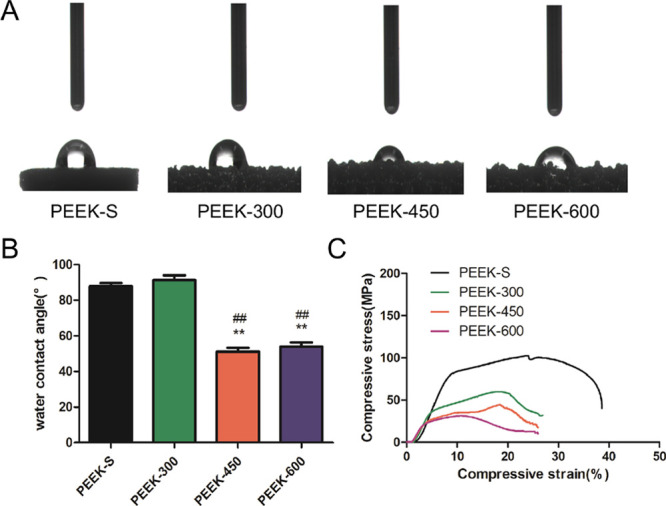
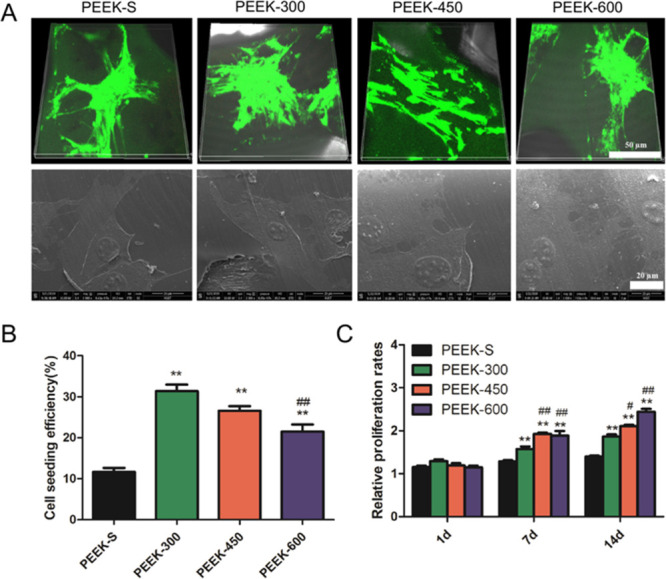
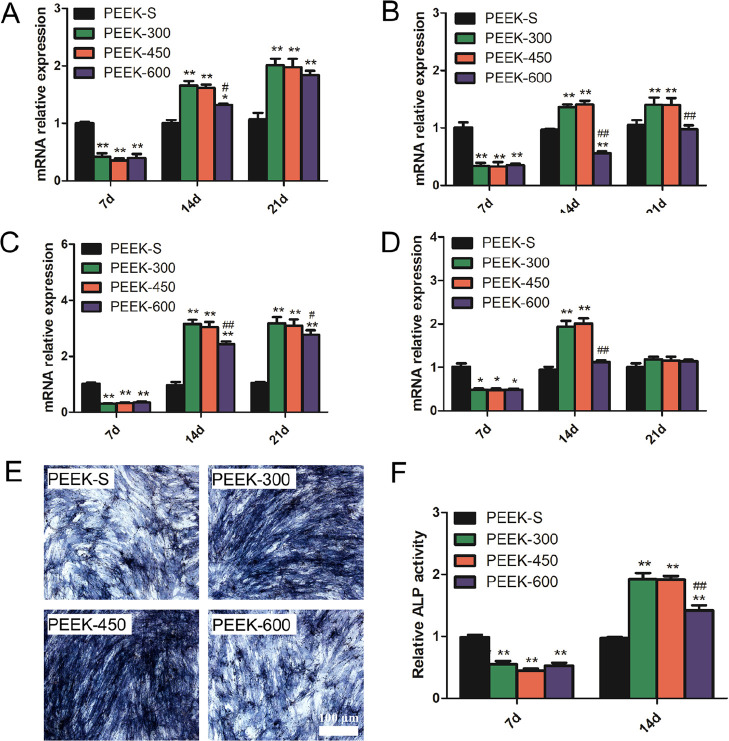
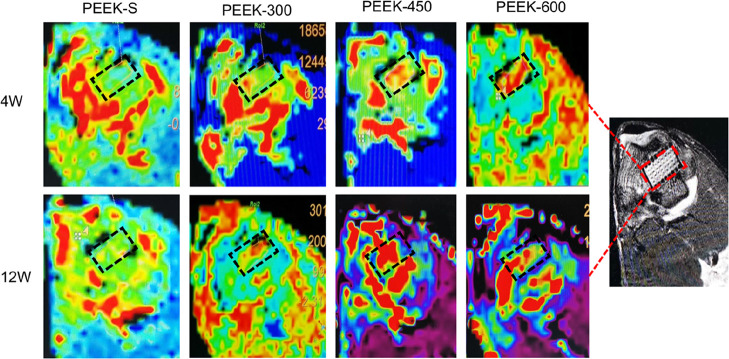
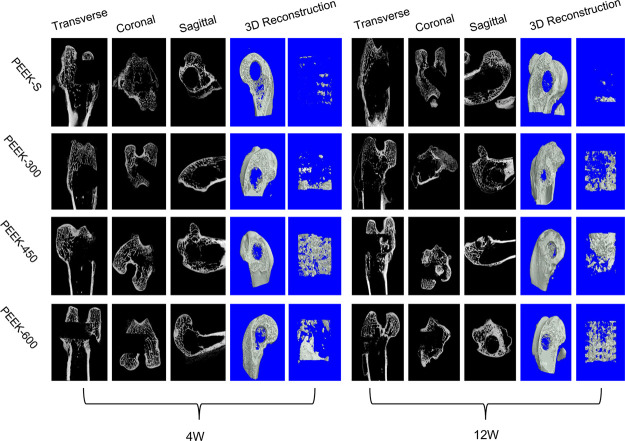
Polyetheretherketone (PEEK) constitutes a preferred alternative material for orthopedic implants owing to its good mechanical properties and biocompatibility. However, the poor osseointegration property of PEEK implants has limited their clinical applications. To address this issue, in this study, we investigated the mechanical and biological properties of fully porous PEEK scaffolds with different pore sizes both in vitro and in vivo. PEEK scaffolds with designed pore sizes of 300, 450, and 600 μm and a porosity of 60% were manufactured via fused deposition modeling (FDM) to explore the optimum pore size. Smooth solid PEEK cylinders (PEEK-S) were used as the reference material. The mechanical, cytocompatibility, proliferative, and osteogenic properties of PEEK scaffolds were characterized in comparison to those of PEEK-S. In vivo dynamic contrast-enhanced magnetic resonance imaging, microcomputed tomography, and histological observation were performed after 4 and 12 weeks of implantation to evaluate the microvascular perfusion and bone formation afforded by the various PEEK implants using a New Zealand white rabbit model with distal femoral condyle defects. Results of in vitro testing supported the good biocompatibility of the porous PEEK scaffolds manufactured via FDM. In particular, the PEEK-450 scaffolds were most beneficial for cell adhesion, proliferation, and osteogenic differentiation. Results of in vivo analysis further indicated that PEEK-450 scaffolds exhibited preferential potential for bone ingrowth and vascular perfusion. Together, our findings support that porous PEEK implants designed with a suitable pore size and fabricated via three-dimensional printing constitute promising alternative biomaterials for bone grafting and tissue engineering applications with marked potential for clinical applications.
聚醚醚酮(PEEK)因其良好的机械性能和生物相容性,成为骨科植入物的首选替代材料。然而,PEEK植入物较差的骨整合性能限制了其临床应用。为解决这一问题,在本研究中,我们在体外和体内研究了不同孔径的全多孔PEEK支架的机械性能和生物学性能。通过熔融沉积建模(FDM)制造了孔径设计为300、450和600μm且孔隙率为60%的PEEK支架,以探索最佳孔径。光滑的实心PEEK圆柱体(PEEK-S)用作参考材料。与PEEK-S相比,对PEEK支架的机械性能、细胞相容性、增殖和成骨性能进行了表征。在植入4周和12周后,使用新西兰白兔股骨远端髁缺损模型进行体内动态对比增强磁共振成像、微型计算机断层扫描和组织学观察,以评估各种PEEK植入物提供的微血管灌注和骨形成情况。体外测试结果支持了通过FDM制造的多孔PEEK支架具有良好的生物相容性。特别是,PEEK-450支架对细胞粘附、增殖和成骨分化最为有利。体内分析结果进一步表明PEEK-450支架在骨长入和血管灌注方面具有优先潜力。总之,我们的研究结果支持,设计合适孔径并通过三维打印制造的多孔PEEK植入物是骨移植和组织工程应用中有前景的替代生物材料,具有显著的临床应用潜力。