Razvi Salman, Mrabeti Sanaa, Luster Markus
Translational and Clinical Research Institute, University of Newcastle, Newcastle-upon-Tyne, UK.
Medical Affairs EMEA, Merck Serono Middle East FZ-LLC, Dubai, United Arab Emirates.
Endocr Connect. 2020 Nov;9(11):R241-R250. doi: 10.1530/EC-20-0205.
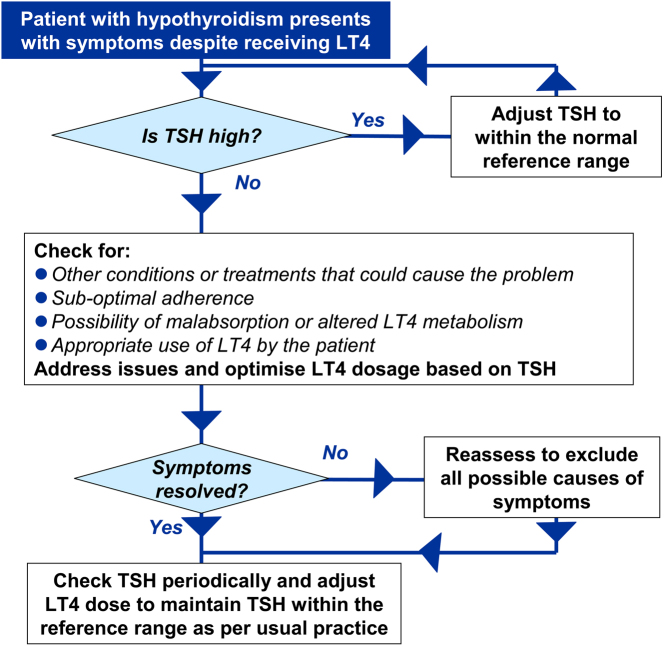
The current standard of care for hypothyroidism is levothyroxine (LT4) monotherapy to reduce levels of thyrotropin (thyroid-stimulating hormone, TSH) within its reference range and amelioration of any symptoms. A substantial minority continues to report hypothyroid-like symptoms despite optimized TSH, however. These symptoms are not specific to thyroid dysfunction and are frequent among the euthyroid population, creating a therapeutic dilemma for the treating clinician as well as the patient. We present a concise, narrative review of the clinical research and evidence-based guidance on the management of this challenging population. The clinician may endeavor to ensure that the serum TSH is within the target range. However, the symptomatic patient may turn to alternative non-evidence-based therapies in the hope of obtaining relief. Accordingly, it is important for the clinician to check for conditions unrelated to the thyroid that could account for the ongoing symptoms such as other autoimmune conditions, anemia or mental health disorders. Systematic and thorough investigation of the potential causes of persistent symptoms while receiving LT4 therapy will resolve the problem for most patients. There may be some patients that may benefit from additional treatment with liothyronine (LT3), although it is unclear as yet as to which patient group may benefit the most from combined LT4 + LT3 therapy. In the future, personalized treatment with LT4 + LT3 may be of benefit for some patients with persistent symptoms of hypothyroidism such as those with polymorphisms in the deiodinase enzyme 2 (DIO2). For now, this remains a subject for research.
目前甲状腺功能减退症的标准治疗方法是左甲状腺素(LT4)单药治疗,以将促甲状腺激素(甲状腺刺激激素,TSH)水平降低至参考范围内,并改善任何症状。然而,仍有相当一部分患者尽管TSH已得到优化,但仍报告有甲状腺功能减退样症状。这些症状并非甲状腺功能障碍所特有,在甲状腺功能正常的人群中也很常见,这给治疗医生和患者都带来了治疗难题。我们对这一具有挑战性人群的管理方面的临床研究和循证指南进行了简要的叙述性综述。临床医生可能会努力确保血清TSH在目标范围内。然而,有症状的患者可能会转向非循证的替代疗法,希望能得到缓解。因此,临床医生检查是否存在与甲状腺无关的可能导致持续症状的情况非常重要,比如其他自身免疫性疾病、贫血或精神健康障碍。在接受LT4治疗时,对持续症状的潜在原因进行系统而彻底的调查将解决大多数患者的问题。可能有一些患者可能会从额外的三碘甲状腺原氨酸(LT3)治疗中获益,尽管目前尚不清楚哪类患者从LT4 + LT3联合治疗中获益最大。未来,对于一些有持续甲状腺功能减退症状的患者,如那些脱碘酶2(DIO2)存在多态性的患者,LT4 + LT3个体化治疗可能会有益处。目前,这仍是一个研究课题。