Holz N E, Nees F, Meyer-Lindenberg A, Tost H, Hölling H, Keil T, Brandeis D, Romanos M, Banaschewski T
Klinik für Psychiatrie und Psychotherapie des Kindes- und Jugendalters, Zentralinstitut für seelische Gesundheit, Medizinische Fakultät Mannheim, Universität Heidelberg, J5, 68167, Mannheim, Deutschland.
Institut für Medizinische Psychologie und Medizinische Soziologie, Universitätsklinikum Schleswig-Holstein, Universität Kiel, Kiel, Deutschland.
Nervenarzt. 2021 Mar;92(3):208-218. doi: 10.1007/s00115-020-01018-4. Epub 2020 Oct 28.
Longitudinal cohort studies with early start and life span perspectives are increasingly recognized as being crucial to uncover developmental trajectories as well as risk and resilience factors of psychiatric disorders.
The importance of longitudinal studies is presented and the main findings of the Mannheim study of children at risk (MARS), the adolescent brain cognitive development (ABCD), the pediatric and adolescent health survey (Kinder- und Jugendgesundheitssurvey, KiGGS) and the AIMS longitudinal European autism project (LEAP) cohort studies are described.
A literature search was carried out in MEDLINE.
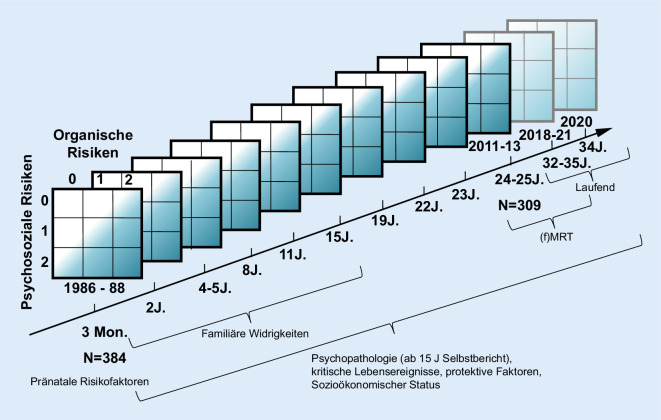
The MARS followed participants with psychosocial and organic risks over more than 30 years starting from birth and showed the importance of early risk factors (prenatal period up to early childhood) for neuropsychosocial development. The ABCD cohort study (start 9-10 years old) underlined the developmental significance of early socioemotional and prenatal risks as well as toxin exposure. The KiGGS cohort followed children and adolescents from age 0-17 years up to the ages of 10-28 years. Main findings underline the importance of the socioeconomic status and gender-specific effects with respect to sensitive periods for the onset and trajectories of psychiatric disorders. The AIMS cohort followed patients with and without autism spectrum disorders aged between 6 and 30 years and first results revealed small effects regarding group differences. Further, cohort studies starting prenatally along with deep phenotyping are warranted to uncover the complex etiology of mental disorders.
Existing cohort studies on early mental development have shown specific focal points. To identify general and specific risk and resilience factors for psychiatric disorders and to model trajectories, there is a need for multimodal integration of data sets.
从早期开始并具有终生视角的纵向队列研究,越来越被认为对于揭示精神疾病的发展轨迹以及风险和复原力因素至关重要。
阐述纵向研究的重要性,并描述曼海姆高危儿童研究(MARS)、青少年大脑认知发展研究(ABCD)、儿童和青少年健康调查(Kinder- und Jugendgesundheitssurvey,KiGGS)以及AIMS欧洲自闭症纵向项目(LEAP)队列研究的主要发现。
在MEDLINE中进行文献检索。
MARS从出生开始对具有心理社会和器质性风险的参与者进行了30多年的跟踪研究,显示了早期风险因素(从孕期到幼儿期)对神经心理社会发展的重要性。ABCD队列研究(始于9至10岁)强调了早期社会情感和产前风险以及毒素暴露的发展意义。KiGGS队列对0至17岁的儿童和青少年进行跟踪,直至他们10至28岁。主要发现强调了社会经济地位以及性别特异性效应在精神疾病发病和发展轨迹敏感期方面的重要性。AIMS队列对年龄在6至30岁之间患有和未患有自闭症谱系障碍的患者进行了跟踪,初步结果显示组间差异影响较小。此外,有必要开展从孕期开始并进行深度表型分析的队列研究,以揭示精神障碍的复杂病因。
现有的关于早期心理发展的队列研究已经显示出特定的重点。为了确定精神疾病的一般和特定风险及复原力因素并模拟发展轨迹,需要对数据集进行多模式整合。