Han L H, Wu G, Horak E, Halling R E, Xu J, Ndolo E S T, Sato H, Fechner N, Sharma Y P, Yang Z L
CAS Key Laboratory for Plant Diversity and Biogeography of East Asia, Kunming Institute of Botany, Chinese Academy of Sciences, Kunming 650201, Yunnan, China.
Key Laboratory of Yunnan Province Universities of the Diversity and Ecological Adaptive Evolution for Animals and Plants on Yungui Plateau, Qujing Normal University, Qujing 655011, Yunnan, China.
Persoonia. 2020 Jun;44:113-139. doi: 10.3767/persoonia.2020.44.05. Epub 2019 Dec 16.
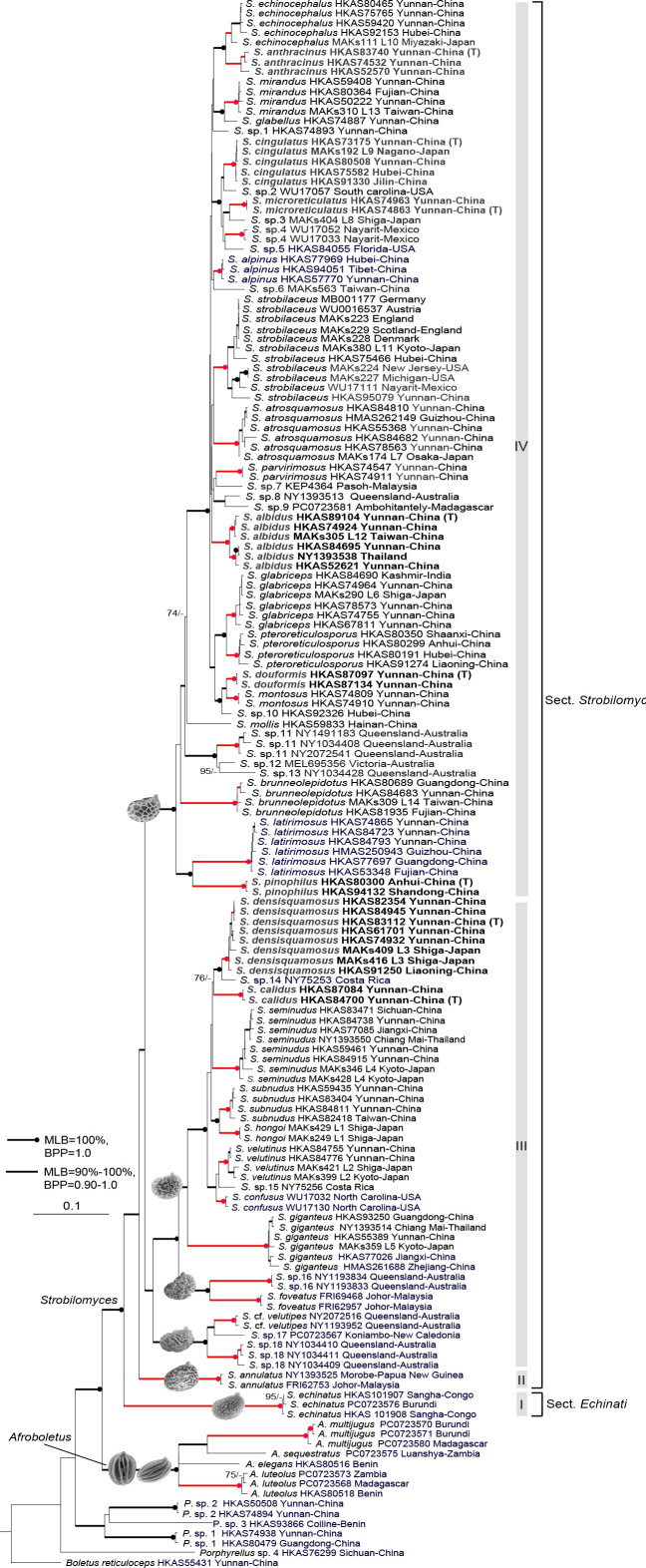
is broadly distributed geographically and serves an important ecological function. However, it has been difficult to delimit species within the genus, primarily due to developmental variations and phenotypic plasticity. To elucidate phylogenetic relationships among species within the genus and to understand its species diversity, especially in Asia, materials of the genus collected from five continents (Africa, Asia, Australia, Europe, and North/Central America) were investigated. The phylogeny of was reconstructed based on nucleotide sequences of four genes coding for: the largest and the second largest subunits of the RNA polymerase II (1 and 2); the translation elongation factor subunit 1-α (1); and the mitochondrial cytochrome oxidase subunit 3 (3). The combined results based on molecular phylogenetics, morphological characters, host tree associations, and geographical distribution patterns support a new classification consisting of two sections, sect. and sect. . Using the genealogical concordance phylogenetic species recognition (GCPSR) approach, at least 33 phylogenetic species in Asia can be delimited, all of which are supported by morphological features, and five phylogenetic species remain to be described. The mountainous region of Southwest China is especially special, containing at least 21 species and likely represents a centre of diversification. We further compared our specimens with the type specimens of 25 species of . Our comparisons suggest that, there are a total of 31 distinct species, while , , and /, are synonyms of , , and , respectively. Eight new species, namely, , , , , , , and , are described. A dichotomous key to the Asian species is provided.
其在地理上分布广泛并发挥着重要的生态功能。然而,由于发育变异和表型可塑性,该属内的物种很难界定。为了阐明该属内物种间的系统发育关系并了解其物种多样性,尤其是在亚洲的情况,对从五大洲(非洲、亚洲、澳大利亚、欧洲和北美洲/中美洲)收集的该属材料进行了研究。基于编码以下四种基因的核苷酸序列重建了该属的系统发育:RNA聚合酶II的最大和第二大亚基(RPB1和RPB2);翻译延伸因子亚基1-α(TEF1);以及线粒体细胞色素氧化酶亚基3(COX3)。基于分子系统发育、形态特征、寄主树关联和地理分布模式的综合结果支持一个由两个组组成的新分类,即组 和组 。使用谱系一致性系统发育物种识别(GCPSR)方法,在亚洲可以界定至少33个系统发育物种,所有这些都得到形态特征的支持,还有五个系统发育物种有待描述。中国西南部的山区尤为特殊,包含至少21个物种,可能代表了一个多样化中心。我们进一步将我们的标本与该属25个物种的模式标本进行了比较。我们的比较表明,共有31个不同的物种,而 、 和 / 分别是 、 和 的同义词。描述了八个新物种,即 、 、 、 、 、 、 和 。提供了亚洲该属物种的检索表。