Fu Shijian, Wang Yanhong, Li Hang, Chen Leilei, Liu Quanzhong
The First Affiliated Hospital of Harbin Medical University, Harbin 150081, People's Republic of China.
Department of Laboratory Medicine, Yuebei People's Hospital of Shaoguan, The Affiliated Hospital of Shantou University, Shaoguan 512025, People's Republic of China.
Cancer Manag Res. 2020 Oct 15;12:10181-10198. doi: 10.2147/CMAR.S276022. eCollection 2020.
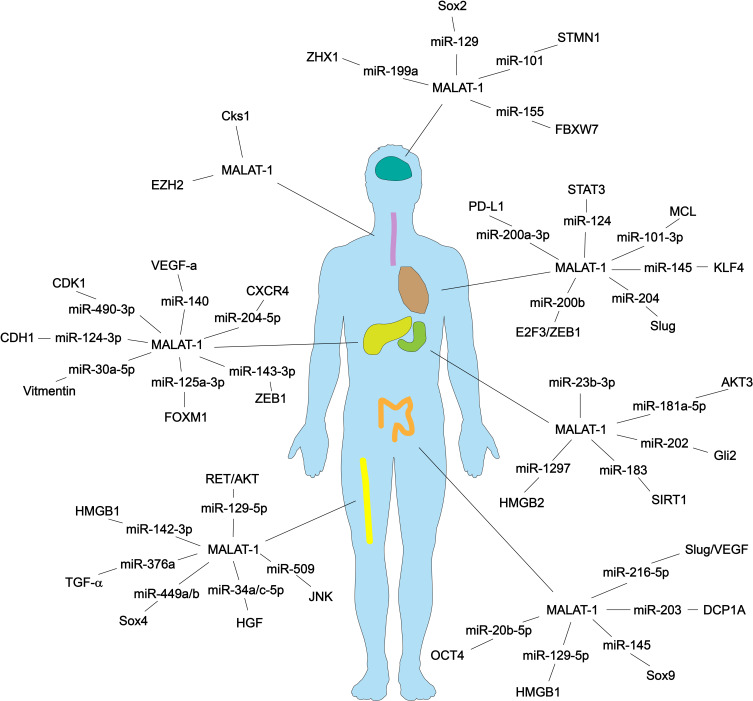
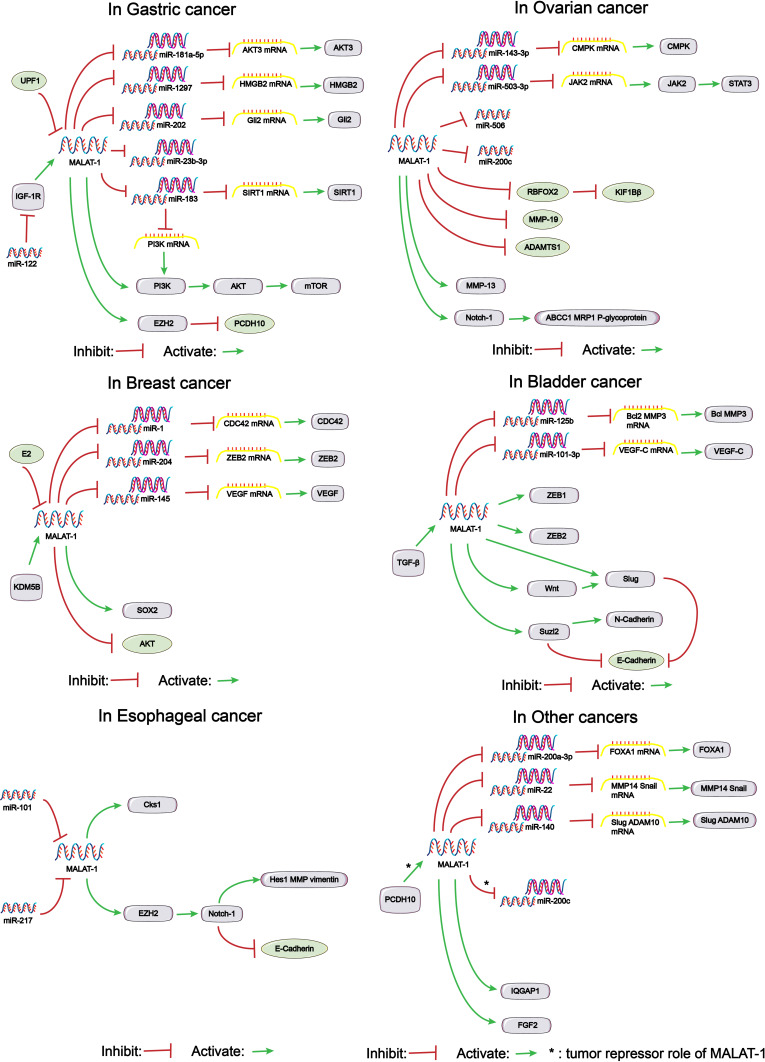
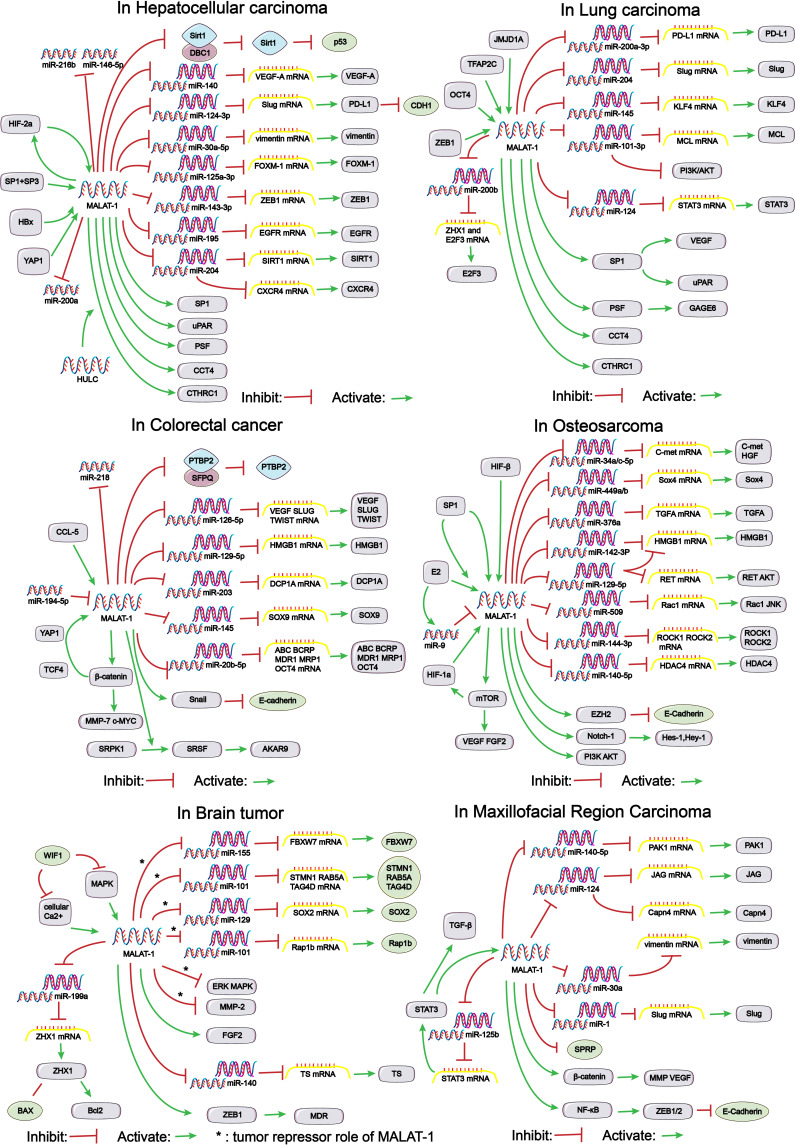
Long noncoding (lnc)RNAs are a group of RNAs with a length greater than 200 nt that do not encode a protein but play an essential role in regulating the expression of target genes in normal biological contexts as well as pathologic processes including tumorigenesis. The lncRNA metastasis-associated lung adenocarcinoma transcript (MALAT)-1 has been widely studied in cancer. In this review, we describe the known functions of MALAT-1; its mechanisms of action; and associated signaling pathways and their clinical significance in different cancers. In most malignancies, including lung, colorectal, thyroid, and other cancers, MALAT-1 functions as an oncogene and is upregulated in tumors and tumor cell lines. MALAT-1 has a distinct mechanism of action in each cancer type and is thus at the center of large gene regulatory networks. Dysregulation of MALAT-1 affects cellular processes such as alternative splicing, epithelial-mesenchymal transition, apoptosis, and autophagy, which ultimately results in the abnormal cell proliferation, invasion, and migration that characterize cancers. In other malignancies, such as glioma and endometrial carcinoma, MALAT-1 functions as a tumor suppressor and thus forms additional regulatory networks. The current evidence indicates that MALAT-1 and its associated signaling pathways can serve as diagnostic or prognostic biomarker or therapeutic target in the treatment of many cancers.
长链非编码(lnc)RNA是一类长度大于200个核苷酸的RNA,它们不编码蛋白质,但在正常生物学环境以及包括肿瘤发生在内的病理过程中,对调控靶基因的表达起着至关重要的作用。长链非编码RNA转移相关肺腺癌转录本(MALAT)-1已在癌症研究中得到广泛研究。在本综述中,我们描述了MALAT-1的已知功能、其作用机制、相关信号通路及其在不同癌症中的临床意义。在大多数恶性肿瘤中,包括肺癌、结直肠癌、甲状腺癌和其他癌症,MALAT-1作为一种癌基因发挥作用,在肿瘤和肿瘤细胞系中表达上调。MALAT-1在每种癌症类型中都有独特的作用机制,因此处于大型基因调控网络的中心。MALAT-1的失调会影响细胞过程,如可变剪接、上皮-间质转化、凋亡和自噬,最终导致癌症所特有的细胞异常增殖、侵袭和迁移。在其他恶性肿瘤中,如神经胶质瘤和子宫内膜癌,MALAT-1作为一种肿瘤抑制因子发挥作用,从而形成额外的调控网络。目前的证据表明,MALAT-1及其相关信号通路可作为许多癌症治疗中的诊断或预后生物标志物或治疗靶点。