Laureate Institute for Brain Research, 6655 S Yale Ave, Tulsa, OK, 74136, USA.
Sci Rep. 2021 Jun 3;11(1):11783. doi: 10.1038/s41598-021-91308-x.
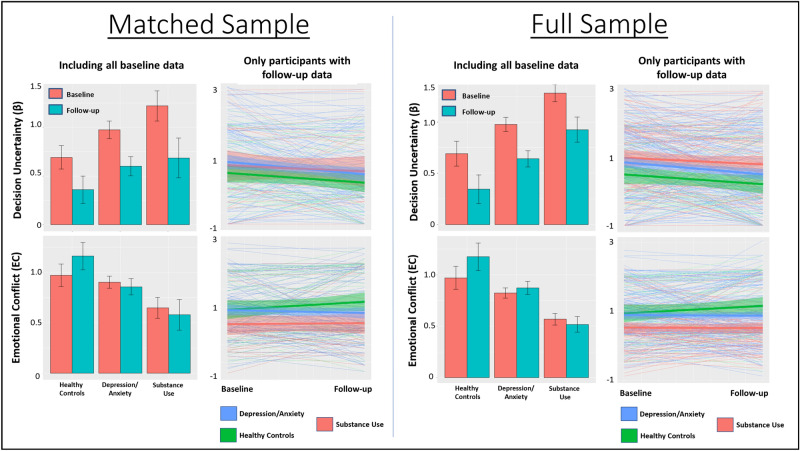
Maladaptive behavior during approach-avoidance conflict (AAC) is common to multiple psychiatric disorders. Using computational modeling, we previously reported that individuals with depression, anxiety, and substance use disorders (DEP/ANX; SUDs) exhibited differences in decision uncertainty and sensitivity to negative outcomes versus reward (emotional conflict) relative to healthy controls (HCs). However, it remains unknown whether these computational parameters and group differences are stable over time. We analyzed 1-year follow-up data from a subset of the same participants (N = 325) to assess parameter stability and relationships to other clinical and task measures. We assessed group differences in the entire sample as well as a subset matched for age and IQ across HCs (N = 48), SUDs (N = 29), and DEP/ANX (N = 121). We also assessed 2-3 week reliability in a separate sample of 30 HCs. Emotional conflict and decision uncertainty parameters showed moderate 1-year intra-class correlations (.52 and .46, respectively) and moderate to excellent correlations over the shorter period (.84 and .54, respectively). Similar to previous baseline findings, parameters correlated with multiple response time measures (ps < .001) and self-reported anxiety (r = .30, p < .001) and decision difficulty (r = .44, p < .001). Linear mixed effects analyses revealed that patients remained higher in decision uncertainty (SUDs, p = .009) and lower in emotional conflict (SUDs, p = .004, DEP/ANX, p = .02) relative to HCs. This computational modelling approach may therefore offer relatively stable markers of transdiagnostic psychopathology.
在趋近回避冲突(AAC)期间出现适应不良行为是多种精神障碍的共同特征。我们之前使用计算模型报告称,与健康对照者(HCs)相比,患有抑郁症、焦虑症和物质使用障碍(DEP/ANX;SUDs)的个体在决策不确定性和对负面结果与奖励(情绪冲突)的敏感性方面存在差异。然而,这些计算参数和组间差异是否随时间稳定仍然未知。我们分析了同一参与者的一部分(N=325)的 1 年随访数据,以评估参数稳定性及其与其他临床和任务测量的关系。我们在整个样本中评估了组间差异,以及在 HCs(N=48)、SUDs(N=29)和 DEP/ANX(N=121)中按年龄和智商匹配的子集中评估了组间差异。我们还在另一个由 30 名 HCs 组成的独立样本中评估了 2-3 周的可靠性。情绪冲突和决策不确定性参数在 1 年内具有中等的组内相关系数(分别为.52 和.46),在较短时间内具有中等至极好的相关性(分别为.84 和.54)。与之前的基线研究结果相似,参数与多个反应时测量值(p<0.001)和自我报告的焦虑(r=.30,p<0.001)和决策难度(r=.44,p<0.001)相关。线性混合效应分析表明,与 HCs 相比,患者在决策不确定性方面仍然较高(SUDs,p=0.009),在情绪冲突方面较低(SUDs,p=0.004,DEP/ANX,p=0.02)。因此,这种计算建模方法可能提供了相对稳定的跨诊断精神病理学标志物。