International Rescue Committee, Addis Ababa, Ethiopia.
International Rescue Committee, New York City, NY, United States of America.
PLoS One. 2020 Oct 29;15(10):e0237319. doi: 10.1371/journal.pone.0237319. eCollection 2020.
Routine immunization coverage has stagnated over the past decade and fallen short of WHO targets in Ethiopia. Community engagement strategies that reach beyond traditional health systems may reduce dropout and increase coverage. This evaluation assesses changes in immunization, postpartum family planning, and antenatal care coverage after implementation of an enhanced community engagement and defaulter tracing strategy, entitled "Fifth Child" project, across two districts in Benishangul-Gumuz Regional State (BGRS), Ethiopia.
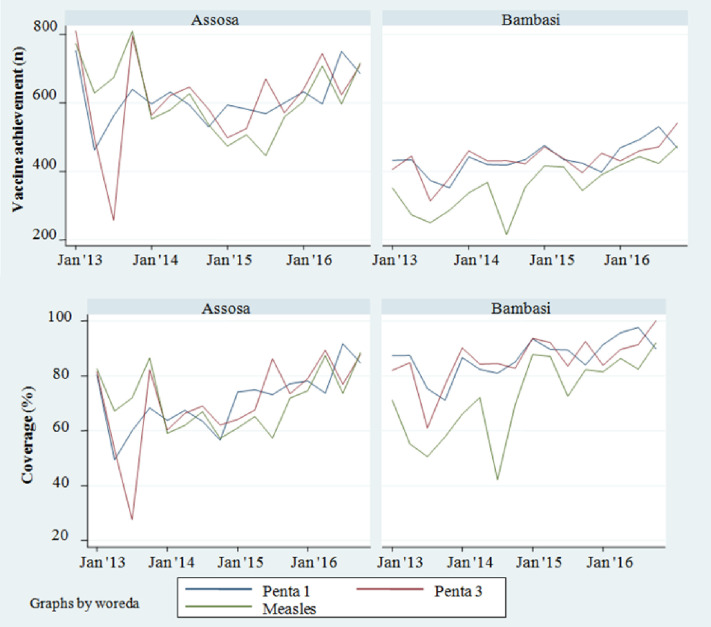
A formative evaluation was conducted to examine the contribution of the strategy on immunization, postpartum family planning and antenatal care utilization in Assosa and Bambasi districts of BGRS. The quantitative findings are presented here. Routine and project-specific data were analyzed to assess changes in uptake of childhood vaccinations, postpartum family planning and antenatal care. Between January 2013 and December 2016, pentavalent-3 coverage increased from 63% to 84% in Assosa, and from 78% to 93% in Bambasi. Similarly, measles vaccine coverage increased from 77% to 81% in Assosa, and from 59% to 86% in Bambasi. Approximately 54% of all eligible infants across both woredas defaulted on scheduled vaccinations at least once during the period. Among defaulting children, 84% were identified and subsequently caught up on the vaccinations missed. Secondary outcomes of postpartum family planning and antenatal care also increased in both woredas.
The "Fifth Child" project likely contributed to enhanced immunization performance and increased utilization of immunization and select perinatal health services in two woredas of BGRS. Further research is required in order to determine the impact of this community engagement strategy.
在过去的十年中,常规免疫接种覆盖率停滞不前,未达到世卫组织在埃塞俄比亚的目标。超越传统卫生系统的社区参与策略可能会减少辍学率并提高覆盖率。本评估评估了在实施名为“第五个孩子”项目的强化社区参与和追踪违约者战略后,在埃塞俄比亚本尚古勒-古马兹地区(BGRS)的两个区(阿萨萨和班巴西)的免疫接种、产后计划生育和产前护理覆盖率的变化。
进行了一项形成性评估,以检查该策略对阿萨萨和班巴西区免疫接种、产后计划生育和产前护理利用的贡献。这里介绍了定量发现。分析了常规和特定项目的数据,以评估儿童疫苗接种、产后计划生育和产前护理利用率的变化。2013 年 1 月至 2016 年 12 月期间,在阿萨萨,五价疫苗-3 的覆盖率从 63%增加到 84%,在班巴西,从 78%增加到 93%。同样,在阿萨萨,麻疹疫苗覆盖率从 77%增加到 81%,在班巴西,从 59%增加到 86%。在这两个区,大约 54%的所有符合条件的婴儿在整个期间至少有一次错过了计划接种疫苗。在所有违约儿童中,84%的儿童被发现并随后赶上了错过的疫苗接种。产后计划生育和产前护理的次要结果也在两个区都有所增加。
“第五个孩子”项目可能有助于提高 BGRS 两个区的免疫接种绩效,并增加免疫接种和部分围产期保健服务的利用率。需要进一步研究以确定这种社区参与策略的影响。