Lee TaeGi, Enomoto Kazushi, Ohshiro Kazuma, Inoue Daishi, Kikitsu Tomoka, Hyeon-Deuk Kim, Pu Yong-Jin, Kim DaeGwi
Department of Applied Physics, Osaka City University, Osaka, 558-8585, Japan.
RIKEN Center for Emergent Matter Science (CEMS), Saitama, 351-0198, Japan.
Nat Commun. 2020 Oct 29;11(1):5471. doi: 10.1038/s41467-020-19337-0.
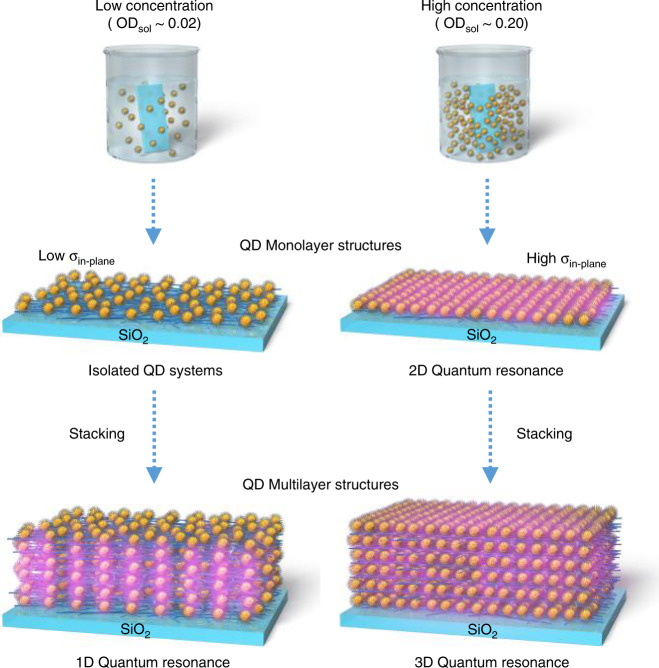
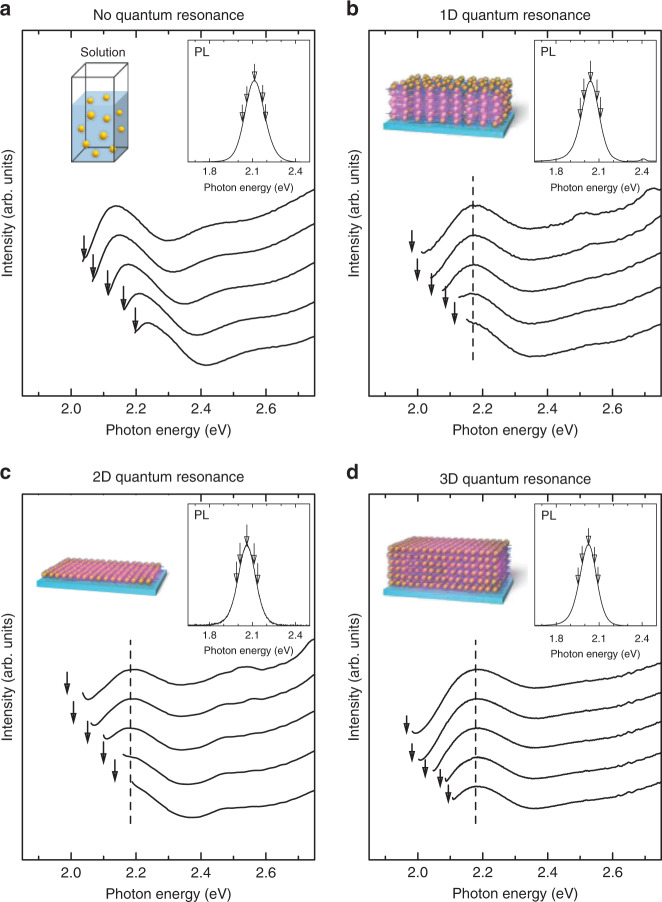
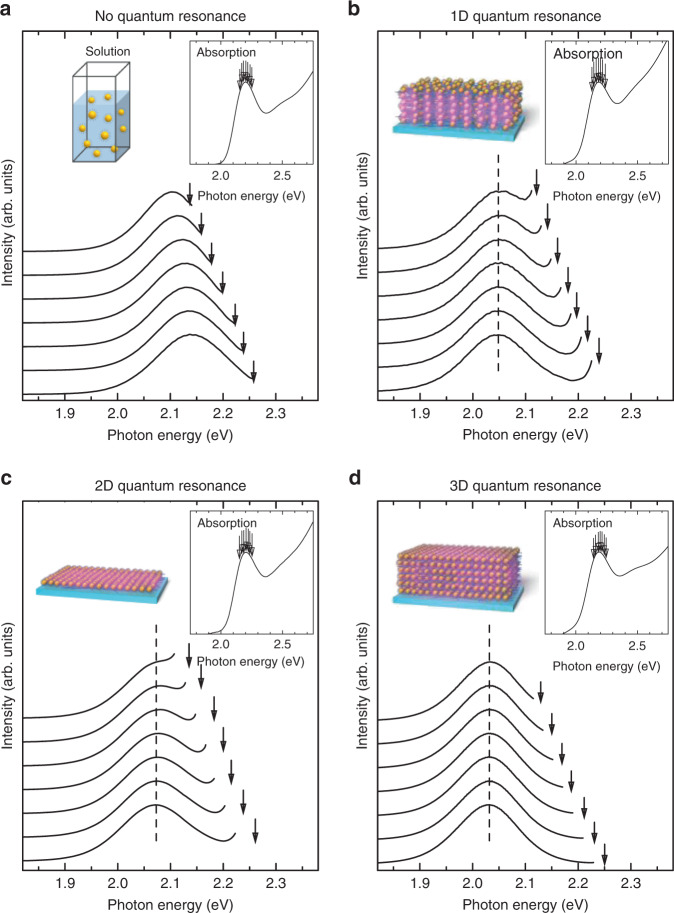
In quantum dot superlattices, wherein quantum dots are periodically arranged, electronic states between adjacent quantum dots are coupled by quantum resonance, which arises from the short-range electronic coupling of wave functions, and thus the formation of minibands is expected. Quantum dot superlattices have the potential to be key materials for new optoelectronic devices, such as highly efficient solar cells and photodetectors. Herein, we report the fabrication of CdTe quantum dot superlattices via the layer-by-layer assembly of positively charged polyelectrolytes and negatively charged CdTe quantum dots. We can thus control the dimension of the quantum resonance by independently changing the distances between quantum dots in the stacking (out-of-plane) and in-plane directions. Furthermore, we experimentally verify the miniband formation by measuring the excitation energy dependence of the photoluminescence spectra and detection energy dependence of the photoluminescence excitation spectra.
在量子点超晶格中,量子点呈周期性排列,相邻量子点之间的电子态通过量子共振耦合,这种共振源于波函数的短程电子耦合,因此有望形成微带。量子点超晶格有潜力成为新型光电器件的关键材料,如高效太阳能电池和光电探测器。在此,我们报告了通过带正电的聚电解质和带负电的碲化镉量子点的逐层组装来制备碲化镉量子点超晶格。因此,我们可以通过独立改变堆叠(面外)方向和平面内方向上量子点之间的距离来控制量子共振的维度。此外,我们通过测量光致发光光谱的激发能量依赖性和光致发光激发光谱的探测能量依赖性,实验验证了微带的形成。