School of Animal Science and Technology, Shihezi University, Shihezi City, Xinjiang, China.
State Key Laboratory for Infectious Disease Prevention and Control, Collaborative Innovation Center for Diagnosis and Treatment of Infectious Diseases, National Institute for Communicable Disease Control and Prevention, Chinese Center for Disease Prevention and Control, Beijing, China.
PLoS One. 2020 Oct 30;15(10):e0232568. doi: 10.1371/journal.pone.0232568. eCollection 2020.
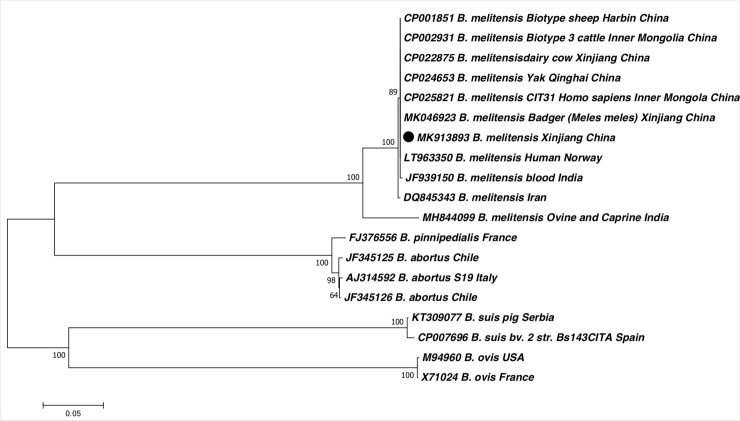
We studied livestock abortion and various associated risk factors in the Ili region of northwest China. Livestock abortion prevalence was estimated and correlated with infections (Brucellosis, Salmonellosis, Mycoplasma and Chlamydia seropositivity) and management (farming type and contact with other herds/flocks) risk factors. A total of 2996 serum samples (1406 cow, 1590 sheep) were identified by RBPT (Rose Bengal Plate Test) and c-ELISA (competitive-enzyme linked immunosorbent assay), and they showed the overall seroprevalence of brucellosis in the study area was cow 6.76%, sheep 9.50%. The seroprevalence of brucellosis in X county was cow 7.06%, sheep 9.12%; in H county was cow 11.70%, sheep 10.80%; and in Q county was cow 4.22%, sheep 9.11%. The overall seroprevalence of Mycoplasma in the study area was cow 3.20%, sheep 6.42%. The seroprevalence of Mycoplasma in X county was cow 3.39%, sheep 7.98%; in H county was cow 5.26%, sheep 9.97%; and in Q county was cow 2.11%, sheep 4.33%. The Odds ratio of brucellosis for cow and sheep, respectively, were 45.909 [95% CI 26.912-78.317, P<0.001] and 70.507 [95% CI 43.783-113.544, P<0.001] times higher than other abortion-related factors including mixed farming, contact with other flocks and Mycoplasma infection. A total of 54 samples, including aborted cow (22), sheep (30) fetuses and milk samples (2), were identified as Brucella melitensis (B. melitensis) positive. A total of 38 Brucella were isolated from 16 aborted cow, 20 sheep fetuses and 2 milk samples. All of these isolates were identified, and confirmed, as B. melitensis. A phylogenetic tree showed that the Brucella isolates closely matched the B. melitensis biovar 3 isolated in Inner Mongolia, China, and B. melitensis isolated from Norway and India. These results suggest that B. melitensis biovar 3 is the main pathogen responsible for cow and sheep abortion and also pose a human health risk. Additionally, livestock reproduction can also be influenced by Mycoplasma infection and managerial factors (farming type and contact with other herds/flocks), especially in remote areas.
我们研究了中国西北地区伊犁地区的家畜流产和各种相关的危险因素。估计了家畜流产的流行率,并将其与感染(布鲁氏菌病、沙门氏菌病、支原体和衣原体血清阳性)和管理(养殖类型和与其他畜群/羊群接触)危险因素相关联。通过 RBPT(虎红平板试验)和 c-ELISA(竞争酶联免疫吸附试验)共鉴定了 2996 份血清样本(1406 份牛,1590 份羊),结果显示研究区域布鲁氏菌病的总血清阳性率为牛 6.76%,羊 9.50%。X 县的布鲁氏菌病血清阳性率为牛 7.06%,羊 9.12%;H 县为牛 11.70%,羊 10.80%;Q 县为牛 4.22%,羊 9.11%。研究区域内支原体的总血清阳性率为牛 3.20%,羊 6.42%。X 县的支原体血清阳性率为牛 3.39%,羊 7.98%;H 县为牛 5.26%,羊 9.97%;Q 县为牛 2.11%,羊 4.33%。牛和羊的布鲁氏菌病的优势比分别为 45.909[95%CI 26.912-78.317,P<0.001]和 70.507[95%CI 43.783-113.544,P<0.001],远高于其他与流产相关的因素,包括混合养殖、与其他羊群接触和支原体感染。共鉴定出 54 份流产牛(22 份)、流产羊(30 份)胎儿和牛奶样本(2 份)为布鲁氏菌属 melitensis(B. melitensis)阳性。从 16 头流产牛、20 只流产羊胎儿和 2 份牛奶样本中分离出 38 株布鲁氏菌。所有这些分离株均被鉴定并确认为 B. melitensis。系统发育树显示,这些布鲁氏菌分离株与中国内蒙古分离的布鲁氏菌属 3 型生物变种以及挪威和印度分离的布鲁氏菌属 melitensis 密切匹配。这些结果表明,布鲁氏菌属 3 型生物变种是导致牛和羊流产的主要病原体,也对人类健康构成威胁。此外,在偏远地区,家畜繁殖也会受到支原体感染和管理因素(养殖类型和与其他畜群/羊群接触)的影响。