Concha-Meyer Anibal, Palomo Iván, Plaza Andrea, Gadioli Tarone Adriana, Maróstica Junior Mário Roberto, Sáyago-Ayerdi Sonia G, Fuentes Eduardo
Facultad de Ciencias Agrarias, Universidad de Talca, Talca 3460000, Chile.
Centro de Estudios en Alimentos Procesados (CEAP), CONICYT-Regional, Gore Maule, R09I2001, Talca 3460000, Chile.
Foods. 2020 Oct 28;9(11):1564. doi: 10.3390/foods9111564.
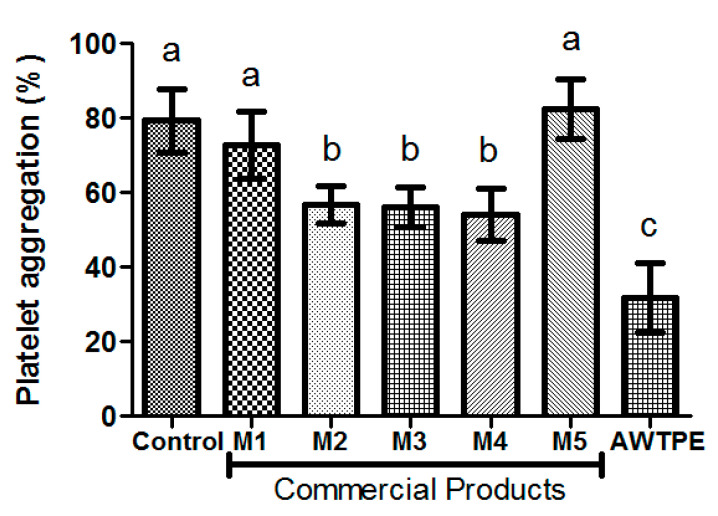
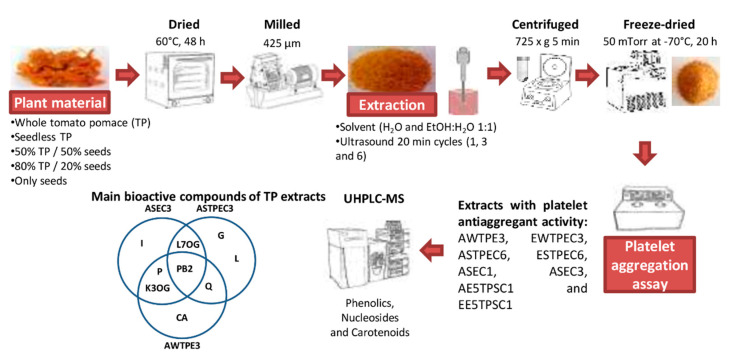
Tomato paste production generates a residue known as tomato pomace, which corresponds to peels and seeds separated during tomato processing. Currently, there is an opportunity to use tomato pomace to obtain a functional extract with antithrombotic properties, such as platelet anti-aggregant activity. The aim of this study was to evaluate the yield and inhibitory activity of different extracts of tomato pomace on in vitro platelet aggregation, comparing this activity with commercial cardioprotective products, and quantify bioactive compounds. Aqueous or ethanolic/water (1:1) extracts of whole tomato pomace, seedless tomato pomace, tomato pomace supplemented with seeds (50% and 20%), and only seeds were obtained with different ultrasound-assisted extraction times. The inhibition of platelet aggregation was evaluated using a lumi-aggregometer. The quantification of bioactive compounds was determined by HPLC-MS. From 5 g of each type of tomato pomace sample, 0.023-0.22 g of a dry extract was obtained for the platelet aggregation assay. The time of sonication and extraction solvent had a significant role in platelet anti-aggregant activity of some extracts respect the control. Thus, the most active extracts decreased adenosine diphosphate (ADP)-induced platelet aggregation from 87 ± 6% (control) to values between 26 ± 6% and 34 ± 2% ( < 0.05). Furthermore, different ultrasound-assisted extraction conditions of tomato pomace fractions had varied concentration of flavonoids and nucleosides, and had an effect on extract yield.
番茄酱生产过程中会产生一种名为番茄渣的残渣,它相当于番茄加工过程中分离出的果皮和种子。目前,存在利用番茄渣获取具有抗血栓特性的功能性提取物的机会,比如血小板抗聚集活性。本研究的目的是评估番茄渣不同提取物对体外血小板聚集的得率和抑制活性,将该活性与市售心脏保护产品进行比较,并对生物活性化合物进行定量分析。通过不同的超声辅助提取时间,获得了全番茄渣、无籽番茄渣、添加种子(50%和20%)的番茄渣以及仅种子的水提取物或乙醇/水(1:1)提取物。使用发光聚集仪评估血小板聚集的抑制情况。通过高效液相色谱-质谱联用仪对生物活性化合物进行定量分析。从每种类型的5克番茄渣样品中,获得了0.023 - 0.22克用于血小板聚集测定的干提取物。超声处理时间和提取溶剂对某些提取物相对于对照的血小板抗聚集活性有显著作用。因此,活性最强的提取物将二磷酸腺苷(ADP)诱导的血小板聚集从87±6%(对照)降低至26±6%至34±2%之间的值(P<0.05)。此外,番茄渣各部分不同的超声辅助提取条件下黄酮类化合物和核苷的浓度各不相同,且对提取物得率有影响。