Centre for Exercise and Sports Science Research, School of Medical and Health Sciences, Edith Cowan University, 270 Joondalup Drive, Joondalup, WA, 6027, Australia.
Performance Support, New South Wales Institute of Sport, Sydney Olympic Park, NSW, Australia.
J Int Soc Sports Nutr. 2020 Oct 30;17(1):52. doi: 10.1186/s12970-020-00381-6.
Despite a substantial body of research, no clear best practice guidelines exist for the assessment of hydration in athletes. Body water is stored in and shifted between different sites throughout the body complicating hydration assessment. This review seeks to highlight the unique strengths and limitations of various hydration assessment methods described in the literature as well as providing best practice guidelines.
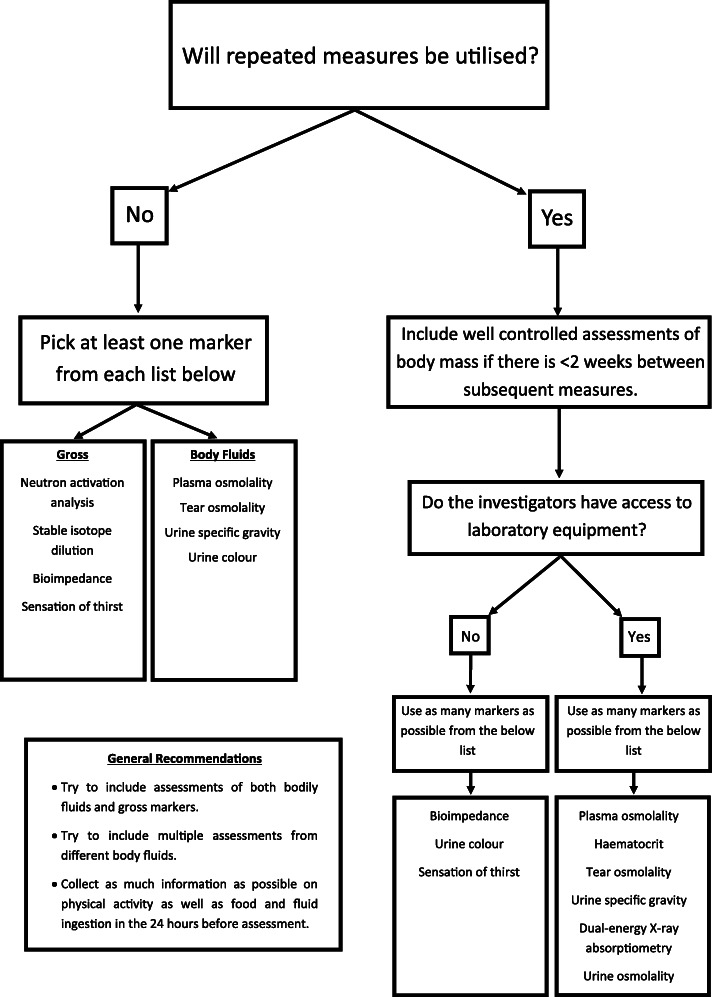
There is a plethora of methods that range in validity and reliability, including complicated and invasive methods (i.e. neutron activation analysis and stable isotope dilution), to moderately invasive blood, urine and salivary variables, progressing to non-invasive metrics such as tear osmolality, body mass, bioimpedance analysis, and sensation of thirst. Any single assessment of hydration status is problematic. Instead, the recommended approach is to use a combination, which have complementary strengths, which increase accuracy and validity. If methods such as salivary variables, urine colour, vital signs and sensation of thirst are utilised in isolation, great care must be taken due to their lack of sensitivity, reliability and/or accuracy. Detailed assessments such as neutron activation and stable isotope dilution analysis are highly accurate but expensive, with significant time delays due to data analysis providing little potential for immediate action. While alternative variables such as hormonal and electrolyte concentration, bioimpedance and tear osmolality require further research to determine their validity and reliability before inclusion into any test battery.
To improve best practice additional comprehensive research is required to further the scientific understanding of evaluating hydration status.
尽管有大量的研究,但对于运动员的水合评估仍没有明确的最佳实践指南。身体水分储存在体内不同部位并在这些部位之间转移,这使得水合评估变得复杂。本综述旨在突出文献中描述的各种水合评估方法的独特优势和局限性,并提供最佳实践指南。
有大量方法在有效性和可靠性方面存在差异,包括复杂和有创的方法(即中子激活分析和稳定同位素稀释),到中等程度的有创血液、尿液和唾液变量,再到非侵入性的指标,如泪液渗透压、体重、生物阻抗分析和口渴感。任何单一的水合状态评估都存在问题。相反,建议采用组合方法,这些方法具有互补的优势,可以提高准确性和有效性。如果单独使用唾液变量、尿液颜色、生命体征和口渴感等方法,则由于其敏感性、可靠性和/或准确性较差,必须格外小心。详细的评估方法,如中子激活和稳定同位素稀释分析,虽然非常准确,但由于数据分析时间长且费用昂贵,几乎没有立即采取行动的可能。虽然替代变量,如激素和电解质浓度、生物阻抗和泪液渗透压,在纳入任何测试组合之前,需要进一步的研究来确定其有效性和可靠性。
为了改进最佳实践,需要进行更多全面的研究,以进一步提高评估水合状态的科学理解。