• 文献检索
  • 文档翻译
  • 深度研究
  • 学术资讯
  • Suppr Zotero 插件Zotero 插件
  • 邀请有礼
  • 套餐&价格
  • 历史记录
应用&插件
Suppr Zotero 插件Zotero 插件浏览器插件Mac 客户端Windows 客户端微信小程序
定价
高级版会员购买积分包购买API积分包
服务
文献检索文档翻译深度研究API 文档MCP 服务
关于我们
关于 Suppr公司介绍联系我们用户协议隐私条款
关注我们

Suppr 超能文献

核心技术专利:CN118964589B侵权必究
粤ICP备2023148730 号-1Suppr @ 2026

文献检索

告别复杂PubMed语法,用中文像聊天一样搜索,搜遍4000万医学文献。AI智能推荐,让科研检索更轻松。

立即免费搜索

文件翻译

保留排版,准确专业,支持PDF/Word/PPT等文件格式,支持 12+语言互译。

免费翻译文档

深度研究

AI帮你快速写综述,25分钟生成高质量综述,智能提取关键信息,辅助科研写作。

立即免费体验

头部运动对单侧聋患者在人工耳蜗开机与关机状态下声源定位的影响。

Effects of Head Movements on Sound-Source Localization in Single-Sided Deaf Patients With Their Cochlear Implant On Versus Off.

作者信息

Pastore M Torben, Natale Sarah J, Clayton Colton, Dorman Michael F, Yost William A, Zhou Yi

机构信息

College of Health Solutions, Arizona State University, Tempe, Arizona, USA.

出版信息

Ear Hear. 2020 Nov/Dec;41(6):1660-1674. doi: 10.1097/AUD.0000000000000882.

DOI:10.1097/AUD.0000000000000882
PMID:33136640
原文链接:https://pmc.ncbi.nlm.nih.gov/articles/PMC7772279/
Abstract

OBJECTIVES

We investigated the ability of single-sided deaf listeners implanted with a cochlear implant (SSD-CI) to (1) determine the front-back and left-right location of sound sources presented from loudspeakers surrounding the listener and (2) use small head rotations to further improve their localization performance. The resulting behavioral data were used for further analyses investigating the value of so-called "monaural" spectral shape cues for front-back sound source localization.

DESIGN

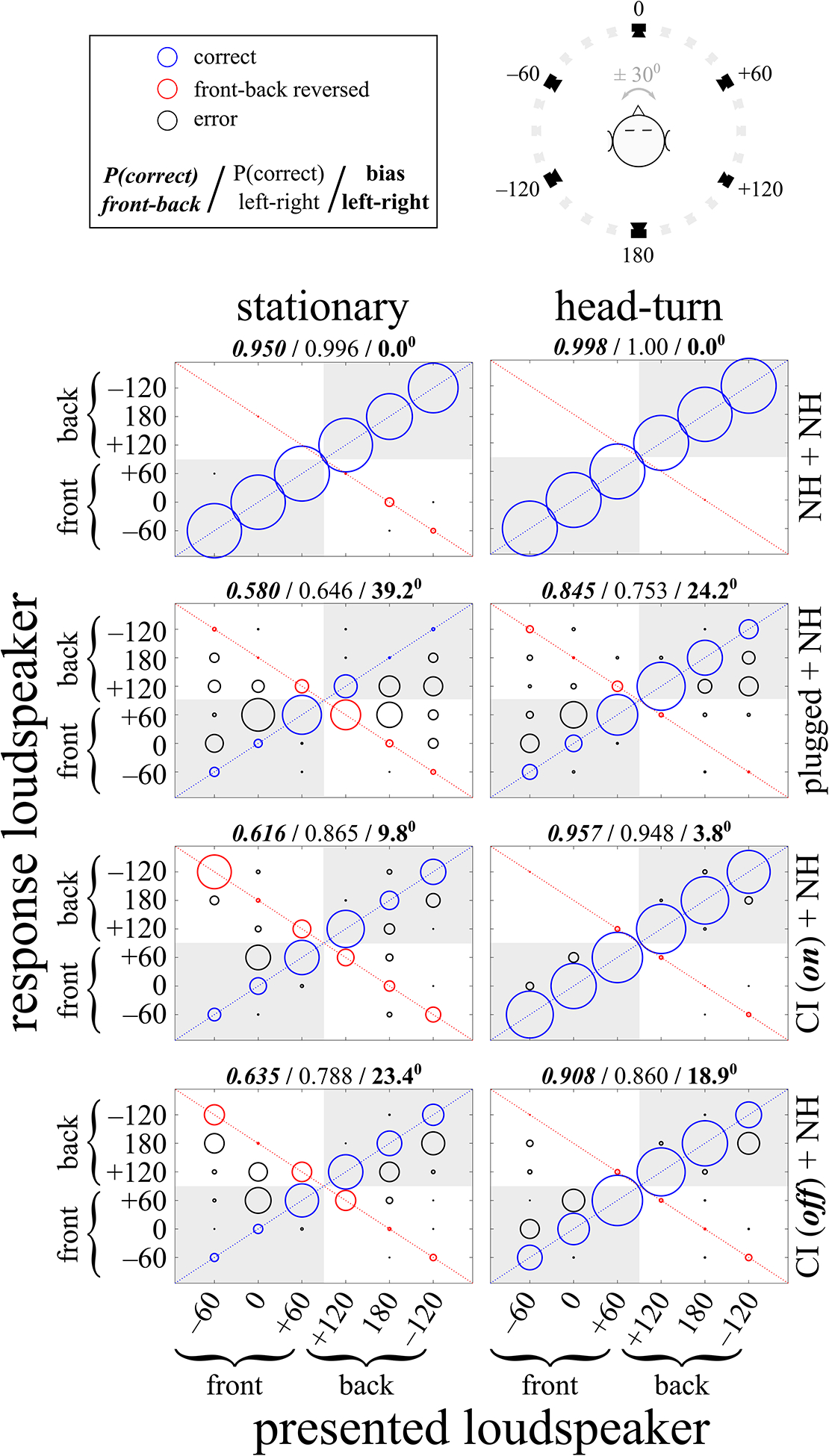
Eight SSD-CI patients were tested with their cochlear implant (CI) on and off. Eight normal-hearing (NH) listeners, with one ear plugged during the experiment, and another group of eight NH listeners, with neither ear plugged, were also tested. Gaussian noises of 3-sec duration were band-pass filtered to 2-8 kHz and presented from 1 of 6 loudspeakers surrounding the listener, spaced 60° apart. Perceived sound source localization was tested under conditions where the patients faced forward with the head stationary, and under conditions where they rotated their heads between (Equation is included in full-text article.).

RESULTS

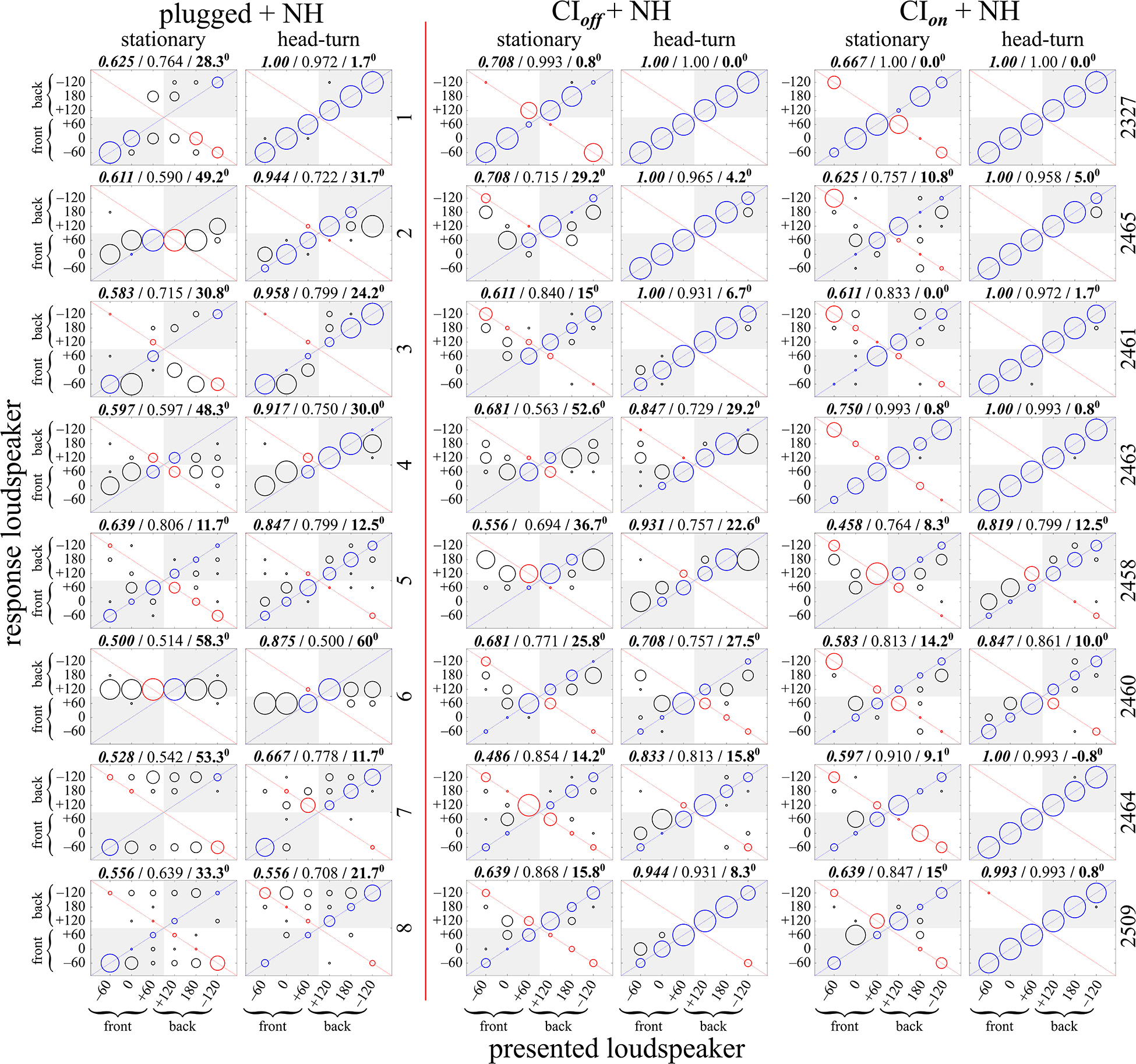
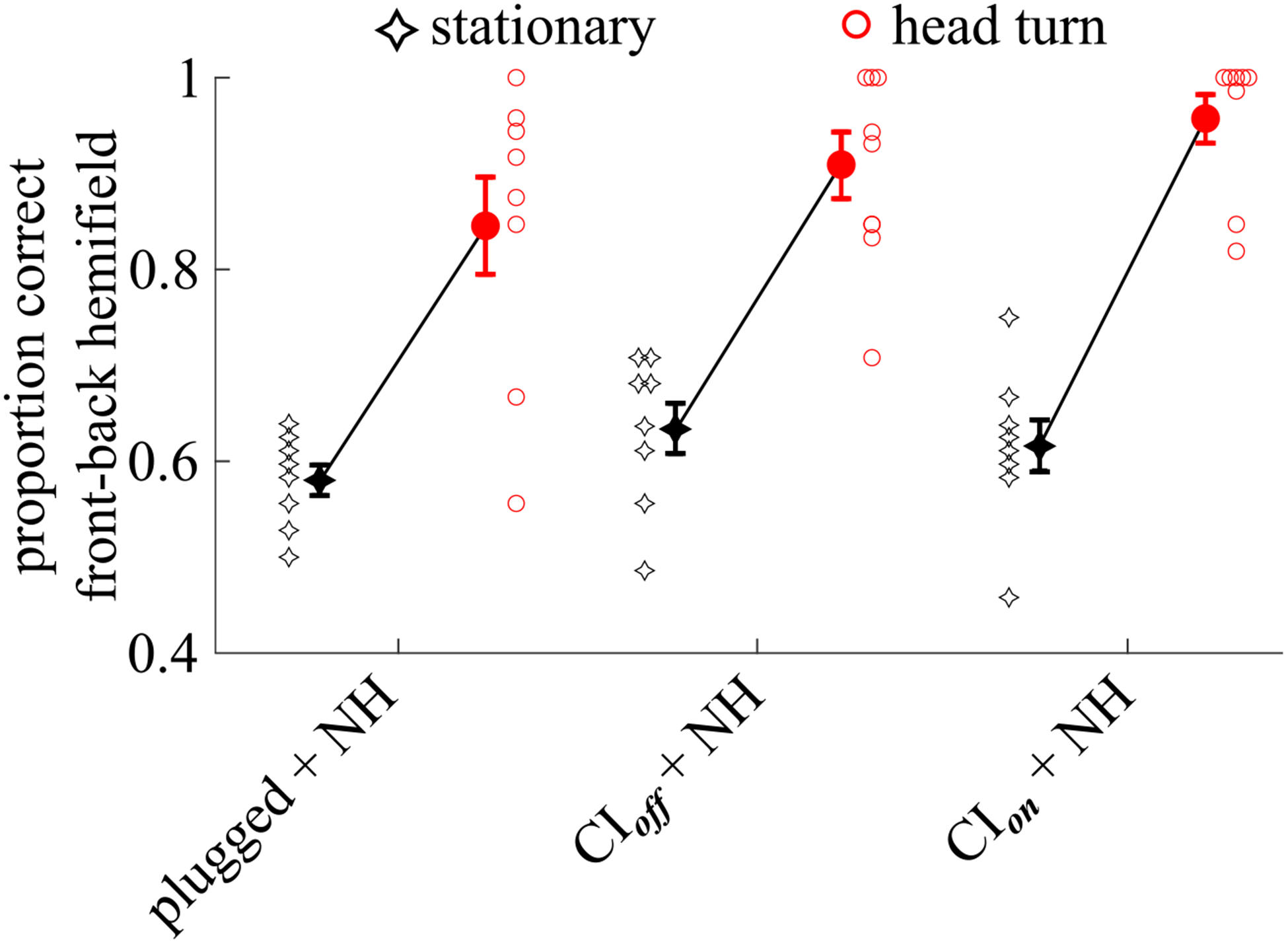
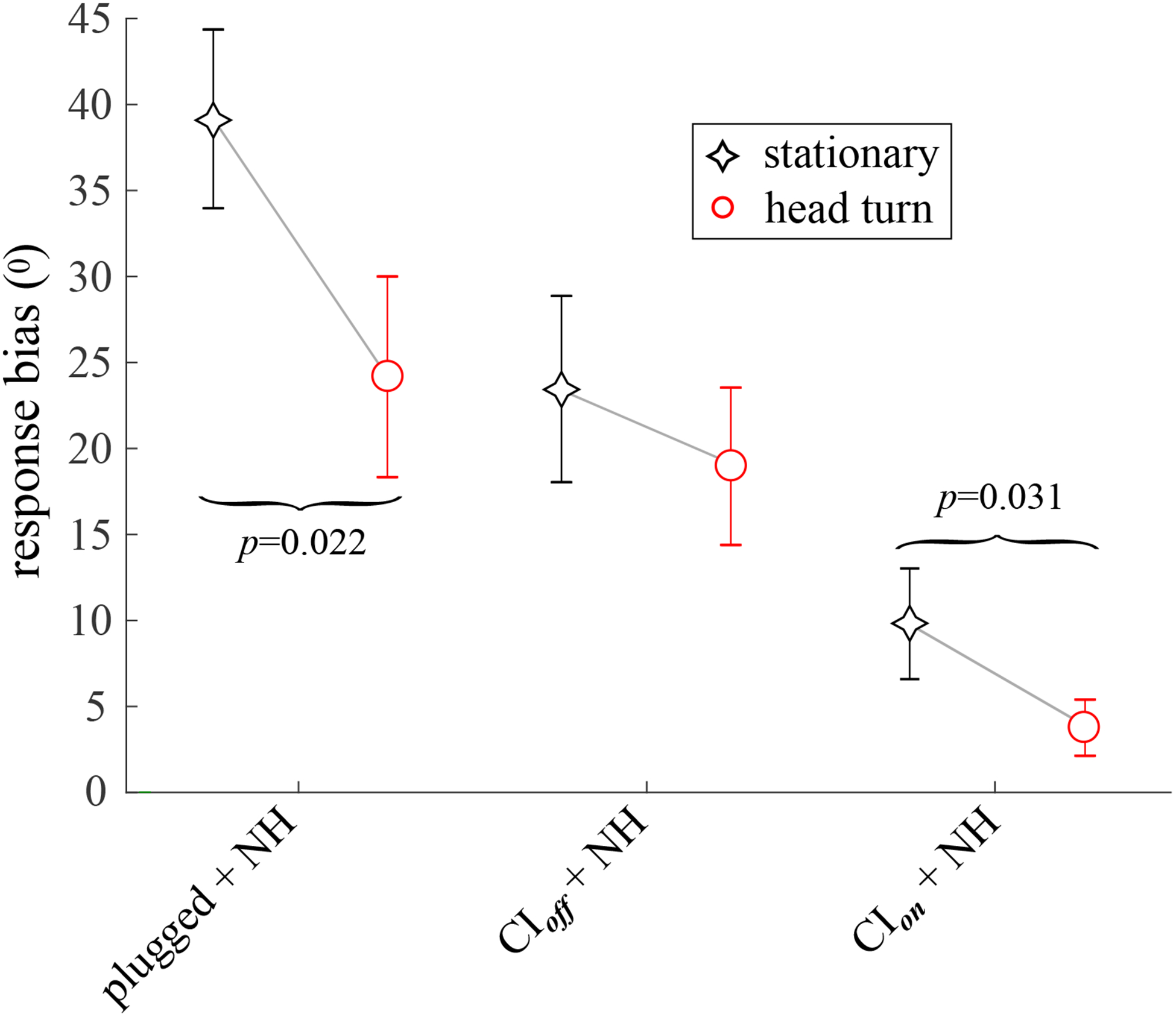
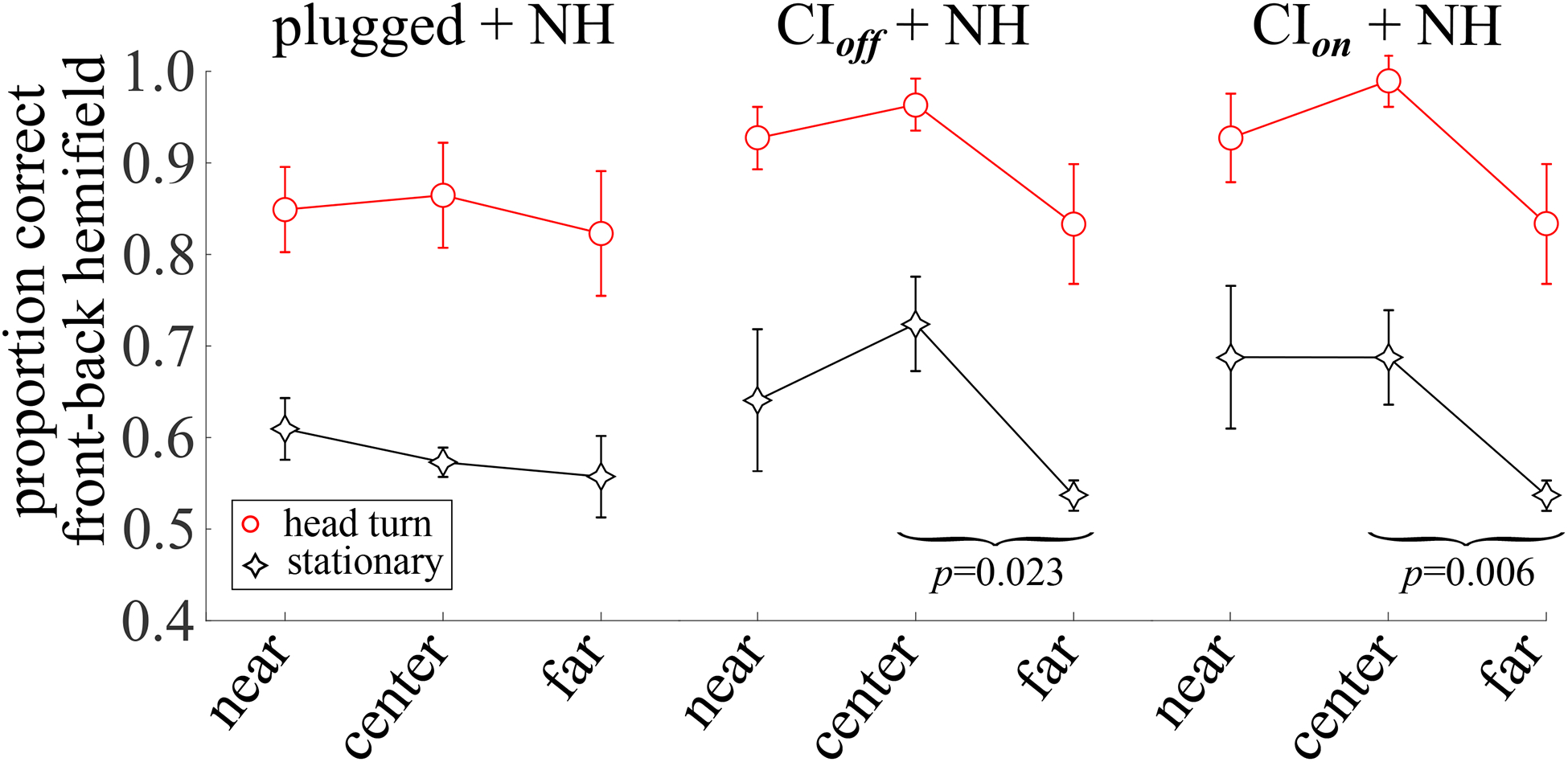
(1) Under stationary listener conditions, unilaterally-plugged NH listeners and SSD-CI listeners (with their CIs both on and off) were nearly at chance in determining the front-back location of high-frequency sound sources. (2) Allowing rotational head movements improved performance in both the front-back and left-right dimensions for all listeners. (3) For SSD-CI patients with their CI turned off, head rotations substantially reduced front-back reversals, and the combination of turning on the CI with head rotations led to near-perfect resolution of front-back sound source location. (4) Turning on the CI also improved left-right localization performance. (5) As expected, NH listeners with both ears unplugged localized to the correct front-back and left-right hemifields both with and without head movements.

CONCLUSIONS

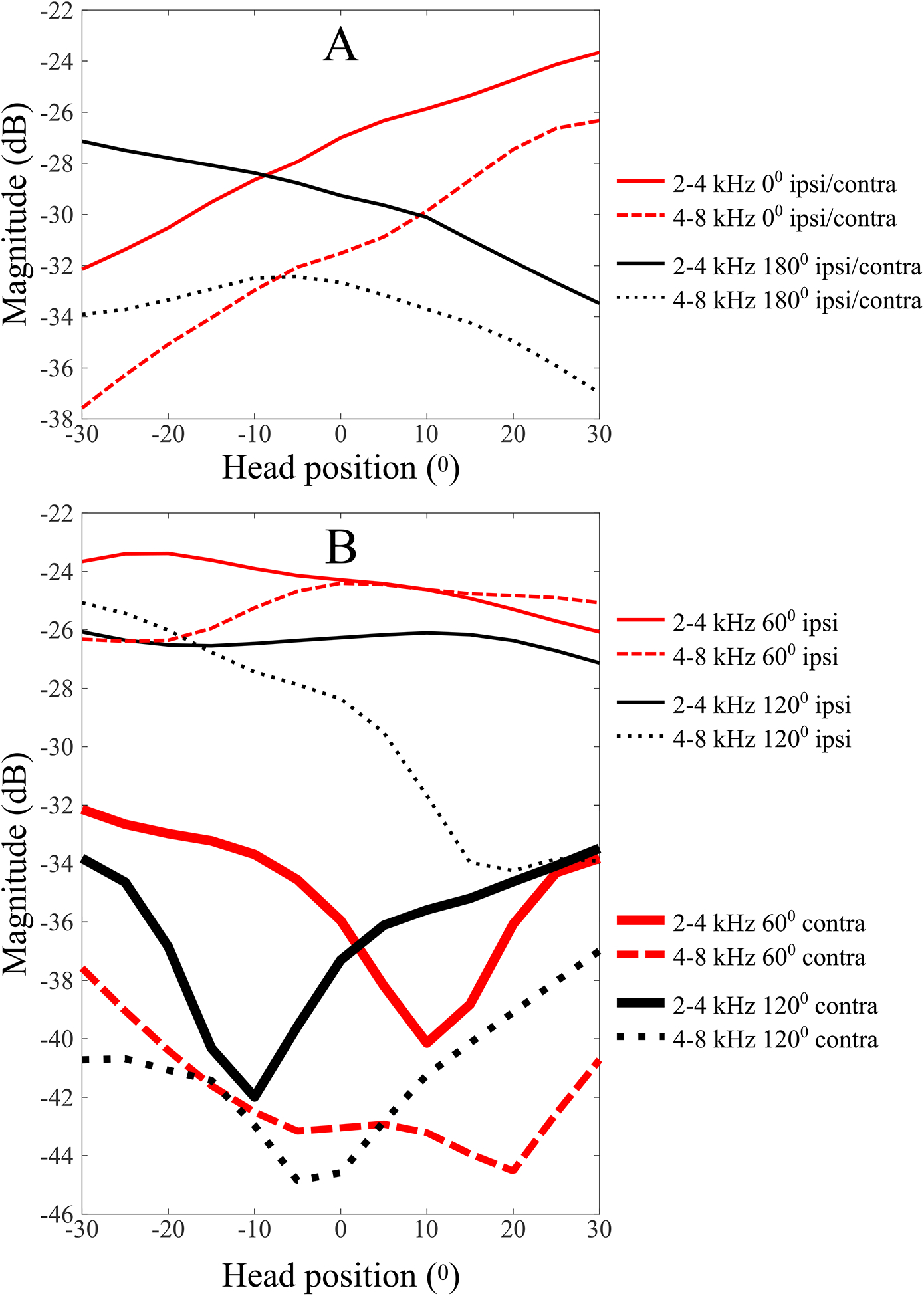
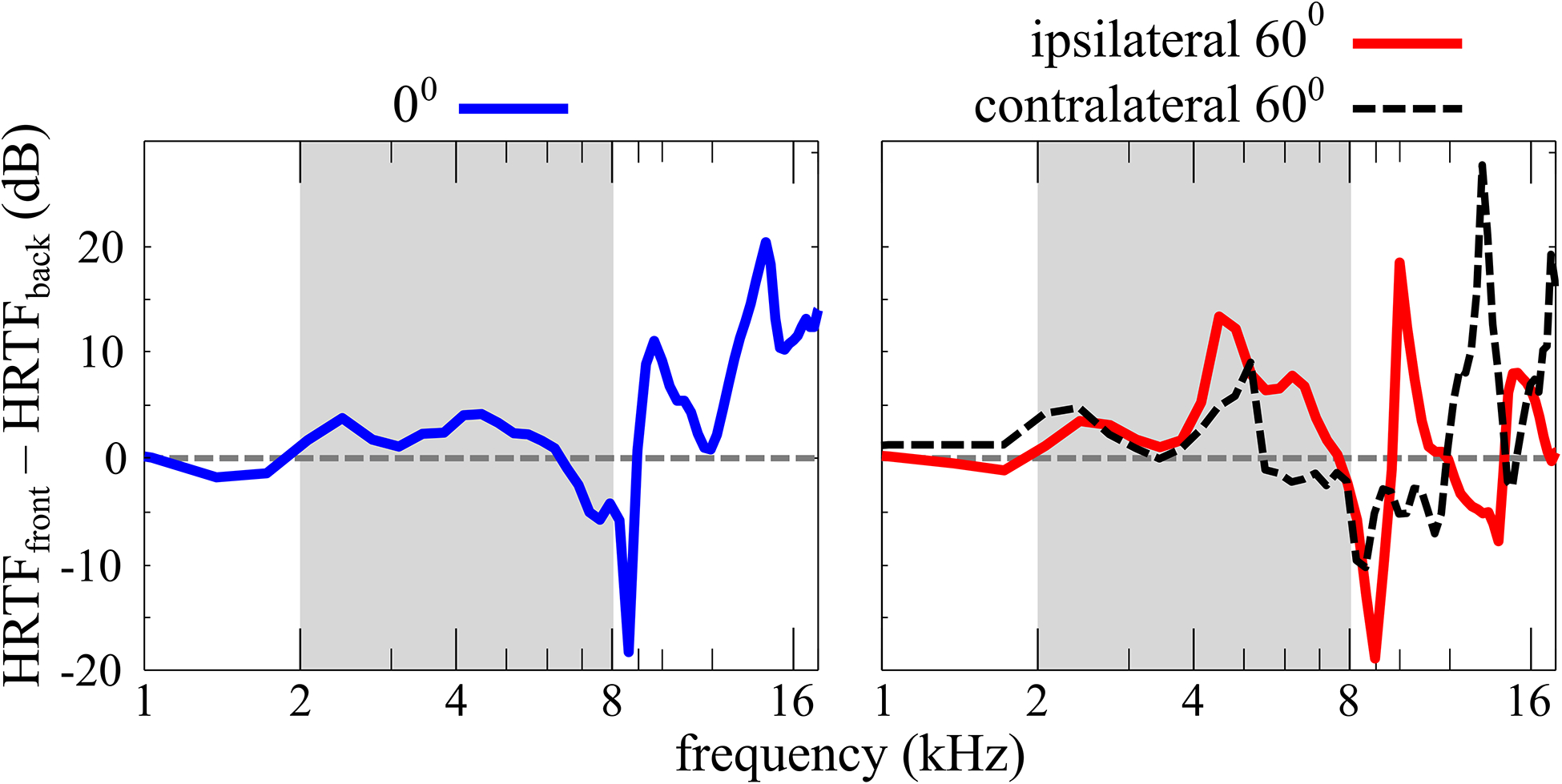
Although SSD-CI listeners demonstrate a relatively poor ability to distinguish the front-back location of sound sources when their head is stationary, their performance is substantially improved with head movements. Most of this improvement occurs when the CI is off, suggesting that the NH ear does most of the "work" in this regard, though some additional gain is introduced with turning the CI on. During head turns, these listeners appear to primarily rely on comparing changes in head position to changes in monaural level cues produced by the direction-dependent attenuation of high-frequency sounds that result from acoustic head shadowing. In this way, SSD-CI listeners overcome limitations to the reliability of monaural spectral and level cues under stationary conditions. SSD-CI listeners may have learned, through chronic monaural experience before CI implantation, or with the relatively impoverished spatial cues provided by their CI-implanted ear, to exploit the monaural level cue. Unilaterally-plugged NH listeners were also able to use this cue during the experiment to realize approximately the same magnitude of benefit from head turns just minutes after plugging, though their performance was less accurate than that of the SSD-CI listeners, both with and without their CI turned on.

摘要

目的

我们研究了植入人工耳蜗的单侧聋患者(SSD-CI)的以下能力:(1)确定来自围绕听者的扬声器的声源的前后和左右位置;(2)利用小幅度头部转动进一步改善其定位表现。所得行为数据用于进一步分析,以研究所谓“单耳”频谱形状线索对前后声源定位的价值。

设计

对8名SSD-CI患者在人工耳蜗(CI)开启和关闭状态下进行测试。还测试了8名正常听力(NH)听者,其中一组在实验期间一只耳朵堵塞,另一组8名NH听者两只耳朵均未堵塞。将持续3秒的高斯噪声进行带通滤波至2 - 8kHz,并从围绕听者的6个扬声器中的1个发出,扬声器间隔60°。在患者头部静止向前的条件下以及在他们在(全文包含公式)之间转动头部的条件下测试感知到的声源定位。

结果

(1)在听者静止的条件下,单侧堵塞的NH听者和SSD-CI听者(CI开启和关闭状态)在确定高频声源的前后位置时几乎是随机的。(2)允许头部转动提高了所有听者在前后和左右维度上的表现。(3)对于CI关闭的SSD-CI患者,头部转动显著减少了前后反转,并且CI开启与头部转动相结合导致前后声源位置几乎完美分辨。(4)CI开启也改善了左右定位表现。(5)正如预期的那样,两只耳朵均未堵塞的NH听者在有和没有头部运动的情况下都能定位到正确的前后和左右半视野。

结论

尽管SSD-CI听者在头部静止时区分声源前后位置的能力相对较差,但头部运动可使其表现大幅改善。这种改善大部分发生在CI关闭时,这表明NH耳在这方面起了大部分“作用”,尽管开启CI也带来了一些额外的提升。在头部转动期间,这些听者似乎主要依靠比较头部位置的变化与由声头影导致的高频声音方向依赖性衰减产生的单耳水平线索的变化。通过这种方式,SSD-CI听者克服了静止条件下单耳频谱和水平线索可靠性的限制。SSD-CI听者可能通过人工耳蜗植入前的长期单耳经验,或通过其植入CI的耳朵提供的相对匮乏的空间线索,学会了利用单耳水平线索。单侧堵塞的NH听者在实验期间也能够使用这种线索,在堵塞后几分钟内从头部转动中获得大致相同程度的益处,尽管无论CI开启与否,他们的表现都不如SSD-CI听者准确。
https://cdn.ncbi.nlm.nih.gov/pmc/blobs/0e1c/7772279/848afd58396e/nihms-1581344-f0007.jpg
https://cdn.ncbi.nlm.nih.gov/pmc/blobs/0e1c/7772279/930e77a83b94/nihms-1581344-f0001.jpg
https://cdn.ncbi.nlm.nih.gov/pmc/blobs/0e1c/7772279/c50fba2341c1/nihms-1581344-f0002.jpg
https://cdn.ncbi.nlm.nih.gov/pmc/blobs/0e1c/7772279/32dfd866ca3b/nihms-1581344-f0003.jpg
https://cdn.ncbi.nlm.nih.gov/pmc/blobs/0e1c/7772279/29a7a93c1e82/nihms-1581344-f0004.jpg
https://cdn.ncbi.nlm.nih.gov/pmc/blobs/0e1c/7772279/b924b1cee391/nihms-1581344-f0005.jpg
https://cdn.ncbi.nlm.nih.gov/pmc/blobs/0e1c/7772279/794a93997938/nihms-1581344-f0006.jpg
https://cdn.ncbi.nlm.nih.gov/pmc/blobs/0e1c/7772279/848afd58396e/nihms-1581344-f0007.jpg
https://cdn.ncbi.nlm.nih.gov/pmc/blobs/0e1c/7772279/930e77a83b94/nihms-1581344-f0001.jpg
https://cdn.ncbi.nlm.nih.gov/pmc/blobs/0e1c/7772279/c50fba2341c1/nihms-1581344-f0002.jpg
https://cdn.ncbi.nlm.nih.gov/pmc/blobs/0e1c/7772279/32dfd866ca3b/nihms-1581344-f0003.jpg
https://cdn.ncbi.nlm.nih.gov/pmc/blobs/0e1c/7772279/29a7a93c1e82/nihms-1581344-f0004.jpg
https://cdn.ncbi.nlm.nih.gov/pmc/blobs/0e1c/7772279/b924b1cee391/nihms-1581344-f0005.jpg
https://cdn.ncbi.nlm.nih.gov/pmc/blobs/0e1c/7772279/794a93997938/nihms-1581344-f0006.jpg
https://cdn.ncbi.nlm.nih.gov/pmc/blobs/0e1c/7772279/848afd58396e/nihms-1581344-f0007.jpg

相似文献

1
Effects of Head Movements on Sound-Source Localization in Single-Sided Deaf Patients With Their Cochlear Implant On Versus Off.头部运动对单侧聋患者在人工耳蜗开机与关机状态下声源定位的影响。
Ear Hear. 2020 Nov/Dec;41(6):1660-1674. doi: 10.1097/AUD.0000000000000882.
2
Head Movements Allow Listeners Bilaterally Implanted With Cochlear Implants to Resolve Front-Back Confusions.头部运动使双侧植入人工耳蜗的听众能够解决前后混淆问题。
Ear Hear. 2018 Nov/Dec;39(6):1224-1231. doi: 10.1097/AUD.0000000000000581.
3
Single-Sided Deafness Cochlear Implant Sound-Localization Behavior With Multiple Concurrent Sources.单侧耳聋人工耳蜗在多个并发声源情况下的声音定位行为
Ear Hear. 2022 Jan/Feb;43(1):206-219. doi: 10.1097/AUD.0000000000001089.
4
Synchronizing Automatic Gain Control in Bilateral Cochlear Implants Mitigates Dynamic Localization Deficits Introduced by Independent Bilateral Compression.双侧人工耳蜗中的自动增益控制同步可减轻独立双侧压缩引起的动态定位缺陷。
Ear Hear. 2024;45(4):969-984. doi: 10.1097/AUD.0000000000001492. Epub 2024 Mar 13.
5
The Effect of Interaural Mismatches on Contralateral Unmasking With Single-Sided Vocoders.双耳失配对单侧声码器对侧掩蔽的影响。
Ear Hear. 2017 May/Jun;38(3):374-386. doi: 10.1097/AUD.0000000000000374.
6
Binaural Optimization of Cochlear Implants: Discarding Frequency Content Without Sacrificing Head-Shadow Benefit.人工耳蜗的双耳优化:在不牺牲头影效应益处的情况下摒弃频率成分
Ear Hear. 2020 May/Jun;41(3):576-590. doi: 10.1097/AUD.0000000000000784.
7
Acoustic Hearing Can Interfere With Single-Sided Deafness Cochlear-Implant Speech Perception.声觉可以干扰单侧聋人工耳蜗植入者的言语感知。
Ear Hear. 2020 Jul/Aug;41(4):747-761. doi: 10.1097/AUD.0000000000000805.
8
Cochlear Implant Facilitates the Use of Talker Sex and Spatial Cues to Segregate Competing Speech in Unilaterally Deaf Listeners.人工耳蜗有助于单侧耳聋听众利用说话者性别和空间线索来分离竞争性言语。
Ear Hear. 2023;44(1):77-91. doi: 10.1097/AUD.0000000000001254. Epub 2022 Jun 23.
9
Spatial Hearing Difficulties in Reaching Space in Bilateral Cochlear Implant Children Improve With Head Movements.双侧人工耳蜗植入儿童在空间中定位声源的空间听觉困难可随头部运动而改善。
Ear Hear. 2022 Jan/Feb;43(1):192-205. doi: 10.1097/AUD.0000000000001090.
10
Sound Source Localization by Cochlear Implant Recipients with Normal Hearing in the Contralateral Ear: Effects of Spectral Content and Duration of Listening Experience.正常听力对侧耳的人工耳蜗植入者声源定位:频谱内容和聆听经验持续时间的影响。
Audiol Neurootol. 2022;27(6):437-448. doi: 10.1159/000523969. Epub 2022 Apr 19.

引用本文的文献

1
Evaluating Auditory Localization Capabilities in Young Patients with Single-Side Deafness.评估单侧耳聋年轻患者的听觉定位能力。
Audiol Res. 2025 Jul 9;15(4):85. doi: 10.3390/audiolres15040085.
2
Children With Bilateral Cochlear Implants Show Emerging Spatial Hearing of Stationary and Moving Sound.双侧人工耳蜗植入儿童表现出对静止和移动声音的空间听觉逐渐形成。
Trends Hear. 2025 Jan-Dec;29:23312165251356333. doi: 10.1177/23312165251356333. Epub 2025 Jul 4.
3
Sound-seeking before and after hearing loss in mice.小鼠听力损失前后的声寻求行为。

本文引用的文献

1
Sound source localization is a multisystem process.声源定位是一个多系统过程。
Acoust Sci Technol. 2020 Jan;41(1):113-120. doi: 10.1250/ast.41.113.
2
Sound-source localization as a multisystem process: The Wallach azimuth illusion.声源定位作为一个多系统过程:沃拉赫方位错觉。
J Acoust Soc Am. 2019 Jul;146(1):382. doi: 10.1121/1.5116003.
3
Simulations of the effect of unlinked cochlear-implant automatic gain control and head movement on interaural level differences.不相关的人工耳蜗自动增益控制和头部运动对侧间水平差的影响的模拟。
Sci Rep. 2024 Aug 19;14(1):19181. doi: 10.1038/s41598-024-67577-7.
4
Spatial hearing training in virtual reality with simulated asymmetric hearing loss.虚拟现实环境下模拟非对称听力损失的空间听觉训练。
Sci Rep. 2024 Jan 30;14(1):2469. doi: 10.1038/s41598-024-51892-0.
5
Sound-seeking before and after hearing loss in mice.小鼠听力丧失前后的声音寻找行为。
bioRxiv. 2024 Jan 9:2024.01.08.574475. doi: 10.1101/2024.01.08.574475.
6
Randomizing spectral cues used to resolve front-back reversals in sound-source localization.随机化用于解决声源定位中前后反转的频谱线索。
J Acoust Soc Am. 2023 Aug 1;154(2):661-670. doi: 10.1121/10.0020563.
7
Differing postural control patterns in individuals with bilateral and unilateral hearing loss.双侧和单侧听力损失个体的不同姿势控制模式。
Am J Otolaryngol. 2023 Jul-Aug;44(4):103866. doi: 10.1016/j.amjoto.2023.103866. Epub 2023 Mar 23.
8
Dynamic spectral cues do not affect human sound localization during small head movements.在小幅度头部运动过程中,动态频谱线索不会影响人类的声音定位。
Front Neurosci. 2023 Feb 3;17:1027827. doi: 10.3389/fnins.2023.1027827. eCollection 2023.
9
Instant improvement in monaural spatial hearing abilities through cognitive feedback.通过认知反馈,单耳空间听觉能力即刻改善。
Exp Brain Res. 2022 May;240(5):1357-1369. doi: 10.1007/s00221-022-06333-7. Epub 2022 Mar 3.
10
Proficiency in Using Level Cue for Sound Localization Is Related to the Auditory Cortical Structure in Patients With Single-Sided Deafness.使用水平线索进行声音定位的熟练程度与单侧耳聋患者的听觉皮层结构有关。
Front Neurosci. 2021 Oct 11;15:749824. doi: 10.3389/fnins.2021.749824. eCollection 2021.
J Acoust Soc Am. 2019 Mar;145(3):1389. doi: 10.1121/1.5093623.
4
Audiovisual Interactions in Stereo Sound Localization for Individuals With Unilateral Hearing Loss.单侧听力损失个体的立体声声音定位中的视听相互作用。
Trends Hear. 2019 Jan-Dec;23:2331216519846232. doi: 10.1177/2331216519846232.
5
Mechanisms of Localization and Speech Perception with Colocated and Spatially Separated Noise and Speech Maskers Under Single-Sided Deafness with a Cochlear Implant.单侧聋患者使用人工耳蜗时,共定位和语音感知的机制与共定位和空间分离噪声和语音掩蔽器
Ear Hear. 2019 Nov/Dec;40(6):1293-1306. doi: 10.1097/AUD.0000000000000708.
6
Effects of Cochlear Implantation on Binaural Hearing in Adults With Unilateral Hearing Loss.人工耳蜗植入对单侧听力损失成人双耳听觉的影响。
Trends Hear. 2018 Jan-Dec;22:2331216518771173. doi: 10.1177/2331216518771173.
7
Head Movements Allow Listeners Bilaterally Implanted With Cochlear Implants to Resolve Front-Back Confusions.头部运动使双侧植入人工耳蜗的听众能够解决前后混淆问题。
Ear Hear. 2018 Nov/Dec;39(6):1224-1231. doi: 10.1097/AUD.0000000000000581.
8
Effect of Cochlear Implantation on Quality of Life in Adults with Unilateral Hearing Loss.人工耳蜗植入对单侧听力损失成人生活质量的影响。
Audiol Neurootol. 2017;22(4-5):259-271. doi: 10.1159/000484079. Epub 2018 Jan 4.
9
Unilateral Hearing Loss: Understanding Speech Recognition and Localization Variability-Implications for Cochlear Implant Candidacy.单侧听力损失:理解言语识别和定位变异性——对人工耳蜗植入候选资格的影响
Ear Hear. 2017 Mar/Apr;38(2):159-173. doi: 10.1097/AUD.0000000000000380.
10
Sound Source Localization by Normal-Hearing Listeners, Hearing-Impaired Listeners and Cochlear Implant Listeners.正常听力者、听力受损者及人工耳蜗使用者的声源定位
Audiol Neurootol. 2016;21(3):127-31. doi: 10.1159/000444740. Epub 2016 Apr 15.