Eckels Mary, Zeilinger Terry, Lee Henry C, Bergin Janine, Halamek Louis P, Yamada Nicole, Fuerch Janene, Chitkara Ritu, Quinn Jenny
Maternal Newborn Services, St. Jude Medical Center, Fullerton, CA 92835, USA.
Neonatal Intensive Care Unit, Lucile Packard Children's Hospital, Stanford, CA 94305, USA.
Children (Basel). 2020 Oct 29;7(11):202. doi: 10.3390/children7110202.
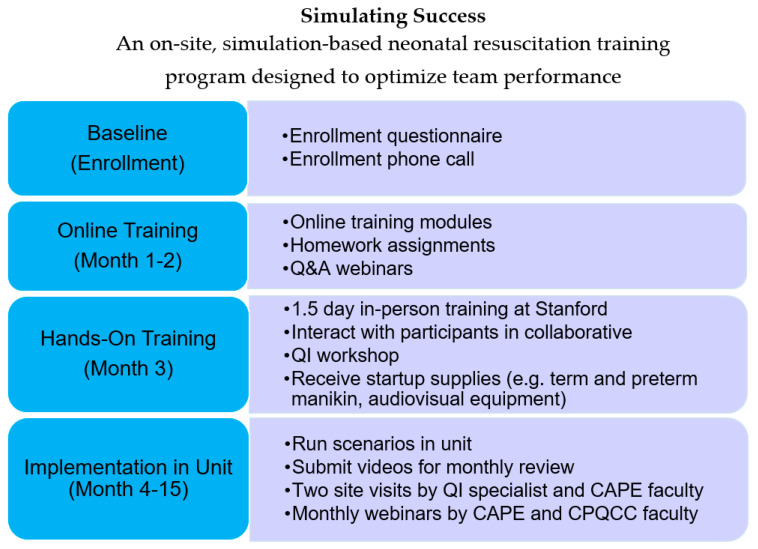
Extensive neonatal resuscitation is a high acuity, low-frequency event accounting for approximately 1% of births. Neonatal resuscitation requires an interprofessional healthcare team to communicate and carry out tasks efficiently and effectively in a high adrenaline state. Implementing a neonatal patient safety simulation and debriefing program can help teams improve the behavioral, cognitive, and technical skills necessary to reduce morbidity and mortality. In , a 15-month quality improvement (QI) project, the Center for Advanced Pediatric and Perinatal Education (CAPE) and California Perinatal Quality Care Collaborative (CPQCC) provided outreach and training on neonatal simulation and debriefing fundamentals to individual teams, including community hospital settings, and assisted in implementing a sustainable program at each site. The primary Aim was to conduct two simulations a month, with a goal of 80% neonatal intensive care unit (NICU) staff participation in two simulations during the implementation phase. While the primary Aim was not achieved, in-situ simulations led to the identification of latent safety threats and improvement in system processes. This paper describes one unit's QI collaborative experience implementing an in-situ neonatal simulation and debriefing program.
广泛的新生儿复苏是一种高敏锐度、低频率的事件,约占出生人数的1%。新生儿复苏需要跨专业的医疗团队在高度紧张的状态下高效且有效地进行沟通和执行任务。实施新生儿患者安全模拟和汇报程序有助于团队提升行为、认知和技术技能,这些技能对于降低发病率和死亡率至关重要。在一个为期15个月的质量改进(QI)项目中,高级儿科和围产期教育中心(CAPE)以及加利福尼亚围产期质量护理协作组织(CPQCC)向各个团队,包括社区医院的团队,提供了关于新生儿模拟和汇报基础的推广及培训,并协助在每个地点实施可持续的项目。主要目标是每月进行两次模拟,目标是在实施阶段80%的新生儿重症监护病房(NICU)工作人员参与两次模拟。虽然未达成主要目标,但现场模拟促成了潜在安全威胁的识别以及系统流程的改进。本文描述了一个科室实施现场新生儿模拟和汇报程序的质量改进协作经验。