Alcázar Rubén, Bueno Milagros, Tiburcio Antonio F
Polyamine's Laboratory, Department of Biology, Healthcare and Environment, Faculty of Pharmacy and Food Sciences, University of Barcelona, 08028 Barcelona, Spain.
Laboratory of Plant Physiology, Department of Animal Biology, Plant Biology and Ecology, Faculty of Experimental Science, University of Jaén, E-23071 Jaén, Spain.
Cells. 2020 Oct 29;9(11):2373. doi: 10.3390/cells9112373.
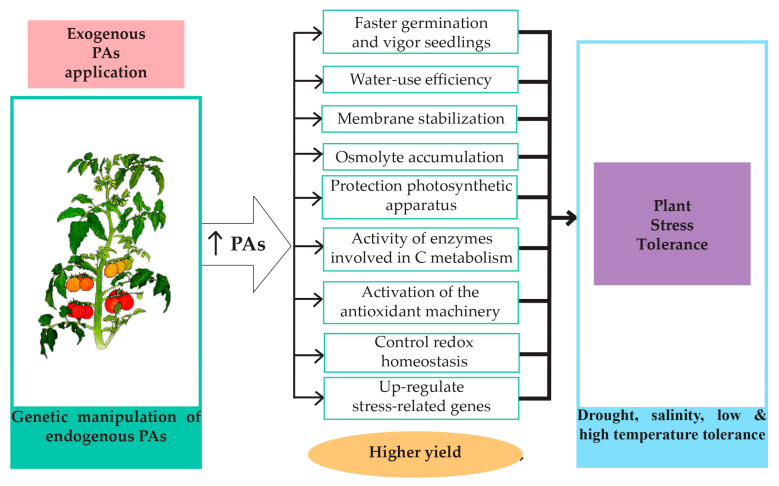
In recent years, climate change has altered many ecosystems due to a combination of frequent droughts, irregular precipitation, increasingly salinized areas and high temperatures. These environmental changes have also caused a decline in crop yield worldwide. Therefore, there is an urgent need to fully understand the plant responses to abiotic stress and to apply the acquired knowledge to improve stress tolerance in crop plants. The accumulation of polyamines (PAs) in response to many abiotic stresses is one of the most remarkable plant metabolic responses. In this review, we provide an update about the most significant achievements improving plant tolerance to drought, salinity, low and high temperature stresses by exogenous application of PAs or genetic manipulation of endogenous PA levels. We also provide some clues about possible mechanisms underlying PA functions, as well as known cross-talks with other stress signaling pathways. Finally, we discuss about the possible use of PAs for seed priming to induce abiotic stress tolerance in agricultural valuable crop plants.
近年来,由于频繁干旱、降水不均、土壤盐渍化加剧和高温等多种因素的综合作用,气候变化已经改变了许多生态系统。这些环境变化也导致了全球作物产量的下降。因此,迫切需要全面了解植物对非生物胁迫的反应,并将所获得的知识应用于提高作物的胁迫耐受性。多胺(PAs)在响应多种非生物胁迫时的积累是最显著的植物代谢反应之一。在这篇综述中,我们提供了有关通过外源施用多胺或对内源多胺水平进行基因操作来提高植物对干旱、盐度、低温和高温胁迫耐受性的最重要成果的最新信息。我们还提供了一些关于多胺功能潜在机制的线索,以及与其他胁迫信号通路已知的相互作用。最后,我们讨论了多胺在种子引发方面的可能用途,以诱导具有农业价值的作物对非生物胁迫的耐受性。