Department of Midwifery, College of Medicine and Health Sciences, Bahir Dar University, Bahir Dar, Ethiopia.
Department of Orthopedics, College of Medicine and Health Sciences, Bahir Dar University, Bahir Dar, Ethiopia.
Syst Rev. 2020 Nov 3;9(1):251. doi: 10.1186/s13643-020-01505-4.
Globally, a total of 13.6 million women have died due to maternal causes from 1990 to 2015. Majority of these deaths occurred in resource-limited countries. Among the causes of these deaths, obstructed and prolonged labor covers the highest percentage, which could be prevented by cost-effective and affordable health interventions like partograph use. Therefore, this systematic review and meta-analysis aimed to assess the level of partograph utilization among obstetric care providers and its associated factors in Ethiopia.
For this review, we used the standard PRISMA checklist guideline. Different online databases were used for the review: PubMed/Medline, Google Scholar, EMBASE, Cochrane Library, HINARI, WHO Afro Library Databases, and African Online Journals. Based on the adapted PICO principles, different search terms were applied to achieve and access all the essential articles. Microsoft Excel was used for data entry and Stata version 11.0 (Stata Corporation, College Station, TX, USA) for data analysis.
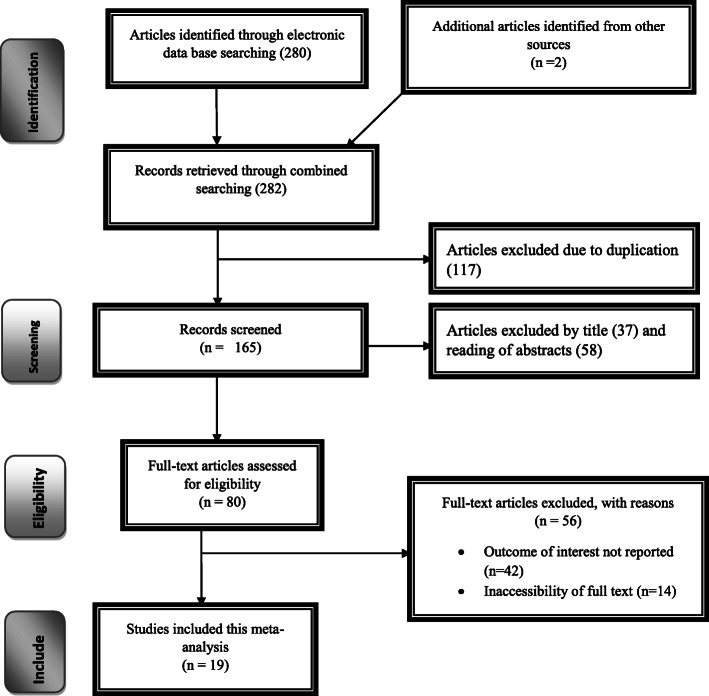
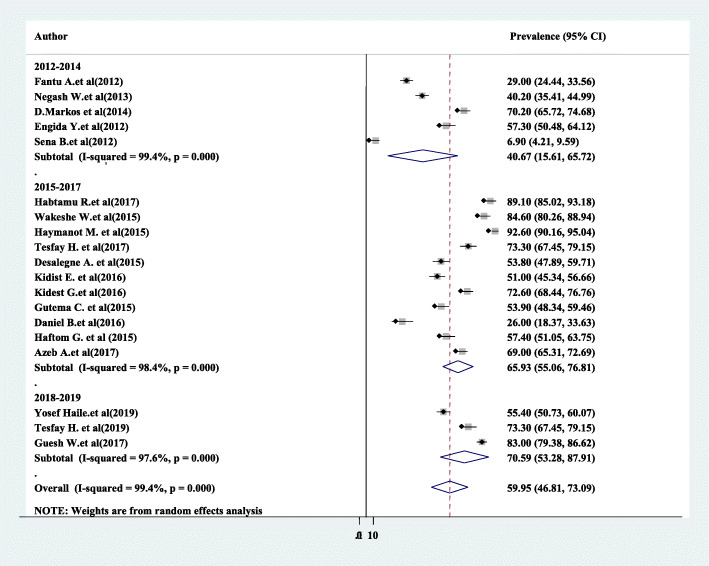
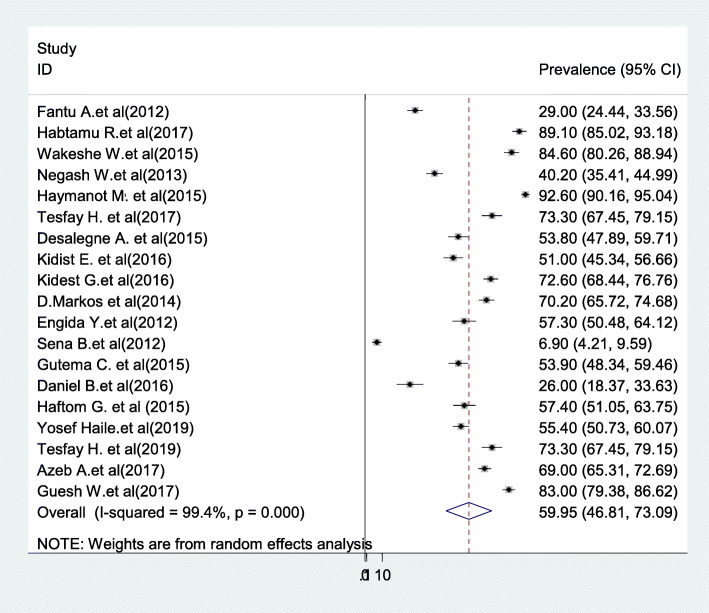
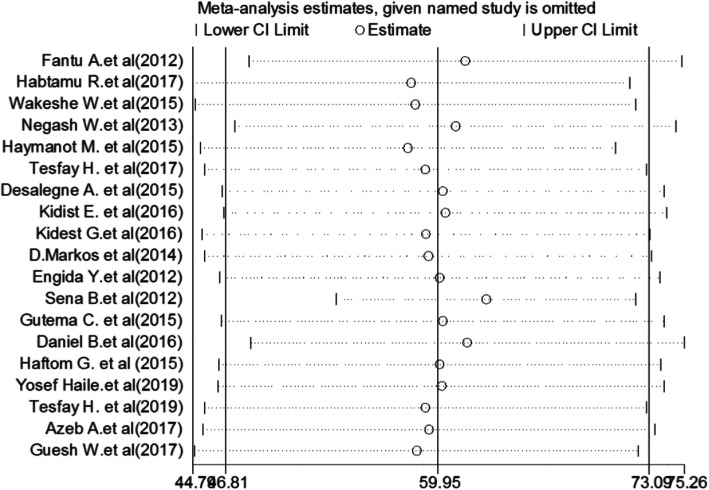
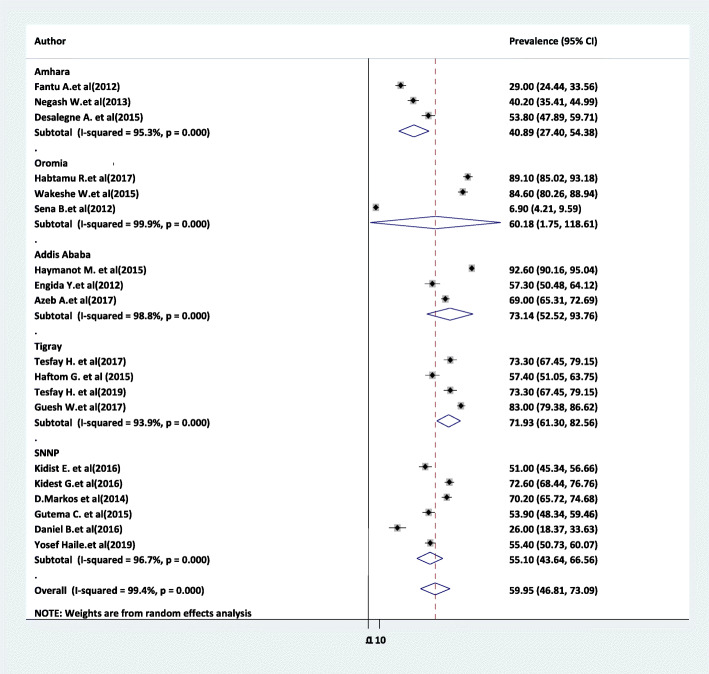
Nineteen studies were included in this systematic review and meta-analysis with a total of 6237 obstetric care providers. The overall pooled prevalence of partograph utilization was 59.95% (95% CI 46.8-73.09, I = 99.4%, P < 0.001). Being in midwifery profession (adjusted odds ratio (AOR) 3.97; 95% confidence interval (CI) 2.63-5.99, I = 28.8%, P = 0.198), presence of supervision (AOR = 3.21; 95% CI 2.22-4.66, I = 0.0%, P = 0.742), Basic Emergency Obstetric and Newborn Care (BEmONC) training (AOR = 2.90; 95% CI 2.19-3.84, I = 36.9%, P = 0.13), knowledge of partograph (AOR = 2.5; 95% CI 1.6-3.8, I = 64.58%, P = 0.024), on-the-job refresher training on partograph (AOR = 5.7; 95% CI 2.5-12.9, I = 87.8%, P < 0.001), favorable attitude (AOR = 2.12; 95% CI 1.48-3.04, I = 0.0%, P = 0.58), and working at health center (AOR = 3.50; 95% CI 2.49-4.92, I = 49.1%, P = 0.08) were the determinant factors for partograph use among obstetric care providers in Ethiopia.
The overall pooled prevalence of partograph utilization among obstetric care providers was low. Therefore, supportive supervision, providing Basic Emergency Obstetric and Newborn Care training, on-the-job refresher training on partograph, and promoting midwifery profession are strongly recommended to increase the use of partograph.
1990 年至 2015 年,全球共有 1360 万妇女死于孕产妇原因。这些死亡大多发生在资源有限的国家。在这些死亡原因中,梗阻性和延长性分娩占比最高,可以通过使用成本效益高且负担得起的卫生干预措施,如产图,来预防。因此,本系统评价和荟萃分析旨在评估埃塞俄比亚产科护理提供者使用产图的水平及其相关因素。
为了进行这项综述,我们使用了标准的 PRISMA 清单指南。我们使用了不同的在线数据库进行综述:PubMed/Medline、Google Scholar、EMBASE、Cochrane Library、HINARI、世界卫生组织非洲图书馆数据库和非洲在线期刊。根据改编后的 PICO 原则,应用了不同的搜索词来获取和访问所有必要的文章。使用 Microsoft Excel 进行数据输入,使用 Stata 版本 11.0(Stata Corporation,College Station,TX,USA)进行数据分析。
这项系统评价和荟萃分析共纳入了 19 项研究,共有 6237 名产科护理提供者。产图使用率的总体汇总患病率为 59.95%(95%置信区间 46.8-73.09,I = 99.4%,P < 0.001)。助产专业(调整后的优势比(AOR)3.97;95%置信区间 2.63-5.99,I = 28.8%,P = 0.198)、存在监督(AOR = 3.21;95%置信区间 2.22-4.66,I = 0.0%,P = 0.742)、基础紧急产科和新生儿护理(BEmONC)培训(AOR = 2.90;95%置信区间 2.19-3.84,I = 36.9%,P = 0.13)、产图知识(AOR = 2.5;95%置信区间 1.6-3.8,I = 64.58%,P = 0.024)、产图在职进修(AOR = 5.7;95%置信区间 2.5-12.9,I = 87.8%,P < 0.001)、良好的态度(AOR = 2.12;95%置信区间 1.48-3.04,I = 0.0%,P = 0.58)和在卫生中心工作(AOR = 3.50;95%置信区间 2.49-4.92,I = 49.1%,P = 0.08)是影响产科护理提供者使用产图的决定因素。
产科护理提供者使用产图的总体汇总患病率较低。因此,强烈建议提供支持性监督、提供基础紧急产科和新生儿护理培训、产图在职进修以及促进助产专业,以提高产图的使用。