Department of Aeronautics & Astronautics, Stanford University, Stanford, CA 94305.
Department of Mechanical Engineering, Stanford University, Stanford, CA 94305.
Proc Natl Acad Sci U S A. 2020 Nov 24;117(47):29518-29525. doi: 10.1073/pnas.2010254117. Epub 2020 Nov 4.
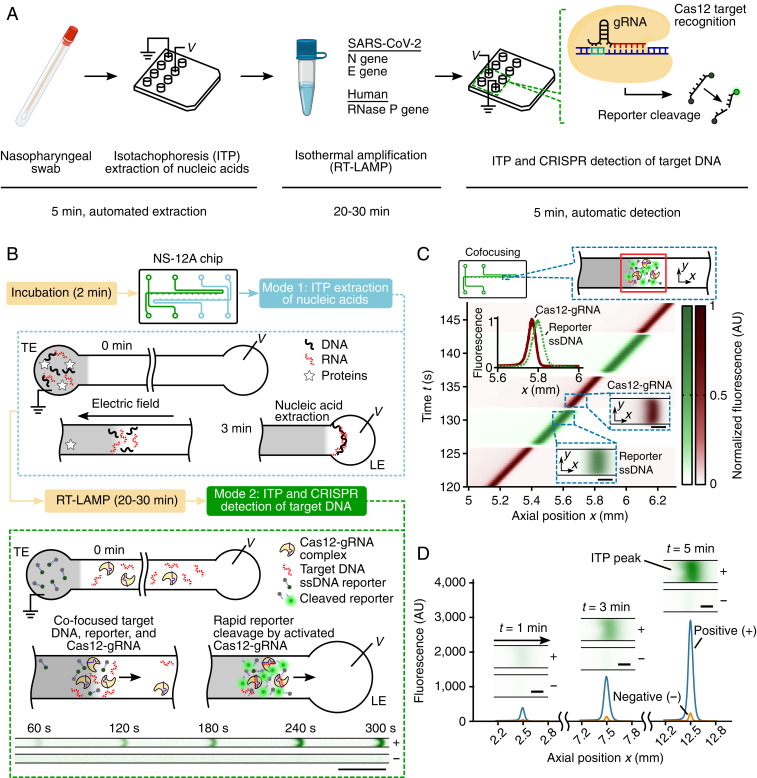
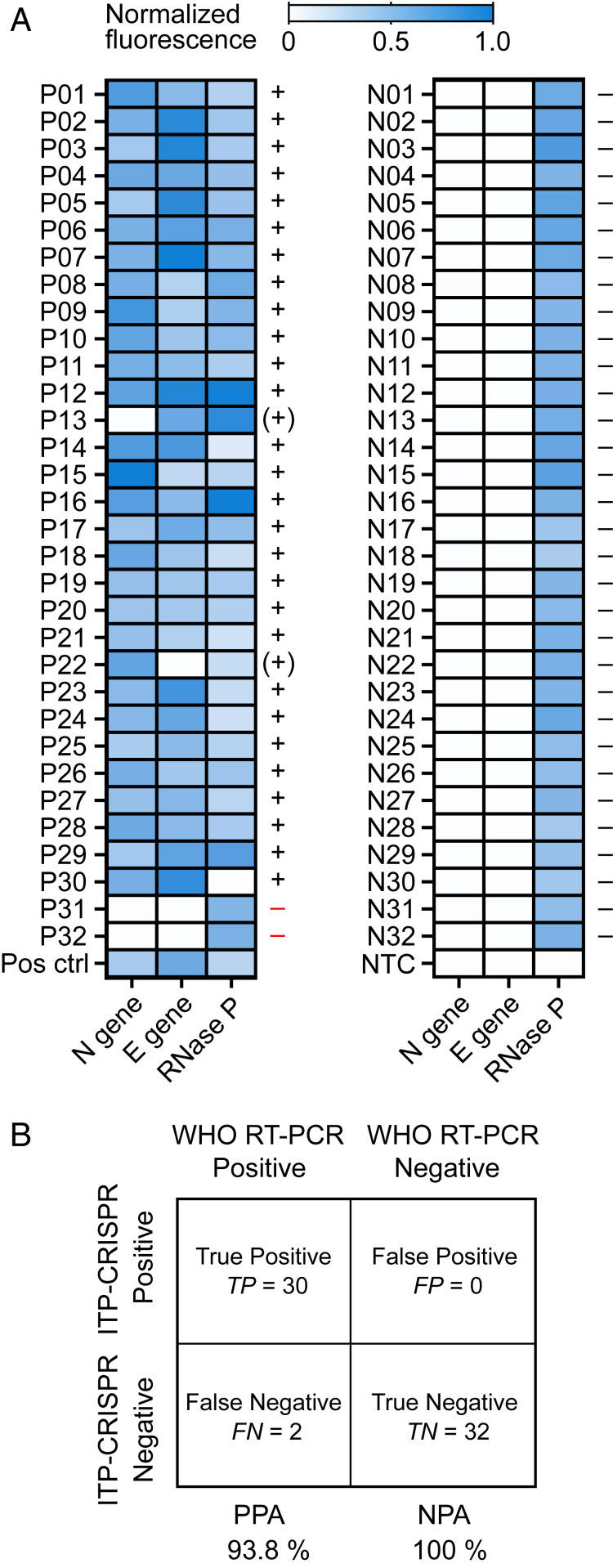
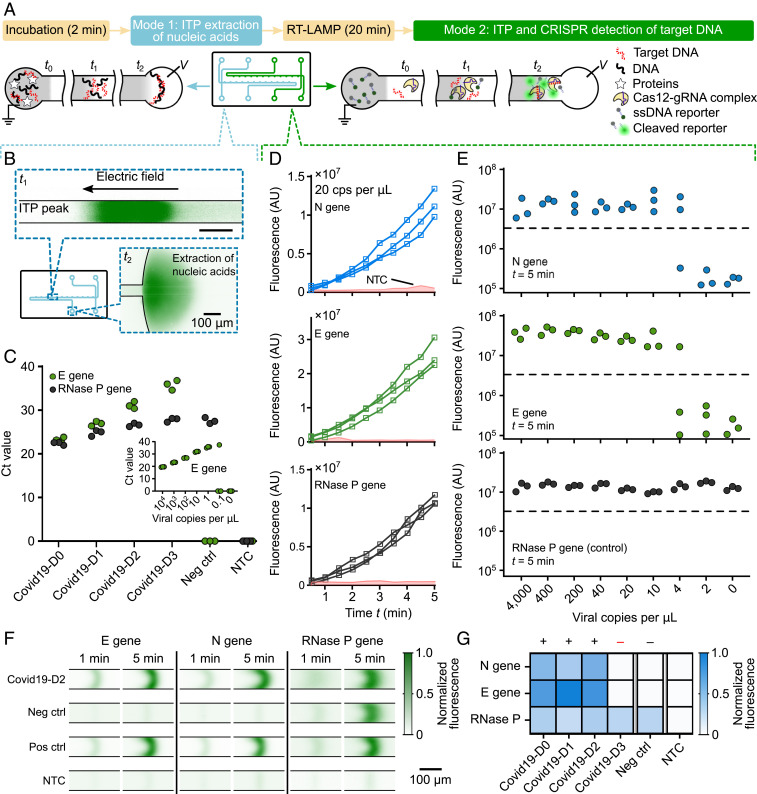
The rapid spread of COVID-19 across the world has revealed major gaps in our ability to respond to new virulent pathogens. Rapid, accurate, and easily configurable molecular diagnostic tests are imperative to prevent global spread of new diseases. CRISPR-based diagnostic approaches are proving to be useful as field-deployable solutions. In one basic form of this assay, the CRISPR-Cas12 enzyme complexes with a synthetic guide RNA (gRNA). This complex becomes activated only when it specifically binds to target DNA and cleaves it. The activated complex thereafter nonspecifically cleaves single-stranded DNA reporter probes labeled with a fluorophore-quencher pair. We discovered that electric field gradients can be used to control and accelerate this CRISPR assay by cofocusing Cas12-gRNA, reporters, and target within a microfluidic chip. We achieve an appropriate electric field gradient using a selective ionic focusing technique known as isotachophoresis (ITP) implemented on a microfluidic chip. Unlike previous CRISPR diagnostic assays, we also use ITP for automated purification of target RNA from raw nasopharyngeal swab samples. We here combine this ITP purification with loop-mediated isothermal amplification and the ITP-enhanced CRISPR assay to achieve detection of severe acute respiratory syndrome coronavirus 2 (SARS-CoV-2) RNA (from raw sample to result) in about 35 min for both contrived and clinical nasopharyngeal swab samples. This electric field control enables an alternate modality for a suite of microfluidic CRISPR-based diagnostic assays.
COVID-19 在全球范围内的迅速传播暴露了我们应对新的烈性病原体的能力存在重大差距。快速、准确、易于配置的分子诊断测试对于防止新疾病的全球传播至关重要。基于 CRISPR 的诊断方法已被证明是一种有用的现场部署解决方案。在这种检测方法的一种基本形式中,CRISPR-Cas12 酶与合成的向导 RNA(gRNA)结合。只有当它特异性地与靶 DNA 结合并切割它时,该复合物才会被激活。激活的复合物随后会非特异性地切割带有荧光团-猝灭剂对标记的单链 DNA 报告探针。我们发现可以通过在微流控芯片中共同聚焦 Cas12-gRNA、报告物和靶标,利用电场梯度来控制和加速这种 CRISPR 检测。我们使用一种称为等速电泳(ITP)的选择性离子聚焦技术在微流控芯片上实现适当的电场梯度。与以前的 CRISPR 诊断检测不同,我们还使用 ITP 从原始鼻咽拭子样本中自动纯化靶 RNA。我们将这种 ITP 纯化与环介导等温扩增和 ITP 增强的 CRISPR 检测相结合,在大约 35 分钟内从原始样本中检测到严重急性呼吸综合征冠状病毒 2(SARS-CoV-2)RNA(从原始样本到结果),无论是人工合成的还是临床鼻咽拭子样本。这种电场控制为一系列基于微流控的 CRISPR 诊断检测提供了替代模式。