Department of Electrical Engineering, Pennsylvania State University, University Park, PA, 16802, United States.
Department of Electrical Engineering, Pennsylvania State University, University Park, PA, 16802, United States; Department of Biomedical Engineering, Pennsylvania State University, University Park, PA, 16802, United States.
Biosens Bioelectron. 2021 Apr 15;178:113012. doi: 10.1016/j.bios.2021.113012. Epub 2021 Jan 21.
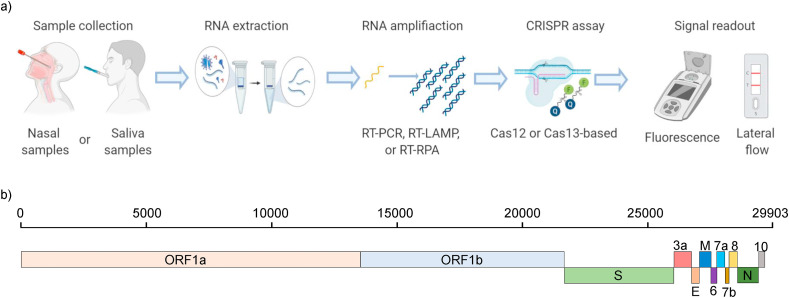
The current pandemic of the 2019 novel coronavirus (COVID-19) caused by SARS-CoV-2 (severe acute respiratory syndrome coronavirus-2) has raised significant public health concern. Rapid, affordable, and accurate diagnostics of SARS-CoV-2 is essential for early treatment and control of the disease spread. In the past few years, CRISPR technology has shown great potential for highly sensitive and specific molecular diagnostics. Amid the ongoing COVID-19 pandemic, there is an increasing interest in implementing CRISPR-based diagnostic principles to develop fast and precise methods for detecting SARS-CoV-2. In this work, we reviewed and summarized these CRISPR-based diagnostic systems as well as their characteristics and challenges. We also provided future perspectives of CRISPR-based sensing towards point-of-care molecular diagnosis applications.
当前由严重急性呼吸综合征冠状病毒 2 型(SARS-CoV-2)引起的 2019 年新型冠状病毒(COVID-19)大流行引起了重大的公共卫生关注。快速、经济实惠且准确的 SARS-CoV-2 诊断对于早期治疗和控制疾病传播至关重要。在过去的几年中,CRISPR 技术在高灵敏度和特异性分子诊断方面显示出巨大的潜力。在当前 COVID-19 大流行期间,人们越来越有兴趣实施基于 CRISPR 的诊断原理,以开发快速准确的方法来检测 SARS-CoV-2。在这项工作中,我们综述和总结了这些基于 CRISPR 的诊断系统及其特点和挑战。我们还对基于 CRISPR 的传感技术在即时护理分子诊断应用方面的未来发展进行了展望。