Sugiyama Kemmyo, Tsuboya Toru, Okita Taketoshi, Tsuchiya Naho, Tarasawa Kunio, Ogata Tomoaki, Yanaka Shintaro, Tomoda Akio
Liaison Center for Innovative Dentistry, Tohoku University Graduate School of Dentistry, Sendai, Japan.
Department of Internal Medicine, Amishou Clinic, Ishinomaki, Japan.
JMA J. 2020 Apr 15;3(2):138-145. doi: 10.31662/jmaj.2019-0026. Epub 2020 Apr 10.
To investigate the proportion of those having preferred place for end-of-life care among residents in a remote island and its association with family composition.
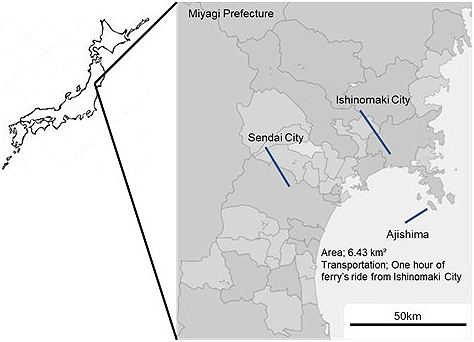
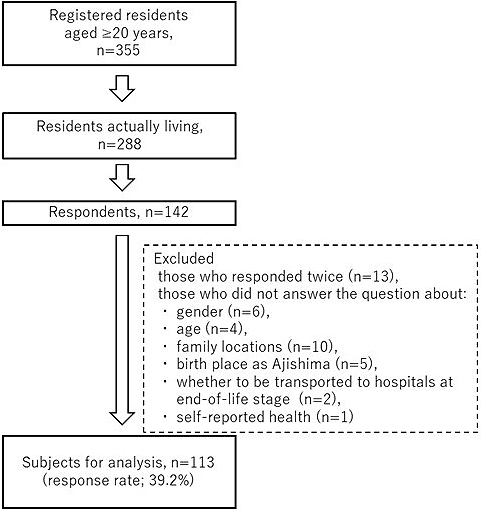
Cross-sectional questionnaire survey was conducted in Ajishima, an island 23 km away from the coast of Ishinomaki City, northeast of Japan. Between October 2017 and February 2018, the questionnaire was distributed to 288 eligible residents and 113 valid responses were analyzed. Primary outcome was whether the subjects had preferred place for end-of-life care. The explanatory variable was family composition defined as whether having family members inside or outside the island [none (In-/Out-), only inside the island (In+/Out-), only outside the island (In-/Out+), and both inside and outside (In+/Out+)]. Poisson regression analysis was used to calculate the prevalence ratios (PRs) and 95% confidence intervals (CIs) of showing preferred place in each group.
The proportion of those having preferred place for end-of-life care was 72.6% in total. This rate significantly differed across family composition groups: 67.6%, 40.0%, and 82.9% for In+/Out+, In+/Out-, and In-/Out+ groups, respectively. The PR (95%CI) of having preferred place was 0.66 (0.33, 1.36) and 1.26 (1.01, 1.56) for In+/Out- and In-/Out+ groups, respectively, compared with In+/Out+ group.
This study showed that significantly higher preference for place of end-of-life care was seen among residents who had family members only outside the island compared with those who had families both inside and outside. Health care professionals should consider family compositions when initiating end-of-life discussion to residents in remote areas.
调查偏远岛屿居民中对临终关怀首选地点的比例及其与家庭构成的关系。
在距离日本东北部石卷市海岸23公里的阿久岛进行横断面问卷调查。2017年10月至2018年2月期间,向288名符合条件的居民发放问卷,对113份有效回复进行分析。主要结果是受试者是否有临终关怀的首选地点。解释变量是家庭构成,定义为家庭成员是否在岛内或岛外[无(岛内/岛外均无)、仅在岛内(岛内有/岛外无)、仅在岛外(岛内无/岛外有)以及岛内岛外均有(岛内有/岛外有)]。采用泊松回归分析计算每组中显示有首选地点的患病率比(PRs)和95%置信区间(CIs)。
总体上有临终关怀首选地点的比例为72.6%。该比例在不同家庭构成组之间存在显著差异:岛内有/岛外有组为67.6%,岛内有/岛外无组为40.0%,岛内无/岛外有组为82.9%。与岛内有/岛外有组相比,岛内有/岛外无组和岛内无/岛外有组有首选地点的PR(95%CI)分别为0.66(0.33,1.36)和1.26(1.01,1.56)。
本研究表明,与岛内岛外均有家人的居民相比,仅在岛外有家庭成员的居民对临终关怀地点的偏好明显更高。医疗保健专业人员在与偏远地区居民开始临终讨论时应考虑家庭构成。