Servicio de Endocrinología y Nutrición, Hospital Clínico San Carlos. IDISSC. Facultad de Medicina, Universidad Complutense, Madrid, España.
Servicio de Endocrinología y Nutrición, Hospital Universitario Gregorio Marañón. Facultad de Medicina, Universidad Complutense, Madrid, España.
Endocrinol Diabetes Nutr (Engl Ed). 2021 Feb;68(2):123-129. doi: 10.1016/j.endinu.2020.10.001. Epub 2020 Oct 21.
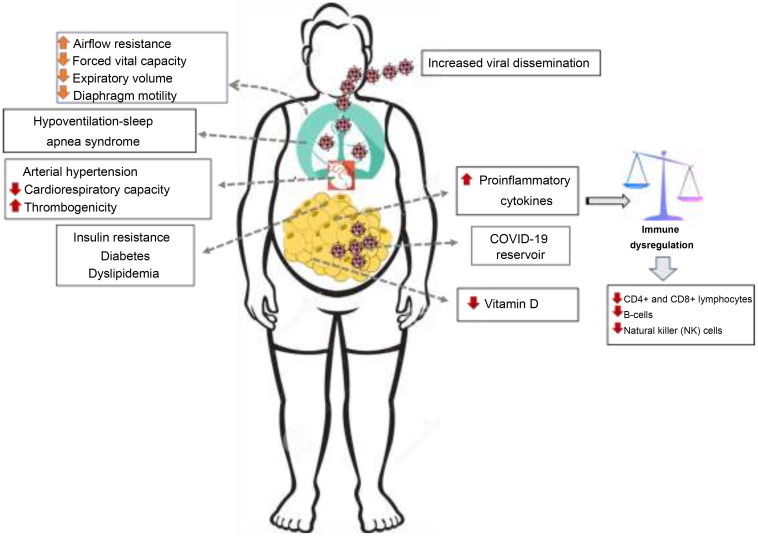
Obesity is a chronic disease that leads to an increased risk of mortality and morbidity, and the impact of the COVID-19 pandemic may create a new health challenge. There is clear evidence showing that some biological and social factors associated with obesity involve an increased risk of COVID-19 infection, hospitalization, and greater severity compared to people with normal weight. Undoubtedly, obesity involves a low-grade proinflammatory state that produces a dysregulation of the immune system that compromises its ability to respond to respiratory infection by COVID-19 and so produces a worsening of the disease. In this review, the main epidemiological and pathophysiological data that associate obesity with COVID-19 are described.
肥胖是一种慢性疾病,会导致死亡率和发病率增加,而 COVID-19 大流行的影响可能会带来新的健康挑战。有明确的证据表明,一些与肥胖相关的生物和社会因素与 COVID-19 感染、住院和更严重的疾病风险增加有关,而与体重正常的人相比。毫无疑问,肥胖涉及低度炎症状态,会导致免疫系统失调,从而削弱其对 COVID-19 呼吸道感染的反应能力,从而使疾病恶化。在这篇综述中,描述了肥胖与 COVID-19 相关的主要流行病学和病理生理学数据。