Center for Minimally Invasive Therapeutics (C-MIT), Los Angeles, CA, United States of America.
Department of Bioengineering, Samueli School of Engineering, University of California, Los Angeles, CA, United States of America.
Biofabrication. 2021 Mar 10;13(2). doi: 10.1088/1758-5090/abc8de.
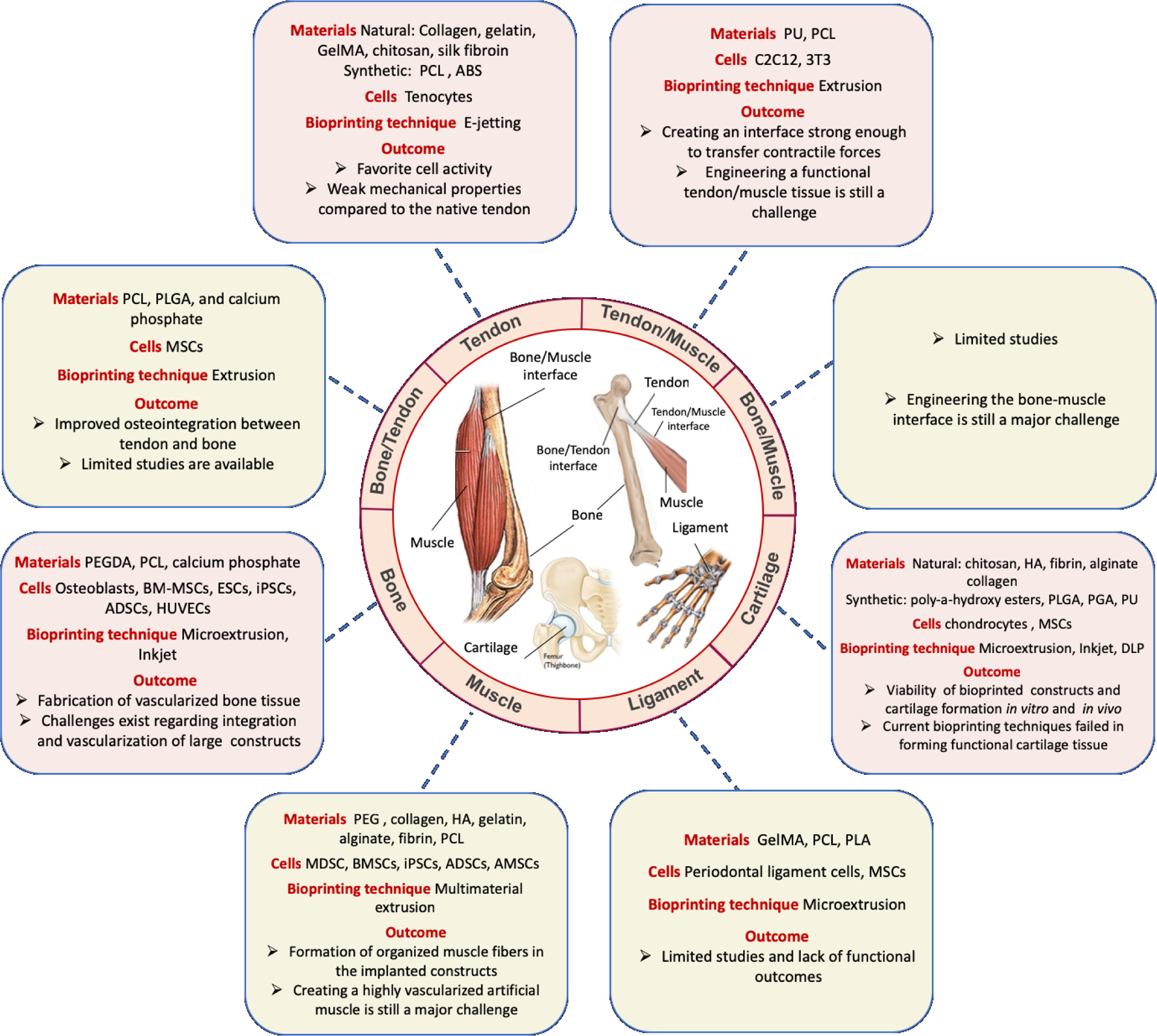
The musculoskeletal system is essential for maintaining posture, protecting organs, facilitating locomotion, and regulating various cellular and metabolic functions. Injury to this system due to trauma or wear is common, and severe damage may require surgery to restore function and prevent further harm. Autografts are the current gold standard for the replacement of lost or damaged tissues. However, these grafts are constrained by limited supply and donor site morbidity. Allografts, xenografts, and alloplastic materials represent viable alternatives, but each of these methods also has its own problems and limitations. Technological advances in three-dimensional (3D) printing and its biomedical adaptation, 3D bioprinting, have the potential to provide viable, autologous tissue-like constructs that can be used to repair musculoskeletal defects. Though bioprinting is currently unable to develop mature, implantable tissues, it can pattern cells in 3D constructs with features facilitating maturation and vascularization. Further advances in the field may enable the manufacture of constructs that can mimic native tissues in complexity, spatial heterogeneity, and ultimately, clinical utility. This review studies the use of 3D bioprinting for engineering bone, cartilage, muscle, tendon, ligament, and their interface tissues. Additionally, the current limitations and challenges in the field are discussed and the prospects for future progress are highlighted.
骨骼肌肉系统对于维持姿势、保护器官、促进运动以及调节各种细胞和代谢功能至关重要。由于创伤或磨损而导致的该系统损伤很常见,严重的损伤可能需要手术来恢复功能并防止进一步的伤害。自体移植物是目前替代丢失或受损组织的金标准。然而,这些移植物受到供应有限和供体部位发病率的限制。同种异体移植物、异种移植物和合成材料代表了可行的替代品,但每种方法都有其自身的问题和局限性。三维(3D)打印及其生物医学适应性——3D 生物打印技术的进步,有可能提供可行的、类似自体的组织样结构,可用于修复骨骼肌肉缺陷。尽管生物打印目前还无法开发出成熟的、可植入的组织,但它可以在 3D 结构中对细胞进行图案设计,这些结构具有促进成熟和血管生成的特征。该领域的进一步进展可能使能够制造出具有模拟天然组织的复杂性、空间异质性,最终是临床实用性的构建体。本综述研究了 3D 生物打印在工程骨、软骨、肌肉、肌腱、韧带及其界面组织中的应用。此外,还讨论了该领域目前的限制和挑战,并强调了未来进展的前景。